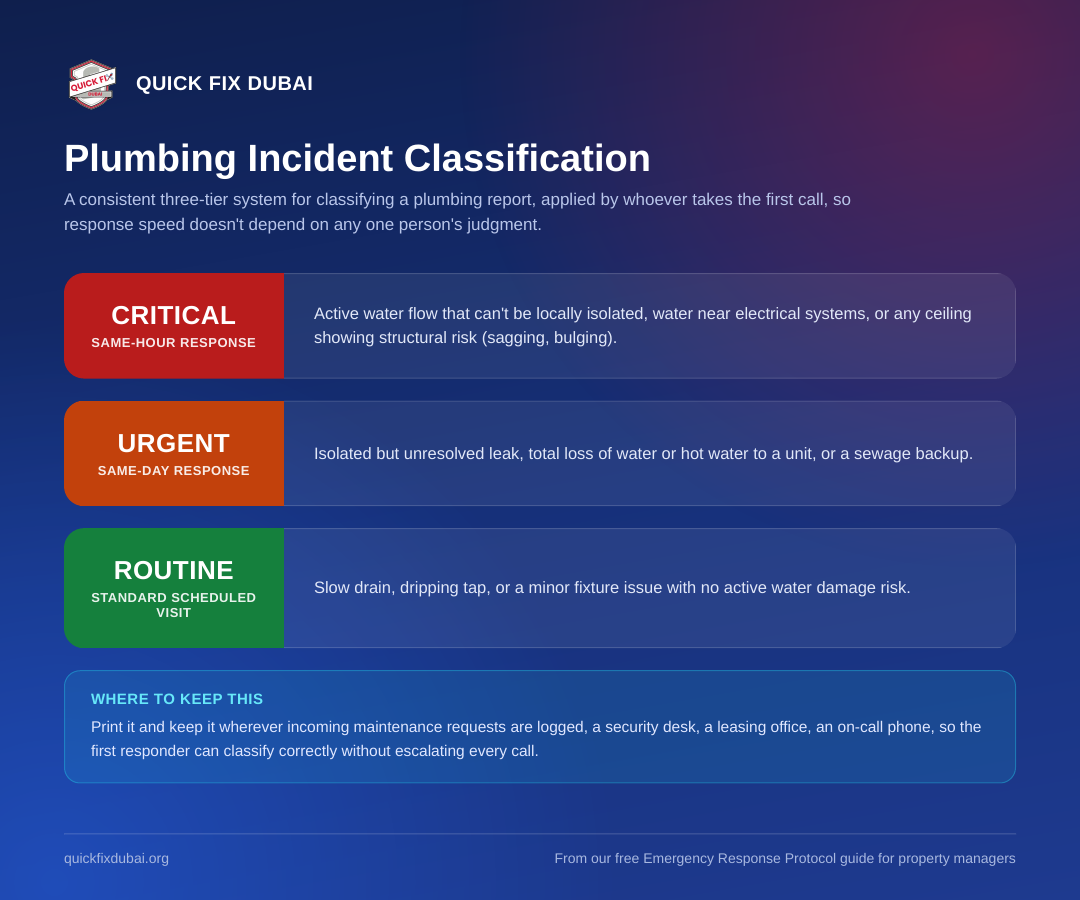
Same-hour response
Active water flow that can't be locally isolated, water near electrical systems, or any ceiling showing structural risk
Same-day response
Isolated but unresolved leak, total loss of water or hot water to a unit, sewage backup
Standard scheduled visit
Slow drain, dripping tap, minor fixture issue with no active water damage risk
Keep this wherever incoming maintenance requests are logged, security desk, leasing office, on-call phone, so classification doesn't depend on any one person's judgment call.
Download this as a printable image to keep near wherever incoming maintenance requests are logged.
Handling one plumbing emergency well is a matter of knowing what to do in the moment. Handling every plumbing emergency well, across a portfolio, with a team that isn't always the same person on call, is a matter of having a protocol that doesn't depend on any one person's memory. This guide is that protocol: how to classify an incident, who gets contacted in what order, what to tell occupants, and what documentation the whole process needs to generate. It's written to be adopted as a standing procedure, not read once during an active leak.
Incident Classification
Not every plumbing issue warrants the same response speed, and treating everything as critical burns out both your team and your vendor relationship. A simple three-tier classification, applied consistently, is what makes the rest of this protocol work.
| Tier | Definition | Response target |
|---|---|---|
| Critical | Active water flow that can't be locally isolated, water near electrical systems, or any ceiling showing structural risk (sagging, bulging) | Immediate, same-hour response |
| Urgent | Isolated but unresolved leak, total loss of water or hot water to a unit, sewage backup | Same day |
| Routine | Slow drain, dripping tap, minor fixture issue with no active water damage risk | Standard scheduled visit, no expedited response needed |
Whoever takes the initial report, a building security guard, a leasing agent, a tenant's WhatsApp message, needs to be able to apply this classification without escalating every call to the property manager personally. Print it, laminate it, put it wherever incoming maintenance requests actually get logged.
The Escalation Chain
A protocol without a clear, ordered contact chain just becomes a group chat where everyone assumes someone else is handling it. Define this in advance, in writing, and make sure every person in the chain actually has the next person's direct contact, not just a general office line.
- 1. First responder logs the incident and applies the tier classification
- 2. Critical and urgent incidents go directly to the on-call plumber or AMC vendor, don't wait for property manager sign-off on genuinely urgent cases
- 3. Property manager is notified in parallel, not sequentially, for critical incidents
- 4. Building facilities or security is looped in immediately if the incident affects shared infrastructure or common areas
- 5. Insurance is notified within the timeframe your policy specifies, which is often shorter than people assume, check this in advance rather than during an incident
!Test the chain before you need it
A contact list that hasn't been verified in six months is a real risk. Confirm every number in the chain quarterly, the same cadence as your maintenance calendar.
Tenant and Occupant Communication
How an incident is communicated affects how it's remembered, independent of how well it's actually resolved. A tenant who hears nothing for two hours during an active leak forms a worse impression than one who gets a two-line message within ten minutes, even if the actual repair timeline is identical.
- Acknowledge within 15 minutes of a critical or urgent report, even if it's just confirming the report was received and a technician is being dispatched
- Give a realistic window, not an optimistic one, a missed estimate damages trust more than a longer-than-hoped-for one that's accurate
- Follow up once the incident is resolved, confirming what was done and whether any follow-up work is scheduled
- For incidents affecting multiple units, a single building-wide notice prevents a dozen individual tenants from calling separately with the same question
Documentation for Insurance and RDC Claims
Every incident, regardless of tier, should generate a record: what was reported, when, the classification applied, who was dispatched, what was found, and what was repaired. Under Dubai's tenancy law, Article 16 of Law No. 26 of 2007, a property manager with a complete incident history is in a materially stronger position if a repair timeline is ever disputed at the Rental Disputes Centre. Insurance claims add their own documentation requirements on top of this, we cover the building-versus-contents split and what a claim actually needs in a separate guide focused specifically on water damage insurance.
!Photos are part of the protocol, not an afterthought
Whoever responds first should photograph the source and the extent of any damage before cleanup begins. This should be a standing instruction to first responders, not something remembered only after the fact.
Coordinating With Your AMC Vendor During an Active Incident
An annual maintenance contract with a fixed response time only works if your team actually knows to invoke it during a critical incident rather than defaulting to whoever's available. Build the vendor's emergency contact directly into the escalation chain above, not as a separate reference document nobody checks under pressure. If your AMC covers multiple properties, confirm in advance whether the vendor can run simultaneous incidents across your portfolio or whether a genuinely critical case at one property could delay response at another.
The Failure Points This Protocol Is Built Around
A protocol is more useful when the people using it understand why each step exists, not just what to do. The most common Dubai-specific incidents this framework is designed for: water heater tank failures, which tend to fail suddenly after gradual hard-water scale buildup rather than with warning signs; water pump or tank system failures, which cut off supply to an entire property rather than a single fixture; and AC condensate overflow, which shows up as a ceiling leak with no obvious plumbing cause unless the responder knows to check it first.
Post-Incident Review
Close the loop on every critical or urgent incident with a short review, five minutes is enough for most cases. Was the classification applied correctly. Was the escalation chain followed, or did someone go around it because it was faster, which is itself useful information about where the chain is too slow. Was the tenant communication timeline met. Is there a systemic fix, like an aging water heater flagged for early replacement, that would prevent a repeat of this specific incident.
FAQ
How is this different from just calling an emergency plumber when something happens? Calling a plumber solves one incident. A protocol makes the response consistent regardless of who's on shift, which contact number is called first, or whether the property manager happens to be reachable at that moment.
Do we need this if we already have an AMC in place? An AMC covers who does the physical repair. This protocol covers who decides it's urgent, who's told, and what gets documented, none of which an AMC contract handles on its own.
How often should this protocol itself be reviewed? Alongside the quarterly contact-chain check is a natural cadence, and always after any incident where the post-incident review surfaces a gap.
Want this as a PDF to keep or share?
Free to download, no email required.