Sprinkler & Irrigation Leak Detection Dubai
Irrigation leaks in Dubai villa gardens are one of the most reliably overlooked causes of elevated water bills in the UAE. The water loss happens underground, drains immediately into the surrounding soil, and leaves no surface sign at all. Not a wet patch, not a puddle, nothing.
The system runs its cycles at five in the morning while no one is watching, and the water disappears into the ground whether it's coming out of an emitter head or leaking from a cracked lateral pipe below it. We use zone isolation, pressure testing, flow analysis, and acoustic ground survey to find water loss accurately.
4-12
Typical zones per villa
30-50cm
Typical repair trench
Same
Day detection & repair
Why Irrigation Systems Leak: The Specific Dubai Factors
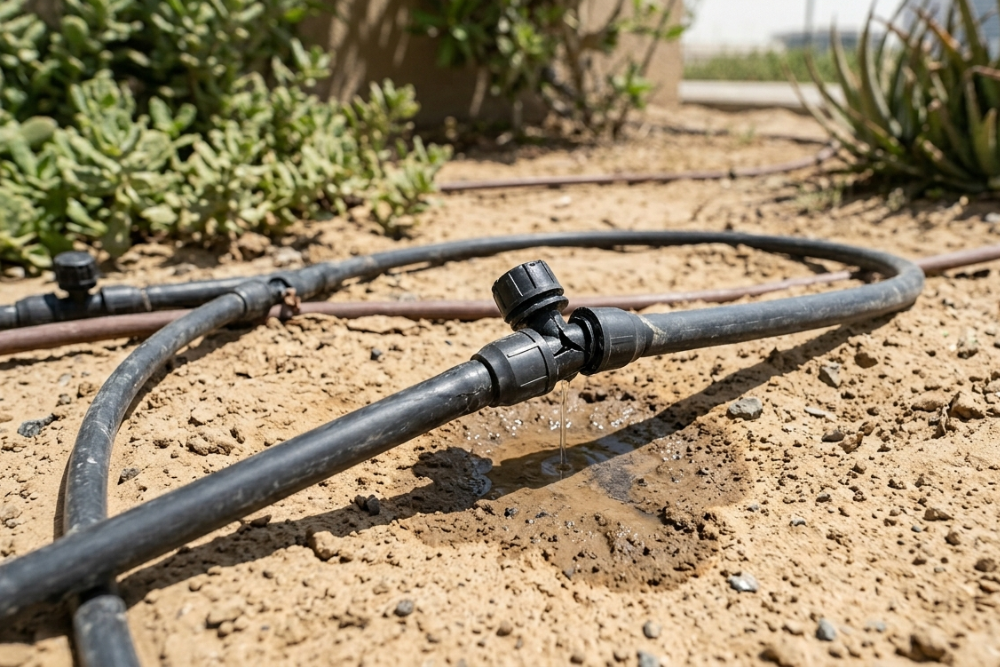
Dubai's climate imposes specific stresses on irrigation system components. The temperature range between a cold January night and a peak summer day is forty degrees or more. Plastic pipe materials expand and contract with temperature, and the joints between them move with each cycle. Over one or two years, push-fit connections that weren't seated to the correct depth work progressively loose. The drip irrigation emitter connections that planting contractors install by hand during garden setup are particularly prone to this.
UV exposure degrades exposed sections of irrigation pipework rapidly. Lateral pipes running near the soil surface, sections that emerge above ground at valve boxes, and any pipe exposed at garden edging are all vulnerable to UV embrittlement. A pipe that was flexible and sound at installation becomes brittle and crack-prone after three to five years of Dubai's sun intensity.
Solenoid valve seals are the least visible failure point in an irrigation system. A solenoid valve body seal that's degraded allows water to weep continuously through the valve even when the irrigation program isn't running. This baseline loss elevates the DEWA meter reading across all hours of the day, one of the diagnostic signs we look for when reviewing consumption data before a survey.
DEWA bill consistently higher than expected across all months
Water meter moving overnight when irrigation is complete and house isn't in use
Garden areas permanently saturated despite no recent irrigation cycle
Soil subsidence or soft patches in garden paving or lawn areas
Visible reduction in emitter performance on one specific zone
Irrigation controller running normal cycles but garden looking under-watered in areas
Water appearing at unexpected locations during or after an irrigation cycle
DEWA's High Water Usage Alert Service
DEWA itself offers a notification service that flags unusually high water consumption, which can be one of the earliest signals of an irrigation leak, well before it's visible in the garden.
DEWA's High Water Usage Alert notifies customers when consumption jumps noticeably above the normal pattern for their account, which is often exactly the signature an irrigation leak produces: water loss that runs continuously, invisible underground, and only shows up as a number on the bill until it's been running long enough to affect the garden itself.
This isn't a substitute for a proper irrigation survey, an alert tells you something changed, not which zone or which specific line is responsible, but it's a genuinely useful early warning that costs nothing to have active on your account. If you haven't checked whether it's enabled, it's worth confirming through DEWA's own channels alongside anything we find during a survey.
Irrigation Leak Detection Methods
Zone Isolation and Pressure Testing
Modern residential irrigation systems in Dubai are divided into independently controlled zones, typically four to twelve zones in a standard villa garden. Each zone is served by a solenoid valve and its own lateral pipe network. By isolating each zone individually and testing the system pressure while it's running, we identify which specific zones are losing water before any ground survey begins. A zone that shows a pressure drop faster than normal operating level indicates active leakage within that zone, reducing the area to be physically surveyed from the entire garden to the specific zone or zones confirmed to be leaking.
Flow Analysis
A temporary inline flow meter fitted to the irrigation supply measures the actual flow rate delivered to each zone during a test cycle. Each zone has an expected flow rate based on the number and type of emitters installed. A zone delivering significantly more flow than its emitters account for is losing that additional flow to leakage somewhere in its pipe network. For solenoid valve leakage, flow analysis identifies the baseline loss rate, the flow reading that appears on the meter when all zones are supposedly off. Any baseline flow above zero indicates that one or more solenoid valves aren't sealing correctly and water is passing through them continuously.
Acoustic Ground Survey
Once the leaking zone or zones have been confirmed by pressure testing and flow analysis, the acoustic survey locates the fault position within the zone. Ground contact microphones are applied to the surface at intervals along the identified zone pipe route, typically following the planting bed edges where the lateral pipe is known to run. Irrigation systems operate at lower pressures than main water supply systems, which reduces the acoustic signal strength compared to a domestic supply pipe survey. However, the combination of pressure testing to confirm active leakage and acoustic survey to locate it almost always produces a reliable result.
Solenoid Valve Inspection
Solenoid valve bodies, pilot seals, and diaphragm membranes are checked both visually and by pressure testing as part of every irrigation survey. A valve body weeping at the bonnet seal, a diaphragm failing to seat correctly when the valve closes, or a pilot port blocked with scale all produce continuous low-level water loss. We replace failing valve components on-site during the survey visit in most cases.
Irrigation System Types and How They Leak
What kind of system your garden runs changes both where leaks tend to occur and how easily they're detected acoustically.
Drip Irrigation
The most common system in Dubai villa gardens, using low-flow emitters at individual plants. Leaks here are almost always at emitter connections or where lateral pipe has cracked from UV exposure, and the low operating pressure means acoustic signal is weaker, making pressure testing and flow analysis especially important before an acoustic survey.
Pop-Up Sprinkler Systems
Used for lawn areas, running at higher pressure than drip systems, which generally makes acoustic detection more straightforward. Common failure points include cracked sprinkler head housings and lateral pipe joints feeding each zone.
Subsurface Drip
Buried slightly below the surface rather than laid on top, common in newer landscaping installations. Leaks are entirely invisible at the surface until water loss shows up in consumption data or an unusually damp patch develops, making proper detection even more valuable than with surface-laid systems.
Bubbler Systems
Used for individual trees and larger shrubs, delivering a higher flow at a single point rather than distributed emitters. A leak in a bubbler line often shows up as one specific plant receiving far more water than intended while others in the same zone appear under-watered.
Irrigation Leak Detection Process
A data-driven process from the start: leaking zones are confirmed by testing before any ground is physically surveyed.
Consumption data review
Before the site visit, the DEWA billing history is reviewed to identify when the leak began and at what approximate rate. A sudden step increase suggests a specific pipe fracture event; a gradual rise suggests slow joint failure or emitter degradation.
Zone isolation test
Each irrigation zone is tested individually at operating pressure. Zones that fail to hold pressure or show elevated flow are confirmed as leaking and flagged for acoustic survey. Zones that hold pressure correctly are excluded, reducing the ground to walk.
Baseline flow check
With all zones switched off, the flow meter reading at the irrigation supply confirms whether any solenoid valve is passing water continuously. Any baseline flow above zero identifies a valve fault to address alongside pipe leaks found.
Acoustic ground survey
Confirmed leaking zones are walked with the acoustic ground microphone, following the known pipe route. Signal strength is compared at multiple positions and the leak location triangulated and marked on the surface.
Solenoid valve check
Each solenoid valve body in the system is inspected and pressure-tested. Failing valves or valve components are replaced on-site.
Repair
Faulty pipe sections are excavated at the confirmed position, cut out, and replaced with new pipe of matching specification. Emitter connections are reseated or replaced, and the full system retested at operating pressure.
Post-repair verification
A final flow meter reading confirms baseline flow is zero, all valves sealing, and each zone's operating flow matches its emitter specification. The DEWA meter is checked before we leave to confirm no residual leakage.
Repair Materials Carried On Every Van
We carry the full range of irrigation system components: HDPE pipe in all common diameters, LDPE drip lateral, push-fit and solvent-weld fittings, solenoid valve bodies, barbed emitter connectors, and drip emitters in all standard flow rates. In the great majority of cases, the repair materials needed for a standard Dubai villa irrigation leak are available from the van immediately after location, so detection and repair are completed on the same visit.
Irrigation Leak Detection & Repair Cost
Pricing depends on the number of zones to be tested and the number of faults found. A written quotation is provided before any repair work begins.
| Service | Typical Dubai Price Range |
|---|---|
| Irrigation system leak detection survey | AED 300 - 700 |
| Zone-by-zone pressure and flow analysis | Included |
| Lateral pipe fracture repair (per point) | AED 150 - 350 |
| Solenoid valve replacement | AED 200 - 450 |
| Emitter connection repair (per zone) | AED 100 - 250 |
| Main supply line repair | AED 400 - 1,200 |
Irrigation system leak detection survey
- Typical Dubai Price Range
- AED 300 - 700
Zone-by-zone pressure and flow analysis
- Typical Dubai Price Range
- Included
Lateral pipe fracture repair (per point)
- Typical Dubai Price Range
- AED 150 - 350
Solenoid valve replacement
- Typical Dubai Price Range
- AED 200 - 450
Emitter connection repair (per zone)
- Typical Dubai Price Range
- AED 100 - 250
Main supply line repair
- Typical Dubai Price Range
- AED 400 - 1,200
Benefits of Professional Irrigation Leak Detection
Data-driven zone targeting
Zone isolation and flow analysis identify the leaking zones definitively before any ground is opened, no guesswork about which area to dig in.
Baseline flow confirmed zero
Post-repair flow verification confirms all solenoid valves are sealing correctly and the water meter baseline has returned to zero before we leave.
Emitter connections checked
Individual drip emitter connections are checked as part of every survey, not just the main pipe runs, since emitter failures are one of the most common sources of elevated consumption.
Minimum garden disruption
Repair excavations are targeted at the confirmed acoustic location only, typically 30-50cm of pipe trench. Established planting and garden finishes are protected.
All components on-site
We carry the full range of irrigation repair components. In most cases, detection and repair are completed on the same visit.
Annual check recommended
A zone-by-zone pressure and flow test at the start of each irrigation season catches developing faults before they contribute to a full season of elevated usage.
Why Choose Quick Fix Dubai for Irrigation Leak Detection
Irrigation leaks in Dubai gardens are routinely missed because most plumbers called for a high water bill investigation focus on the house supply system rather than the irrigation. Our survey is specifically structured to evaluate the irrigation system as a complete assembly: supply connection, main lateral, zone valves, sub-laterals, and emitter connections.
Irrigation-specific survey
The zone isolation, flow analysis, and acoustic survey sequence is designed specifically for irrigation systems, not adapted from a general supply pipe survey approach.
Flow meter analysis
Temporary flow meters quantify the exact volume being lost per zone, so the repair scope is sized against confirmed leakage data, not guesswork.
Emitter connection coverage
Individual drip emitter barbed connections are systematically checked, one of the most common and most overlooked sources of irrigation water loss in Dubai villa gardens.
All system types
Drip irrigation, pop-up sprinkler systems, subsurface drip, and bubblers for trees and shrubs: all irrigation system types used in Dubai residential and commercial gardens.
Commercial landscape systems
Business park grounds, hotel landscape installations, school gardens, and public realm irrigation surveyed with the same methodology as residential.
Annual maintenance available
Annual irrigation system checks at the start of each season: zone pressure tests, flow analysis, valve condition check, and emitter inspection.
Irrigation Leak Detection Across Dubai
Villa gardens, commercial landscape installations, and public realm irrigation across every area of Dubai.
Sprinkler & Irrigation Leak Detection FAQ
My DEWA bill is high but I can't see anything wrong. Could it be the irrigation?
How do I know if the leak is in the main irrigation supply or in a specific zone lateral?
Can you detect drip emitter connection failures as well as pipe leaks?
How often should a Dubai villa irrigation system be inspected?
The garden looks dry in some areas even though the system is running. Does that mean a leak?
Can you detect leaks in commercial landscape irrigation systems?
My irrigation system is over ten years old. Is it worth repairing or replacing?
Are drip irrigation leaks harder to detect than sprinkler leaks?
Can a leak in a subsurface drip system go unnoticed longer than a surface system?
Why does one specific plant in my garden seem to get too much water while others look under-watered?
What is DEWA's High Water Usage Alert, and should I use it?
If DEWA's alert flags my account, does that mean I definitely have an irrigation leak?
Stop Watering the Soil Under Your Garden. Fix the Irrigation Leak.
An irrigation leak running through a Dubai summer adds up to hundreds of cubic metres of wasted water and a DEWA bill that keeps climbing with no visible reason. We identify which zones are leaking, locate the fault position accurately, and repair it on the same visit in most cases.
Licensed & insured. All areas of Dubai.