Grease Trap Cleaning Dubai
A closure order during a busy service period costs far more than the cleaning that would have prevented it. Scheduled grease trap cleaning for restaurants, hotels, and commercial kitchens, with the documentation an inspector actually asks for, not reconstructed after the fact.
Licensed under Dubai Municipality's approved contractor activity code, with signed disposal certificates and before/after photos on every visit.
AED 300+
Per scheduled visit
DM
Certified disposal
24/7
Emergency callout
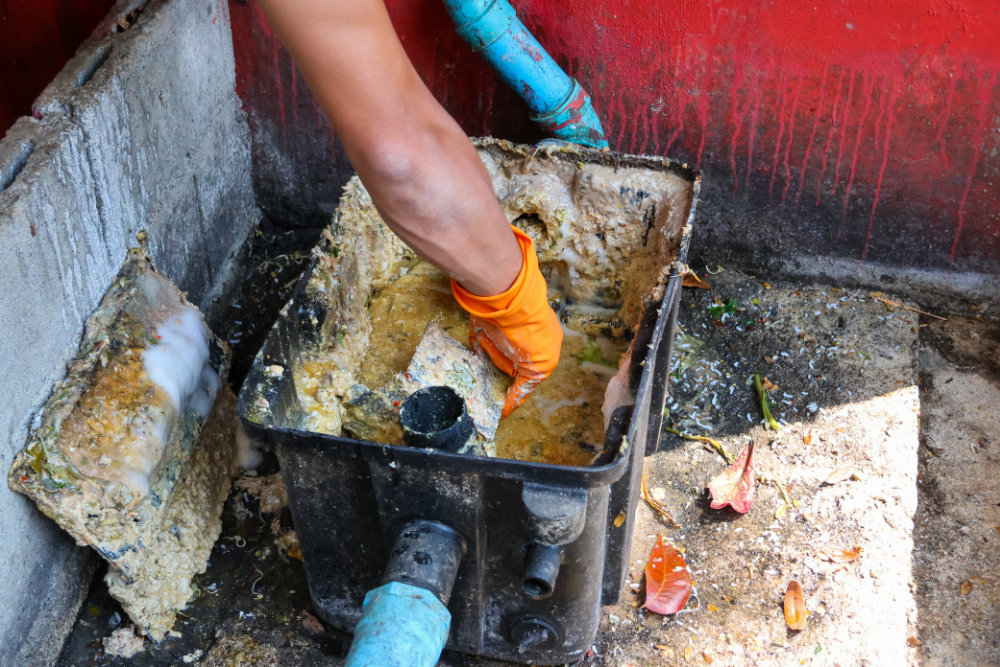
How FOG Separation Actually Works, and Why Cleaning Frequency Isn't One-Size-Fits-All
A grease trap sits inline on a kitchen's drainage run, and its job is entirely mechanical, not chemical. Wastewater slows down as it passes through the trap, and that slowing is what does the actual work. Fats, oils, and grease are lighter than water, so they rise and float, while food solids are heavier and sink. Internal baffles hold both layers back while letting the cleaner water in the middle continue through to the sewer connection.
That mechanism only works while there's still room in the trap for wastewater to actually slow down. As FOG and solids build up, the effective volume shrinks, flow speeds back up, and separation gets progressively worse until grease starts passing straight through into pipework it was never supposed to reach. That's the point a trap stops being a maintenance item and starts being the direct cause of a kitchen drain backup.
This is also why a single blanket cleaning schedule doesn't really make sense across different kitchens. A small trap serving a low-volume café fills at a completely different rate than a large trap under a high-turnover restaurant kitchen, which is exactly why Dubai Municipality ties required frequency to trap size and kitchen output rather than setting one number for everyone.
Real Frequency Depends on Trap Size and Kitchen Output
Dubai Municipality ties the required interval to your specific setup rather than one schedule for every kitchen. These are typical ranges, your exact requirement is confirmed against your trap's actual size and your kitchen's output.
| Kitchen type | Typical interval |
|---|---|
| Small under-sink trap, café or cloud kitchen | Weekly to every 2 weeks |
| Restaurant trap sized to DM's formula | At least twice a month (the basis of DM's sizing table) |
| Any trap, absolute limit | No more than 12 weeks between pump-outs (DM sewerage guidelines) |
Small under-sink trap, café or cloud kitchen
- Typical interval
- Weekly to every 2 weeks
Restaurant trap sized to DM's formula
- Typical interval
- At least twice a month (the basis of DM's sizing table)
Any trap, absolute limit
- Typical interval
- No more than 12 weeks between pump-outs (DM sewerage guidelines)
Sizing matters just as much as frequency. An undersized trap for your kitchen's actual output fills faster than any cleaning schedule can reasonably keep up with, regardless of how often it's serviced, while an oversized trap is simply higher cost than your kitchen needs. If cleaning visits feel like they're never quite enough, that's often a sizing problem, not a scheduling one, worth an actual assessment rather than just booking more frequent visits indefinitely.
Dubai Municipality's capacity table assumes at least two cleanings a month, so a trap cleaned less often than that is effectively undersized. If yours needs replacing or resizing, see grease trap supply and installation, which walks through DM's sizing formula.
The type of trap installed drives this as much as the kitchen itself does. A compact under-sink unit, the kind common in small cafés and cloud kitchens, simply holds far less separated FOG before it needs emptying, which is why these smaller units sit at the frequent end of the range even in a comparatively low-volume kitchen. Larger underground or interceptor-type systems, more typical in hotels and full-service restaurants, hold considerably more before reaching capacity, but a cleanout on one of these is a bigger job when it's actually due.
What Real Compliance Documentation Looks Like
The requirement itself isn't a policy preference from Dubai Municipality, it's written into law. Article 15 of Local Order No. 8 of 2002 is what actually requires a compliant grease trap on the drainage line of a restaurant, cafeteria, food factory, hotel kitchen, or similar food establishment before it connects to the public sewer. Cleaning frequency, contractor licensing, and disposal documentation all exist to enforce that one underlying requirement, not as separate rules layered on top of it.
Dubai Municipality maintains its own list of approved grease trap contractors, and a legitimate provider operates under Activity Code 900017, the specific licence category for this work. Asking a contractor to confirm this directly, rather than just taking "we're licensed" at face value, is a genuine, quick way to check before booking, the same discipline worth applying to any contractor working on your property.
Licensing on its own isn't the whole picture. Dubai Municipality also requires every approved contractor to register on FoodWatch, its own smart platform for tracking grease trap cleaning and waste transport activity. You won't interact with this platform directly as a property owner, but a contractor who can't speak to it, or seems unfamiliar with the requirement, is worth a second look before you book them.
Two separate departments sit behind the paperwork most people never see: the Field Operations Section reviews and approves a grease trap's design before it's installed, and the Technical & Administrative Support Section separately inspects the actual vehicles a contractor uses to transport collected waste. Neither is information most contractors volunteer unprompted, which is itself part of why asking about them is a useful test.
A completed job should produce a written record every time, not just when you ask for one: a signed disposal certificate showing where the collected FOG was actually taken, and before/after documentation of the trap itself. This is what you hand an inspector during a municipality visit, and reconstructing it after the fact, when someone's already asking for it, is a genuinely harder position to be in than having it on file already.
What Actually Happens During a Visit
Inspection
We check trap size, current FOG and solids level, baffle condition, and flow rate before recommending anything.
Removal
Fats, oils, grease, and solids are extracted using vacuum equipment, not a partial manual scoop that leaves buildup behind.
Interior clean
The trap's interior surfaces are scrubbed to remove hardened residue that restricts flow even after the bulk waste is removed.
Compliant disposal
Collected waste goes to a Dubai Municipality-approved disposal facility, with a signed certificate confirming it.
Documentation handover
Before/after photos and the disposal certificate, ready for your own records or an inspection, not something to chase down later.
Grease Trap Cleaning Cost in Dubai
Priced by trap size and condition, confirmed after inspection, not a flat rate that ignores your actual kitchen's output.
| Service | Typical Cost (AED) |
|---|---|
| Site assessment (waived if you proceed) | Free |
| Small trap, standard cleaning visit | AED 300 - 500 |
| Medium to large trap, standard visit | AED 500 - 800 |
| Emergency callout (overflow or blockage) | AED 400 - 900 |
| Scheduled maintenance contract (per visit, contracted) | Discounted vs. one-off rate |
| Trap sizing assessment or replacement | See grease trap installation |
Site assessment (waived if you proceed)
- Typical Cost (AED)
- Free
Small trap, standard cleaning visit
- Typical Cost (AED)
- AED 300 - 500
Medium to large trap, standard visit
- Typical Cost (AED)
- AED 500 - 800
Emergency callout (overflow or blockage)
- Typical Cost (AED)
- AED 400 - 900
Scheduled maintenance contract (per visit, contracted)
- Typical Cost (AED)
- Discounted vs. one-off rate
Trap sizing assessment or replacement
- Typical Cost (AED)
- See grease trap installation
A scheduled maintenance contract is usually the better value for any kitchen cleaning more than a few times a year, fixed visits, no re-negotiating each time.
New or replacement traps are priced on our grease trap installation page.
Why Choose Quick Fix Dubai
Activity Code 900017 licensed
Operating under Dubai Municipality's specific approved contractor category for this work, verifiable, not just claimed.
Documentation on every visit
Signed disposal certificate and before/after photos handed over each time, not produced only when specifically requested.
Real sizing assessment
If your trap is genuinely undersized for your kitchen's output, we tell you that directly rather than just booking more frequent visits indefinitely.
Genuine emergency response
An overflow during service hours gets a same-day response, not a scheduled slot next week.
Fixed, itemised pricing
The assessment is free and waived against the job. No surprise line items on the invoice.
From cafés to hotel kitchens
Sized service for the trap in front of us, not a one-size-fits-all visit regardless of your kitchen's actual scale.
Serving Restaurants & Kitchens Across Dubai
From single cafés to hotel kitchens, licensed grease trap cleaning across every Dubai community.
Grease Trap Cleaning FAQ
How often does Dubai Municipality require grease trap cleaning?
What happens if I skip a scheduled cleaning?
How do I verify a grease trap contractor is licensed?
What is FoodWatch, and does it matter to me as a restaurant owner?
My trap gets cleaned regularly but still overflows between visits. What's wrong?
What documentation should I get after a cleaning visit?
Do you offer emergency grease trap service?
Is a maintenance contract worth it over booking one-off visits?
Due for a Cleaning, or Not Sure of Your Schedule?
A free assessment confirms your actual required frequency and whether your trap is even the right size for your kitchen, not just another cleaning booked on autopilot.
Licensed & insured. All areas of Dubai.