Slab Leak Detection Dubai
A slab leak is a pipe fault in a pressurized water line running through or beneath a concrete foundation. In Dubai, where most villas, apartments, and commercial buildings are slab-constructed, this is one of the most common and most mishandled types of plumbing fault.
It's common because slab pipework sits under continuous stress from thermal cycling, ground settlement, and corrosion. It's mishandled because the instinctive response, start opening the floor, is almost always the wrong first step.
30-50cm
Typical repair opening size
2-3hr
Typical detection survey
2
Detection methods, cross-checked
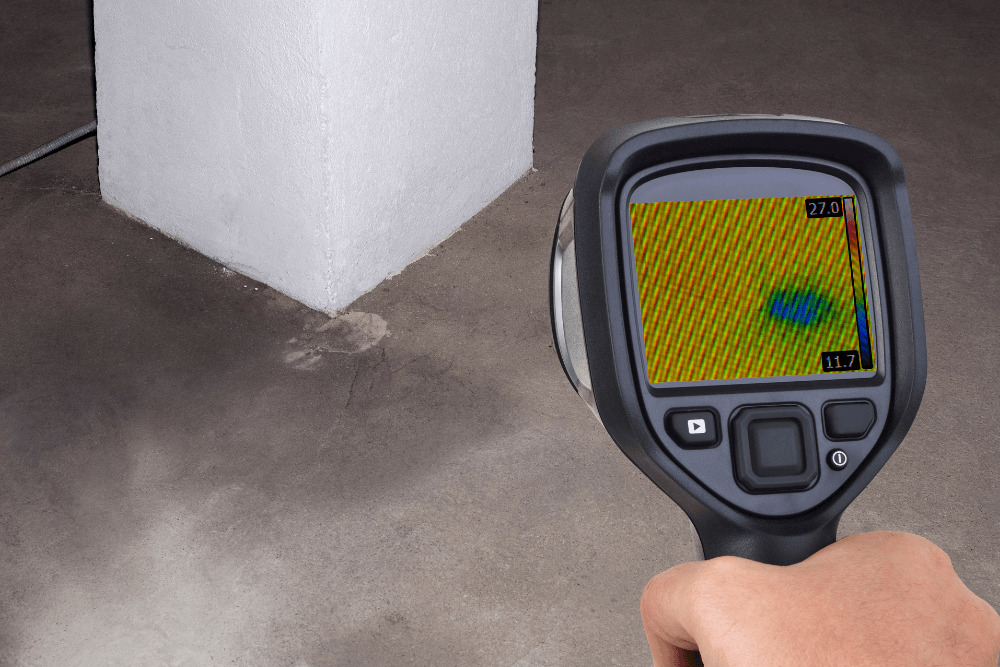
What Is a Slab Leak, and Why Does It Happen?
A slab leak occurs when a water supply pipe embedded in or running directly beneath a concrete floor develops a fracture, joint failure, or corrosion breach. The pipe keeps carrying pressurized water, meaning water continuously escapes into the concrete and surrounding substrate. Concrete is porous at the microscale, so water migrates upward through the slab, into tile adhesive layers, and eventually to the surface above.
In Dubai's slab-built properties, the most common pipe materials in older installations are copper and galvanized steel. Both are susceptible to corrosion, and many have been in service in UAE properties for fifteen or twenty years, reaching the point where failures should be expected. The thermal cycling Dubai's climate imposes on buried pipework accelerates joint fatigue, particularly at elbow fittings where the pipe changes direction.
A less common but increasingly seen source of slab leaks in newer properties involves push-fit fittings that weren't assembled with adequate pipe insertion depth during original installation. These fittings can hold for several years before beginning to weep at the joint.
A separate mechanism worth understanding is abrasion. Where a pipe sits against concrete or the gravel bedding beneath the slab without adequate protective sleeving, the same thermal expansion and contraction that stresses joints also causes the pipe to move slightly against the surrounding material, year after year. Over enough cycles, this physical rubbing wears through the pipe wall at the contact point, a distinct failure mode from corrosion or joint fatigue, and one more commonly found where a pipe run wasn't properly sleeved or bedded during original construction.
A warm or hot patch on a tiled floor, particularly in an area with no underfloor heating
Tiles lifting off the floor with no visible cause, adhesive bond breaking down from moisture
A damp or wet floor surface in one localised area with no fixture or appliance nearby
A rising DEWA water bill with no change in household usage
The sound of running or dripping water at floor level when all fixtures are off
A persistent damp smell at floor level in one specific room
Cracks appearing in floor tiles along a line corresponding to an underlying pipe route
Slab Construction Types We Work With
Not all concrete slabs are built the same way, and construction type affects both how we detect a leak and how safely we can repair one.
Ground-Bearing Slab
The most common residential construction, a solid concrete slab poured directly on prepared ground with pipework typically embedded within or beneath it. Acoustic detection works reliably here since the slab itself transmits sound well, and the pipe depth is usually consistent and predictable across the survey area.
Suspended Slab
Common in multi-story buildings, a suspended slab sits above a void or another level rather than bearing directly on the ground. Pipework may run within the slab itself or in the void space beneath, which changes both the acoustic behavior and the access approach if a repair is needed.
Post-Tensioned Slab
Used in some larger residential and most commercial construction, post-tensioned slabs contain steel tensioning cables that require specific care during any repair excavation. We confirm construction type before any opening is made, since cutting into a tensioning cable is a serious structural risk that has nothing to do with the plumbing repair itself.
The Cost of Getting It Wrong
The single most important thing about slab leak repair is confirming the exact location before any concrete is opened. This sounds obvious, but it's routinely ignored by contractors who either don't have the detection equipment or prefer exploratory demolition to find the fault.
A targeted acoustic survey that identifies the leak to within ten centimetres of the actual fault allows a repair opening of approximately thirty to fifty centimetres in diameter. The pipe section is replaced, the opening made good with new concrete and a tile patch. Total floor damage: one small section in one room.
Without an accurate location, exploratory drilling, following the general direction of the supply pipe until the fault is found, can result in an opening or trench the full length of the pipe run. In a living room, that means the entire tiled floor is effectively destroyed before the fault is found at the far end. The structural repair then rivals the plumbing repair in cost.
Slab Leak Detection Process
Meter test
The water supply is isolated and the meter is checked for movement. This confirms active leakage and establishes the approximate rate of water loss, which helps size the likely fault.
Acoustic survey
Sensors are applied to the tile surface at intervals across the floor. The equipment picks up the sound of water escaping through the pipe fault under the slab and propagating up through the concrete. We map signal strength across the floor to triangulate the source.
Tracer gas injection
For jobs where multiple pipe runs cross the survey area, or where acoustic results need confirmation, tracer gas is introduced into the suspected section. The gas migrates through the concrete to the surface and is detected independently of the acoustic result.
Location mark
The confirmed leak position is marked on the floor tile surface. You're fully briefed on the findings before any work begins.
Targeted repair
A single targeted opening is made at the confirmed location. The faulty pipe section is exposed, assessed, and replaced or repaired. The opening is cleaned up, new concrete poured, and a tile patch applied.
Final pressure test
The repaired section is pressure tested to confirm integrity. Results are recorded and the job is complete.
Slab Leak Detection & Repair Cost
Slab repair costs depend on slab thickness, pipe depth, and pipe material. A written quotation is provided after the detection survey and before any concrete work begins.
| Service | Typical Dubai Price Range |
|---|---|
| Slab leak acoustic detection survey | AED 400 - 900 |
| Combined acoustic + tracer gas | AED 600 - 1,200 |
| Targeted slab opening and pipe repair | AED 1,200 - 3,500 |
| Concrete reinstatement | Included |
| Tile patch (materials extra) | AED 200 - 500 |
| Final pressure test | Included |
Slab leak acoustic detection survey
- Typical Dubai Price Range
- AED 400 - 900
Combined acoustic + tracer gas
- Typical Dubai Price Range
- AED 600 - 1,200
Targeted slab opening and pipe repair
- Typical Dubai Price Range
- AED 1,200 - 3,500
Concrete reinstatement
- Typical Dubai Price Range
- Included
Tile patch (materials extra)
- Typical Dubai Price Range
- AED 200 - 500
Final pressure test
- Typical Dubai Price Range
- Included
Benefits of Professional Slab Leak Detection
One small opening
Acoustic and tracer gas detection limits the repair opening to a single targeted area, typically 30-50cm diameter, rather than a full-length trench across the floor.
Floor preserved
The rest of the floor stays completely undisturbed. Only the tile directly above the confirmed fault location is accessed.
Same-day detection
Most slab leak surveys produce a confirmed fault location within two to three hours of arrival on site.
Dual confirmation
Acoustic survey combined with tracer gas cross-checking produces double confirmation of the leak position before any concrete is opened.
Prevents structural damage
A slab leak repaired before floor finishes are visibly damaged is a much smaller job than one discovered after tiles have lifted and moisture has spread through the slab.
Full repair service
We handle the complete job: detection, slab opening, pipe replacement, concrete reinstatement, and tile patch.
Why Choose Quick Fix Dubai for Slab Leak Detection
Slab leaks are a call type we handle regularly across Dubai villas, apartments, and commercial ground floors.
Acoustic specialists
Our team is trained specifically on acoustic detection through concrete slabs, the most demanding acoustic detection scenario in residential plumbing.
Tracer gas for confirmation
On complex slab jobs where multiple pipe runs overlap the survey area, tracer gas confirms the acoustic result independently before any concrete is opened.
Minimum floor damage
The confirmed location is marked to within centimetres. The repair opening is sized around the actual fault, not around a general area of suspicion.
Same-day if needed
For slab leaks actively migrating to the surface and causing ongoing damage, detection and repair can often be completed in a single day on residential properties.
All construction types
Screeded slabs, suspended ground floors, raft foundations, and beam-and-block construction. We work with the slab construction types common across Dubai.
24/7 emergency response
Active slab leaks causing visible floor damage or rising moisture in walls are treated as urgent. Call any time.
Slab Leak Detection Across Dubai
Villas, apartments, and commercial ground floors across every area of Dubai, with acoustic and tracer gas equipment on every van.
Slab Leak Detection FAQ
How much of my floor will be damaged to find and fix a slab leak?
Can a slab leak cause structural damage?
My floor feels warm in one spot. Is that definitely a slab leak?
How long does slab leak detection and repair take?
Why is acoustic detection better than just drilling to find the leak?
What pipe materials are most likely to develop a slab leak in Dubai?
Can I keep using water in the property while a slab leak is being investigated?
Does home insurance cover slab leak repair in Dubai?
Does the type of slab construction affect how a leak is repaired?
Can a slab leak in a suspended floor be detected the same way as a ground-bearing slab?
How do I know what type of slab construction my property has?
What is pipe abrasion, and how does it cause a slab leak?
Is a slab leak from abrasion different to repair than one from corrosion?
Don't Open the Floor Until You Know Exactly Where
Every square centimetre of floor opened unnecessarily is a tile to replace, a day of disruption, and a repair cost that shouldn't have been incurred.
We find the slab leak precisely, then open exactly where it needs to be opened.
Licensed & insured. All areas of Dubai.