Water Pipe Leak Detection Dubai
A leaking water pipe that's located and repaired promptly is a half-day job in most cases. The same leak left running for three months is a structural remediation project. The difference is entirely in whether the leak is found quickly and accurately, not a process of elimination involving drills and demolition.
This page covers the specific methodology for locating a fault in a pressurized supply pipe: acoustic detection, pressure isolation testing, and thermal imaging for hot water lines. For a broader look at where leaks commonly originate across a property, our residential leak detection page covers the full picture.
5-10cm
Typical acoustic accuracy
3
Detection methods combined
Same
Day repair, most jobs
Why Water Pipe Leaks Are Particularly Damaging
Dubai's water supply network operates at relatively high pressure in many districts. When a pipe fault develops, a fracture, a failed joint, a cracked elbow fitting, water escapes at a rate that can be surprisingly high even through a small opening. A pipe carrying domestic supply at typical residential pressure pushes a significant volume of water through even a hairline crack every hour, saturating the surrounding structure continuously.
Copper and galvanized steel, common in older UAE properties, are both susceptible to corrosion-driven pinhole failures. Our copper pipe leak repair page covers that specific failure mode and real repair pricing in depth. Modern properties using HDPE or CPVC don't corrode, but remain vulnerable to joint failure at threaded connections, push-fit fittings, and solvent-welded joints stressed by ground movement or thermal expansion.
Persistent damp patch on a wall that doesn't dry out after weather changes
Water staining on ceilings without a visible roof or plumbing fault above
Sound of water running inside walls or under floors when all fixtures are off
Visible water seeping from the base of a wall or through floor tile grout lines
Unexplained drop in water pressure at taps or showers
Rising DEWA consumption with no change in usage patterns
Tiles cracking or coming loose in bathroom or kitchen areas
Mould or mildew developing on wall surfaces away from shower or sink areas
Pipe Age and Leak Risk
Not a precise formula, but a reasonable way to gauge whether your property's supply pipes are worth a proactive check rather than waiting for a symptom to appear.
| Property Age | Likely Pipe Material | Relative Leak Risk |
|---|---|---|
| Under 10 years | Copper, HDPE, CPVC | Low, unless installation quality was poor |
| 10 to 20 years | Copper most common | Moderate, worth a first inspection if never checked |
| 20+ years | Copper, galvanized steel | Higher, especially with no prior pipe work done |
Under 10 years
- Likely Pipe Material
- Copper, HDPE, CPVC
- Relative Leak Risk
- Low, unless installation quality was poor
10 to 20 years
- Likely Pipe Material
- Copper most common
- Relative Leak Risk
- Moderate, worth a first inspection if never checked
20+ years
- Likely Pipe Material
- Copper, galvanized steel
- Relative Leak Risk
- Higher, especially with no prior pipe work done
If your property falls in the higher-risk range and has never had a pipe inspection, a proactive acoustic survey costs a fraction of what a leak left running for months costs in water waste and repair scope. Worth doing before a leak forces the issue.
How Pipe Leaks Are Located
Acoustic Detection
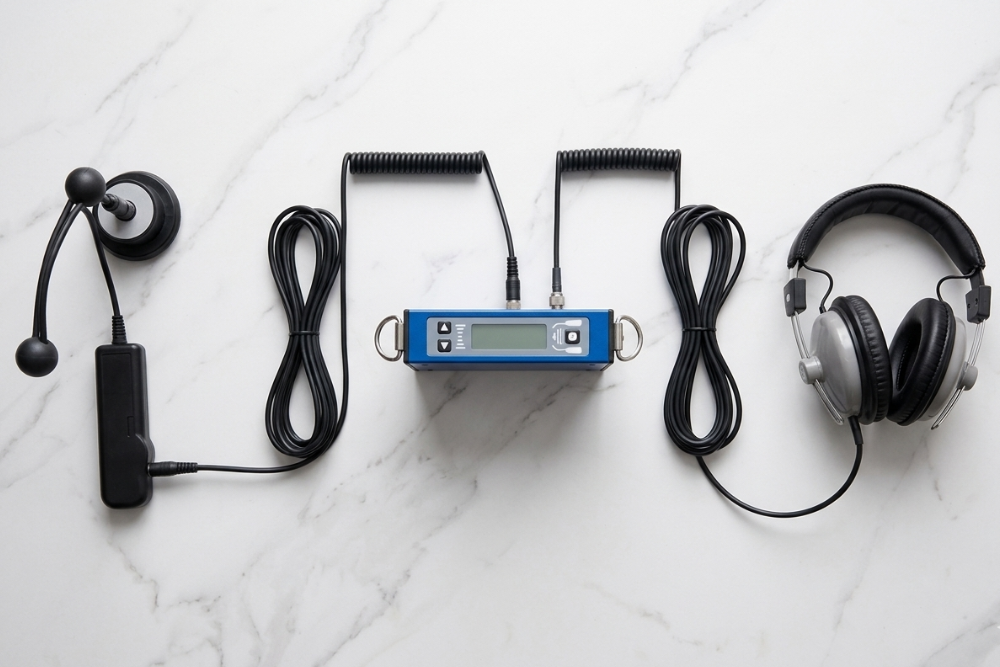
For pressurized supply pipes, this is the primary location method. A pipe carrying water under pressure produces a specific sound frequency when it has a fracture or open joint, the sound of water escaping against the pipe material and surrounding structure. Our sensors are calibrated to pick up this frequency through concrete slabs, tile floors, plastered walls, and compacted soil. The sensor is applied at multiple points along the pipe route, signal strengths compared, and the source triangulated to a precise location, typically within five to ten centimetres of the actual fault.
Acoustic vs. Ultrasonic: Choosing the Right Frequency
Standard acoustic detection works within the range of human hearing and performs well on larger leaks in metallic pipe like copper or galvanized steel. For smaller, high-pressure leaks or non-metallic pipe such as HDPE and CPVC, ultrasonic detection, operating at frequencies above human hearing, picks up subtler leak signatures that standard acoustic sensors can miss. We choose between the two based on pipe material and the leak size indicated by the initial pressure test, not a one-size-fits-all default.
Pipe Route Mapping
On older properties where the original supply pipe layout isn't documented, locating the pipe itself comes before locating the leak. A radar or electromagnetic locator traces the actual buried or embedded route, confirming depth and direction before acoustic survey work begins. This step alone often resolves confusion where a property owner's assumption about where a pipe runs turns out to be wrong.
Pressure Isolation Testing
Isolating and pressure testing individual pipe sections reliably confirms both the presence and the approximate location of a leak before acoustic survey work begins. By progressively isolating sections, from main to distribution branches to individual fixture connections, the leaking section is identified systematically, narrowing the acoustic survey area significantly and improving accuracy.
Thermal Imaging
For hot water supply pipe leaks specifically, thermal imaging provides an additional detection capability. Escaping hot water produces a local temperature increase clearly visible in a thermal scan, even through tiles and plaster. On cold water surveys, moisture-saturated materials are typically cooler than dry surrounding materials, also visible thermally. Used in combination with acoustic methods on complex surveys.
Water Pipe Leak Repair by Location
Once we've confirmed and marked the exact location of a pipe leak, repair begins immediately. The approach depends on the pipe material, the fault type, and the location.
Concealed pipe leaks in walls: a targeted opening at the confirmed location only. The faulty section or fitting is replaced, and the opening made good after pressure testing confirms the repair.
Below-slab pipe leaks: a single targeted slab opening at the confirmed location. The pipe section is replaced and the slab reinstated.
Underground pipe leaks: a targeted excavation at the confirmed location. The faulty section or fitting is replaced, pressure tested, and the ground reinstated.
Accessible pipe leaks: joints, fittings, and connections in plant rooms, riser shafts, and ceiling voids are repaired directly.
In all cases, a final pressure test confirms the repair before the job is signed off.
Pipe Leak Detection Process
Symptom review
We review reported symptoms, consider the property layout, and establish the most likely pipe system affected, hot water, cold water, or a specific circuit serving a particular area.
Pressure isolation test
Individual pipe sections are isolated and pressure tested to identify the leaking section and narrow the survey area before acoustic equipment is deployed.
Acoustic survey
Sensors are applied at multiple points along the identified pipe run. Signal strengths are compared and the leak source triangulated to within centimetres of the actual fault.
Thermal imaging
For hot water leaks, or where moisture spread in surrounding materials needs mapping, thermal imaging is used alongside or in place of acoustic methods.
Location mark
The confirmed fault location is marked clearly on the floor, wall, or ground surface. You're fully briefed on findings before any repair work begins.
Repair & pressure test
Repair is carried out at the confirmed location only. A final pressure test confirms the repair is holding correctly before the opening is made good.
Water Pipe Leak Detection & Repair Cost
| Service | Typical Dubai Price Range |
|---|---|
| Water pipe leak detection survey | AED 350 - 800 |
| Acoustic + thermal combined survey | AED 500 - 1,000 |
| Concealed wall pipe repair | AED 400 - 1,200 |
| Below-slab pipe repair | AED 800 - 2,500 |
| Underground pipe repair | AED 1,500 - 4,000 |
| Pressure test (pre and post) | Included |
Water pipe leak detection survey
- Typical Dubai Price Range
- AED 350 - 800
Acoustic + thermal combined survey
- Typical Dubai Price Range
- AED 500 - 1,000
Concealed wall pipe repair
- Typical Dubai Price Range
- AED 400 - 1,200
Below-slab pipe repair
- Typical Dubai Price Range
- AED 800 - 2,500
Underground pipe repair
- Typical Dubai Price Range
- AED 1,500 - 4,000
Pressure test (pre and post)
- Typical Dubai Price Range
- Included
Benefits of Accurate Pipe Leak Detection
One targeted opening
Acoustic location narrows the repair access to a single confirmed point, no exploratory drilling along the full pipe route.
Correct diagnosis first time
Pressure testing identifies exactly which pipe circuit is leaking before acoustic work begins, avoiding survey time spent on the wrong systems.
Same-day repair
We carry repair materials for the most common pipe types. Detection and repair in a single visit is the standard outcome on most jobs.
Repair confirmed by pressure test
Every repair is pressure tested to confirm integrity before the opening is made good, so you know the problem is resolved.
Hot and cold pipe coverage
Both hot and cold water supply pipes covered; thermal imaging supplements acoustic methods for hot water surveys.
Honest repair advice
If the faulted section is part of a larger run of corroded pipe, we advise honestly on whether sectional repair or full replacement is the better long-term call.
Why Choose Quick Fix Dubai for Pipe Leak Detection
Pipe leak detection requires both the right equipment and the experience to interpret the results correctly. We carry acoustic sensors, thermal cameras, and pressure testing equipment to every pipe leak job.
Acoustic precision
Acoustic detection locates pipe leaks to within centimetres along the pipe run, minimising the repair opening to the absolute minimum.
Thermal imaging included
Used on all hot water pipe surveys, and on any survey where moisture spread in wall or ceiling materials needs mapping.
Pressure testing before and after
Every repair is confirmed with a post-repair pressure test. You know the leak is fixed before we leave.
All pipe materials
Copper, galvanized steel, HDPE, CPVC, and MDPE, our technicians are experienced with all pipe materials common in Dubai properties.
Detection and repair under one roof
No need to bring in a second contractor after detection. We handle the full job.
Emergency response
For active pipe leaks causing ongoing structural damage, 24/7 emergency response is available.
Pipe Leak Detection Across Dubai
Villas, apartments, and commercial properties across every area of Dubai, with acoustic and thermal equipment on every van.
Water Pipe Leak Detection FAQ
How do I know if the leak is in the hot or cold supply pipe?
Can you repair the pipe on the same visit as the detection?
What if the pipe is very old or corroded beyond local repair?
Does pipe material affect how easy it is to detect a leak?
How is this different from your general residential leak detection service?
Is my property at higher risk of a pipe leak based on its age?
Can a pipe leak be detected without shutting off water to the whole property?
Do you offer a proactive pipe inspection even if I don't have symptoms yet?
What's the difference between a leak in a hot water pipe and a cold water pipe in terms of urgency?
What's the difference between acoustic and ultrasonic leak detection?
What if I don't know exactly where my supply pipes run?
Find Your Pipe Leak Before the Structure Does
A pipe leak found today is a small, targeted repair. The same leak left running for another month is a wall, a floor, and a mould remediation project. We locate it accurately and fix it on the same visit in most cases.
Licensed & insured. All areas of Dubai.