An AC leaking or dripping water is almost always a drainage problem, not a broken air conditioner. Your AC pulls moisture out of the air as part of cooling it, that water is supposed to run away through a small drain line, and when it can't, it backs up and shows up as a drip, a puddle, or a ceiling stain. In Dubai specifically, this is one of the most common household plumbing callouts there is, and understanding which of a handful of causes you're dealing with is the difference between a same-day fix and paying for the wrong service.
!Quick answer
If your AC is still cooling normally and there's no ice anywhere on the unit, the drain line is almost certainly blocked, a plumbing fix. If cooling is weak or you can see ice, the coil has frozen and something upstream, a dirty filter or low refrigerant, needs addressing first, an AC technician's job. Both are covered below, along with the two Dubai-specific causes almost nothing else online mentions.
Why This Happens So Much in Dubai Specifically
Dubai's combination of extreme heat, high humidity, and heavy dust loading makes AC condensate drains block faster and more often than in almost any other climate. Your AC's evaporator coil pulls moisture out of the air passing over it, and the hotter and more humid the air, the more water that process produces, sometimes several litres a day from a single unit during peak summer humidity. All of that water has to travel out through a drain line only a centimetre or so wide, and three things specific to Dubai make that line fail faster than it would elsewhere.
Dust and fine sand, present in the air here far more than in most cities, gets pulled into the unit along with everything else and settles inside the drain line and tray over time, narrowing the channel water has to pass through. Sustained high humidity means the drain is handling a larger volume of water for more months of the year than a unit in a milder climate ever would, giving less downtime for anything marginal to dry out and less margin before a partial blockage becomes a full one. And Dubai's coastal, salt-laden air accelerates corrosion of metal components specifically, which matters because older drain trays and some drain pan designs use metal that a drier, inland climate wouldn't punish nearly as hard.
None of this means your AC is faulty. It means the same maintenance an AC needs in any climate is simply needed more often here, and a drain line that would go a year without attention in a temperate climate can genuinely need clearing every few months in Dubai.
Why Leaks Spike in Certain Months
Leaks aren't evenly distributed across the year, and the pattern is worth knowing if you're trying to get ahead of one rather than reacting to it. Humidity in Dubai typically peaks in the summer months, which means condensate production peaks at the same time, exactly when a drain line that's been slowly narrowing since the last clean finally can't keep up. A line that was managing fine through cooler, drier months can tip into an actual leak once summer humidity pushes daily condensate volume up, which is why so many leak callouts cluster in the hottest stretch of the year rather than spreading evenly. If you're on any kind of maintenance schedule, timing a drain clean to land just before peak summer, rather than during or after it, catches the line at its narrowest point before the season that stresses it most.
The 60-Second Check: Plumbing or AC?
If your AC is still cooling the room normally and there's no visible ice anywhere on the unit, the leak is almost certainly a drainage issue and a plumbing job. If cooling is weak or you can see or feel ice on the coil or pipes, the water is a symptom of a frozen coil upstream, and that's an AC technician's job to resolve before the drainage side can be judged properly.
| Check | Drainage (plumbing) | AC-side (technician) |
|---|---|---|
| Cooling performance | Still cooling normally | Weaker than usual, or not cooling |
| Ice on the unit or pipes | None visible | Visible ice on coil or refrigerant lines |
| Sound | Normal | Hissing or bubbling (possible refrigerant issue) |
| Water appearance | Clear, odourless, or faintly musty | Often appears right after the unit's been running a long stretch, then stops once switched off |
| Onset | Got worse gradually over days or weeks | Started suddenly, sometimes right after a service visit or refrigerant top-up |
If you're seeing signs from both columns, that's not a contradiction. A badly frozen coil produces so much meltwater when it thaws that it can overwhelm even a completely clear drain line temporarily, which is why a professional diagnosis matters more than guessing from one symptom alone when the picture is mixed.
Cause 1: Blocked Condensate Drain Line (By Far the Most Common)
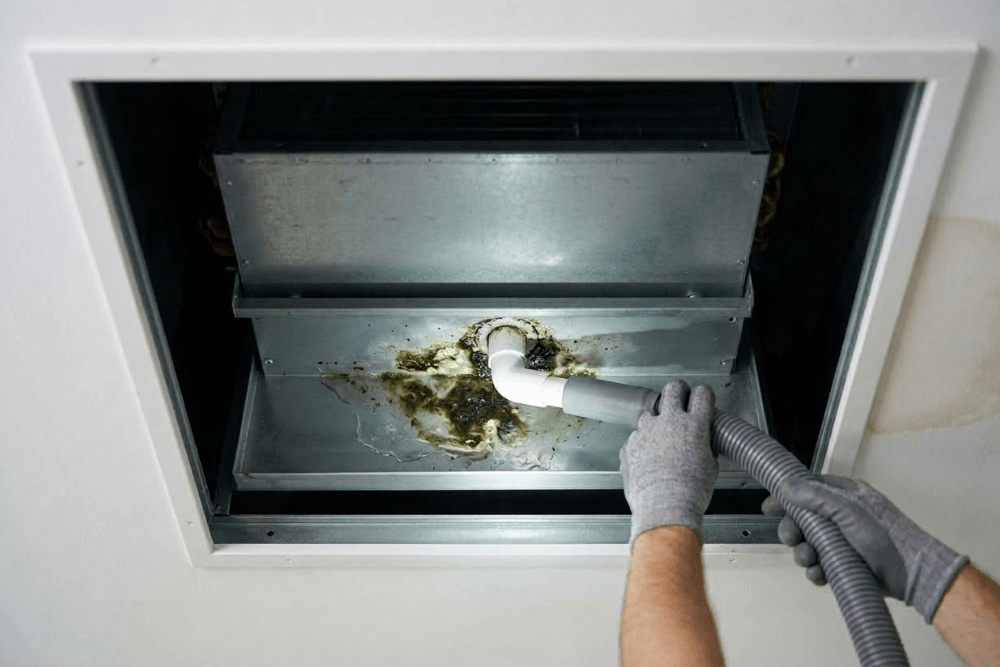
A blocked condensate drain line is the cause behind the large majority of AC water leaks, in Dubai and everywhere else, and it happens when dust, algae, and mineral sludge gradually narrow the drain pipe until water can no longer pass through fast enough. The line itself is usually a thin PVC pipe running from the indoor unit's drain pan to an outside drain or a shared waste line, and because it's narrow and normally out of sight, buildup inside it goes unnoticed until it's already restricting flow significantly.
This is the cause that responds well to a mechanical clean, and it's the one your AC's cooling performance won't tell you anything about, since the unit itself is working perfectly fine, it's just that the water it's correctly producing has nowhere to go. If the room is cooling normally and you're seeing a steady drip or a puddle rather than a sudden gush, this is the first thing worth checking.
What Happens If a Blocked Line Is Left Unaddressed
A blocked drain line doesn't resolve itself, and the practical consequences extend past the immediate puddle. Continued buildup narrows the line further, so what starts as an occasional drip tends to become a steadier leak over subsequent weeks rather than staying at the same severity. Standing water sitting in a tray or a damp line for extended periods is also the exact environment drain flies breed in, so a blocked AC drain left untreated can produce a second, seemingly unrelated symptom on top of the original leak. And water that's been reaching a ceiling or wall cavity for any length of time creates the damp conditions mold needs, turning what began as a plumbing fix into a larger remediation job if it's left long enough.
Cause 2: Dirty Filter Leading to a Frozen Coil
A clogged air filter restricts airflow across the evaporator coil, and instead of condensing moisture normally, the coil freezes moisture directly onto its surface; when that ice eventually melts, it produces far more water at once than the drain was ever designed to carry away in that timeframe, which shows up as leaking even though the actual fault is the filter, not the drain.
This is the cause most easily confused with a blocked drain, since both end in water where it shouldn't be, but the fix is entirely different: cleaning or replacing the filter and letting the coil fully defrost resolves it, and clearing an already-clear drain line won't touch the actual problem. If you've noticed weaker cooling in the days before the leak started, or you can see ice on the unit when you check, this is more likely than a blocked line.
Cause 3: Condensate Pump Failure (the Cause Nobody Else Mentions)
In apartments and units where the indoor AC sits away from an exterior wall or a gravity-fed drain route, a small condensate pump lifts the collected water to wherever it can actually drain, and when that pump fails, water has nowhere to go and backs up at the unit itself regardless of how clear the drain line otherwise is.
This is a genuinely distinct mechanism from a blocked drain line, and it's specific to properties where gravity alone can't get condensate to a drain point, common in mid- and high-rise apartments with indoor units positioned deep in a floor plan. A failed pump produces a symptom pattern that looks identical to a blocked drain from the outside, water pooling at or dripping from the unit, but clearing the drain line does nothing for it, since the water isn't reaching the line in the first place. If you live in an apartment, your AC is positioned away from any outside wall, and a drain-line clear didn't resolve a previous leak, a failed condensate pump is worth checking before repeating the same clearing job.
Cause 4: Cracked, Rusted, or Misaligned Drain Tray
The tray sitting beneath the indoor coil, which collects condensate before it enters the drain line, ages with years of constant water contact, plastic trays can crack and metal trays can corrode, and once it can no longer hold water properly, it leaks regardless of whether the drain line downstream is perfectly clear. Dubai's salt-laden coastal air accelerates this specifically for metal tray designs, meaning a tray that might last well over a decade inland can show corrosion noticeably sooner in a coastal or waterfront property.
This is the one cause on this list where clearing the drain line, however thoroughly, will not fix the leak, because the failure is upstream of the line entirely. A visible crack, a rust line, or water appearing to leak from the tray itself rather than travelling down the drain pipe are the signs worth looking for, and the fix is tray replacement rather than any cleaning process.
Cause 5: Missing or Failed Drain Trap
A proper AC condensate line includes a small trap, the same purpose as the trap under every sink and floor drain in your home, and without one, air can travel back up the line and produce a musty smell alongside a leak that doesn't match a simple blockage pattern. This is a less common cause than a blockage but a real one, particularly on older installations or units where a trap was never fitted correctly to begin with.
If your leak comes with a distinct musty odor rather than just water, and the pattern is an occasional slow drip rather than a steady stream, a missing or failed trap is worth including in the diagnosis alongside a straightforward blockage check.
Cause 6: Poor Installation
A unit that wasn't installed level, or whose drain line was connected at the wrong angle, can leak from day one regardless of how clean the drain or how new the unit, since water needs a consistent downward slope to actually reach the drain point rather than pooling partway along the line. If a leak has been present since installation, or reappeared immediately after a reinstall or a service visit where the unit was moved, installation is worth reviewing before assuming wear-related causes that wouldn't explain a leak this early.
Not a Drainage Issue at All: Refrigerant and Compressor Faults
A refrigerant leak or a failing compressor can also produce water via a frozen coil, but the underlying fault is inside the sealed AC system itself, and no amount of drain clearing, filter changing, or tray replacement will resolve it, since the water is a downstream symptom of a completely different mechanism. This is genuinely outside plumbing scope, and it's worth saying plainly: if a hissing or bubbling sound accompanies the leak, or cooling performance has dropped noticeably alongside the water, or the unit needs a refrigerant top-up to keep working, that's AC repair work, sealed-system servicing, not a job a drain-cleaning visit can fix, and we'll tell you honestly if that's what we're seeing rather than quoting for drainage work that won't solve it.
Villas, Apartments, and Concealed Units
A villa's split units are usually mounted with a straightforward, directly accessible drain run; an apartment's concealed fan coil units and units positioned away from an exterior wall are more likely to involve a condensate pump or a longer, less accessible drain route, which changes both the likely cause and how it gets fixed.
In a villa, each split unit typically has its own short, gravity-fed drain line to the outside, which is both easier to inspect and easier to clear when it blocks. In an apartment, particularly in mid- and high-rise buildings, indoor units are frequently concealed above a false ceiling or positioned in a spot with no direct route to an outside drain, which is exactly the setup that requires a condensate pump, and it's also why an apartment's AC condensate line more often ties into a shared waste stack rather than draining independently outside. That shared-stack connection is worth knowing about beyond just the leak itself: it's the same mechanism behind a gurgling sink or toilet when the AC condensate drains, and behind drain flies breeding in a line most people never think to check, both of which we cover in more depth elsewhere on this site.
If you're in an apartment and a leak keeps recurring at the unit itself despite a cleared drain, checking for a condensate pump and confirming where the line actually terminates, your own drain or a shared building line, are the two things worth establishing before repeating the same fix.
Offices and commercial spaces follow the same underlying mechanisms as residential properties, but typically run larger central or ducted systems with longer drain runs and more units to track, which means a leak in one zone doesn't necessarily indicate a building-wide issue the way it might suggest a shared-stack problem in a small apartment building. A commercial space with a leak recurring in the same zone repeatedly is worth having assessed as part of a broader system check rather than treating each occurrence as an isolated callout.
Toilet & Sink Gurgling (Dubai)
If a gurgling sink or toilet correlates with your AC cycling, this is the same shared-stack mechanism.
Drain Flies in Your Dubai Home
A damp, undisturbed AC condensate line is a common, overlooked breeding site.
Commercial Plumbing
For offices and commercial spaces with recurring leaks in the same zone.
What Brand or Type of AC You Have Doesn't Change Much
Split units, ducted systems, and central AC all use the same basic condensate mechanism, so the causes above apply regardless of brand, whether that's Daikin, Mitsubishi, LG, or Carrier, the common systems found across Dubai homes. Window units are genuinely rare in most Dubai residential properties, split and ducted/central systems dominate here, so if you're researching a window-unit-specific leak, most of what you'll find online (including a lot of the generic advice on this exact topic) is written for a configuration that simply isn't common in this market. The mechanisms, blocked drain, frozen coil, failed pump, cracked tray, missing trap, poor installation, are the same across every system type; what changes between them is mainly how accessible the drain line and tray are to inspect and clear.
DIY Steps That Are Genuinely Safe to Try
Turning the unit off and checking the filter are the two safe, useful things to do yourself before calling anyone; attempting to clear the drain line or move the unit yourself is not recommended and can cause more damage than the leak itself.
Switch the AC off as soon as you notice a leak, since continuing to run it, particularly if a frozen coil is involved, risks more water damage and puts unnecessary strain on the unit. Check whether the filter is visibly dirty and clean or replace it if so, since this is the one cause a non-technician can genuinely address without tools or specialist knowledge. Beyond that, resist the temptation to reach for a wet/dry vacuum on the drain line yourself or to tilt or move a wall-mounted unit to inspect it, both carry real risk of damaging refrigerant lines or electrical connections, and a professional clear of the drain line is a quick, low-cost visit that avoids that risk entirely.
Preventing the Next Leak
Two habits catch the large majority of leaks before they happen, rather than after, and neither requires professional involvement to maintain between scheduled cleans. Cleaning or replacing filters on a regular cycle, more often during peak summer than the rest of the year given how much harder units run, keeps the frozen-coil pathway from ever starting, since a clean filter is the single biggest factor in whether airflow across the coil stays adequate. Keeping the area around any accessible drain outlet clear, no debris, no plant growth, no buildup at the point where the line exits the building, prevents the outdoor end of the system from becoming its own restriction even when the indoor portion is clear.
For anyone who's dealt with a leak once already, a scheduled drain clean, timed for just before peak summer per the seasonal pattern above, is meaningfully cheaper and less disruptive than waiting for the next leak to happen and treating it as an emergency callout each time. This is the same logic behind routine water tank cleaning being scheduled ahead of summer rather than during it: catching a system at its most resilient point, right before the season that stresses it most, beats reacting once it's already failed.
What Professional AC Drain Cleaning Actually Involves
A proper condensate drain clean flushes the full length of the line, not just the accessible end, confirms the trap and tray are intact, and checks whether a condensate pump is involved before declaring the job done, since clearing only the visible portion of a line often leaves the actual blockage untouched further along.
| Situation | What's typically involved | Relative scope |
|---|---|---|
| Straightforward blocked line, villa split unit | Full line flush from an accessible point, trap check | Lowest, usually a single visit |
| Concealed unit or shared riser suspected | Camera-assisted inspection to locate the exact blockage point | Moderate |
| Condensate pump suspected (apartment) | Pump inspection and testing alongside the line clear | Moderate |
| Cracked or corroded tray | Tray replacement, since clearing the line won't resolve this | Higher, parts plus labour |
| Frozen coil, refrigerant, or compressor signs | Referred to AC service, not undertaken as drainage work | Out of plumbing scope |
A fixed price confirmed once the actual cause is identified, rather than assumed from the symptom alone, is the reliable way to avoid paying for a drain clear that was never going to fix a cracked tray or a failed pump. Regular drain cleaning on a schedule, similar in spirit to the six-month cadence recommended for water tanks in Dubai's climate, is the most effective way to stay ahead of the dust and humidity load that makes these blockages so common here in the first place, rather than waiting for a leak to happen and clearing it reactively each time.
Is a Leaking AC Affecting Your DEWA Bill?
A unit struggling with a partially frozen coil or a restricted airflow path, the same underlying causes behind many leaks, has to work harder to reach the same set temperature, which shows up as higher electricity consumption alongside the water itself. This isn't the primary reason to fix a leak, the water damage risk matters more, but it's a genuine secondary cost: a unit that's been leaking for weeks because of a frozen coil hasn't just been dripping water, it's likely been running less efficiently the whole time, and a noticeable jump in your DEWA electricity bill alongside a leak is consistent with, though not proof of, an airflow or refrigerant-side cause rather than a simple blocked drain, since a blocked drain on its own doesn't typically affect the unit's cooling efficiency.
Frequently Asked Questions
Is a leaking AC a plumbing problem or an AC problem?
Can I just pour vinegar or a chemical drain cleaner into my AC's drain line myself?
My AC drain is clear but water is still coming from my ceiling. What's going on?
How much water does an AC actually produce in Dubai's climate?
Do I need to worry about mold from a leaking AC?
Is it normal for my AC to drip water outside the building?
Why did my AC start leaking right after a service visit?
Can a leaking AC damage my ceiling if I leave it?
Does a blocked AC drain ever connect to my other household drains?
Can AC condensate cause drain flies?
How often should AC condensate drains be cleaned in Dubai?
Is a leaking window AC unit different from a split or central system?
Is it safe to run my AC while it's leaking?
My AC is brand new and already leaking. What's going on?
Why is my AC leaking water only when it rains?
Does the type of AC brand I have, Daikin, Mitsubishi, LG, or Carrier, change how the leak should be fixed?
Can a leaking AC unit be a fire or electrical hazard?
Should I be concerned if my AC has never leaked but I want to prevent it starting?
Related Service
AC Condensate Drain Cleaning
Dealing with this issue right now? See real pricing and how we handle it.
View AC Condensate Drain Cleaning