Concealed Cistern Installation in Dubai: Wall-Hung and Back-to-Wall WCs, Fitted Right
A concealed cistern installation hides the toilet's cistern inside the wall. It sits on a steel frame that carries a wall-hung pan, or behind a floor-standing back-to-wall WC. Getting it right comes down to three things decided before tiling: the wall, the measurements, and matching the frame, cistern, pan and flush plate to each other.
We install concealed cisterns in new bathrooms and renovations, and convert exposed toilets to concealed ones, with frames and plates from Geberit, Grohe, Jaquar and TECE, supplied by us or bought by you. If your existing concealed cistern runs, leaks or won't flush, our concealed cistern repair service fixes it without replacing the system.
400 kg
Load rating of a quality WC frame
8 or 12 cm
Slim or standard cistern depth
AED 900+
Pan replaced on an existing frame
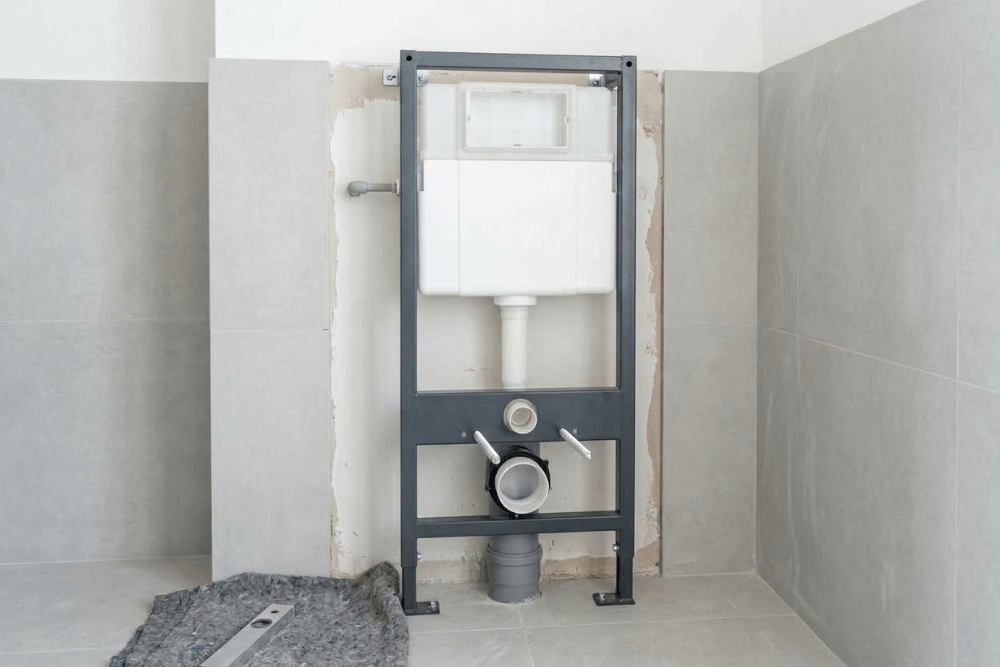
What a Concealed Cistern System Is
A concealed cistern system is a flush tank built into a frame that sits inside the wall or behind a false wall. The only visible parts are the toilet pan and a flush plate. The plate doubles as the service hatch: when it's removed, the cistern's fill valve and flush valve can be reached and replaced without opening the wall.
The system comes in four parts that have to work together: the frame, the cistern inside it, the pan, and the flush plate. Each one decides something about the others. The frame sets the pan's height and the drain position, the cistern decides which flush plates fit, and the pan must match the frame's bolt spacing and outlet. That's why buying the parts separately, without checking them against each other, is the most common cause of problems on installation day.
Most modern cisterns are dual-flush, commonly 6 and 3 litres or 4.8 and 3 litres, and the volumes can usually be adjusted on installation to suit the pan. That's a water saving on every flush, and in a Dubai household paying DEWA tariffs, it adds up.
Wall-Hung vs. Back-to-Wall (Floor-Standing) WCs
A concealed cistern can serve two different toilets. A wall-hung WC hangs from a load-bearing steel frame, leaving the floor clear. A back-to-wall WC stands on the floor with its cistern hidden behind it, so the frame carries only the cistern. Wall-hung is the modern choice; back-to-wall suits bathrooms where a load-bearing frame or a new drain position isn't practical.
| Wall-hung WC | Back-to-wall WC | |
|---|---|---|
| What holds the weight | A steel frame fixed to the floor and wall carries the pan and the person using it | The floor carries the pan; the cistern needs only light support |
| Floor under the toilet | Clear, easy to clean | The pan sits on the floor against the wall |
| Height of the seat | Set during installation, so it can suit tall or older users | Fixed by the pan's own height |
| Cistern behind | A frame with a built-in cistern, typically around 112 to 120 cm tall | A cistern on a lighter frame or bracket, including low-height versions |
| Suits | Most new bathrooms and renovations | Replacing a floor-standing toilet without building a load-bearing frame, or bathrooms with a floor drain outlet that can't move |
What holds the weight
- Wall-hung WC
- A steel frame fixed to the floor and wall carries the pan and the person using it
- Back-to-wall WC
- The floor carries the pan; the cistern needs only light support
Floor under the toilet
- Wall-hung WC
- Clear, easy to clean
- Back-to-wall WC
- The pan sits on the floor against the wall
Height of the seat
- Wall-hung WC
- Set during installation, so it can suit tall or older users
- Back-to-wall WC
- Fixed by the pan's own height
Cistern behind
- Wall-hung WC
- A frame with a built-in cistern, typically around 112 to 120 cm tall
- Back-to-wall WC
- A cistern on a lighter frame or bracket, including low-height versions
Suits
- Wall-hung WC
- Most new bathrooms and renovations
- Back-to-wall WC
- Replacing a floor-standing toilet without building a load-bearing frame, or bathrooms with a floor drain outlet that can't move
Quality wall-hung frames are rated to carry far more than a person. Geberit, for example, rates its Duofix frames to 400 kg. That strength depends on the frame being fixed exactly as its instructions say, to the floor and to the wall or its own supports. A wall-hung toilet that flexes or creaks has a fixing problem, not a pan problem.
Back-to-wall toilets are the practical answer when the existing drain comes up through the floor, which is common in older Dubai apartments. A wall-hung pan needs its drain in the wall behind it, and moving a floor outlet up into the wall can mean opening the floor. A back-to-wall pan can often use the floor outlet as it is, while still hiding the cistern.
Blockwork, Gypsum Partition or False Wall
How a concealed cistern is fitted depends on the wall behind the toilet. In blockwork, the frame is set into a chased recess or, more often, behind a false wall built in front. In a gypsum stud partition, which is common in Dubai apartments, the frame must be self-supporting and fixed to the floor, because the partition can't carry the load.
| Wall | How the frame goes in | What to watch |
|---|---|---|
| Blockwork wall | Chase a recess for the frame, or build a false wall in front of it | Chasing deep enough for a 12 cm cistern weakens thin block walls; a false wall avoids it |
| Gypsum stud partition | A self-supporting frame fixed to the floor, then boxed in with moisture-resistant board | The partition can't carry the load itself, so the frame must |
| False wall (duct) in front of any wall | Frame stands in front of the existing wall, boxed in and tiled | Loses some floor depth but needs no chasing, and gives a shelf above the cistern |
Blockwork wall
- How the frame goes in
- Chase a recess for the frame, or build a false wall in front of it
- What to watch
- Chasing deep enough for a 12 cm cistern weakens thin block walls; a false wall avoids it
Gypsum stud partition
- How the frame goes in
- A self-supporting frame fixed to the floor, then boxed in with moisture-resistant board
- What to watch
- The partition can't carry the load itself, so the frame must
False wall (duct) in front of any wall
- How the frame goes in
- Frame stands in front of the existing wall, boxed in and tiled
- What to watch
- Loses some floor depth but needs no chasing, and gives a shelf above the cistern
A false wall, sometimes called a duct or prewall, is the most flexible option. The frame stands in front of the existing wall and is boxed in with moisture-resistant board, then tiled. It costs some floor depth, usually around 20 to 25 cm from the original wall to the new tiled face, but it needs no chasing, keeps the original wall intact, and leaves a useful shelf above the cistern. It's also where the pipework runs, so no pipes are buried in the blockwork.
Where depth is tight, an 8 cm slim cistern instead of the standard 12 cm makes a real difference. It can fit inside a thinner build-out, or inside a partition that couldn't take a standard cistern. Slim cisterns have their own flush plates, so the plate choice follows from the cistern choice, not the other way round.
The Measurements That Decide Success
A concealed cistern installation is decided by six measurements, all fixed before tiling: finished floor level, pan outlet height, seat height, bolt spacing, flush plate position and cistern depth. Get one wrong and it shows as a pan that won't bolt on, a plate that sits off centre, or a seat that is too low, none of which can be corrected without opening the wall.
| Measurement | Typical value | Why it matters |
|---|---|---|
| Finished floor level | Agreed with the tiler before the frame is fixed | The frame's feet are set from it; a 10 mm error moves the pan and the flush plate |
| Pan outlet height | Typically 180 to 220 mm above the finished floor | Sets where the drain elbow meets the pan |
| Seat height | Around 40 cm is standard; higher for comfort or older users | Chosen before the frame is fixed; it can't be changed after tiling |
| Bolt spacing | Wall-hung pans and frames use standard spacings, most often 180 or 230 mm | Pan and frame must match, or the pan won't bolt on |
| Flush plate position | Centred on the pan and planned against the tile layout | A plate cut across tile joints looks wrong and is harder to seal |
| Cistern depth | 12 cm standard, 8 cm slim | Decides how deep the wall or false wall has to be |
Finished floor level
- Typical value
- Agreed with the tiler before the frame is fixed
- Why it matters
- The frame's feet are set from it; a 10 mm error moves the pan and the flush plate
Pan outlet height
- Typical value
- Typically 180 to 220 mm above the finished floor
- Why it matters
- Sets where the drain elbow meets the pan
Seat height
- Typical value
- Around 40 cm is standard; higher for comfort or older users
- Why it matters
- Chosen before the frame is fixed; it can't be changed after tiling
Bolt spacing
- Typical value
- Wall-hung pans and frames use standard spacings, most often 180 or 230 mm
- Why it matters
- Pan and frame must match, or the pan won't bolt on
Flush plate position
- Typical value
- Centred on the pan and planned against the tile layout
- Why it matters
- A plate cut across tile joints looks wrong and is harder to seal
Cistern depth
- Typical value
- 12 cm standard, 8 cm slim
- Why it matters
- Decides how deep the wall or false wall has to be
The finished floor level is the one that catches people out. The frame's feet are set to the floor level the tiles will finish at, not the bare screed. If the floor build-up changes after the frame is fixed (a thicker tile, extra screed to correct falls), the pan ends up too low and the flush plate moves relative to the tile joints. We agree the finished floor level with whoever is tiling before the frame goes in.
Seat height is worth deciding deliberately. One of the real advantages of a wall-hung toilet is that it can be set higher than a standard pan, which makes a difference for tall people and for older users. It has to be decided before the frame is fixed.
Not every toilet sits against a plain full-height wall. Manufacturers make frames for installation under a window, where a low frame keeps the cistern below the sill; for corners; and for fitting behind a vanity or shelf at counter height, often with a top-operated plate. When the toilet position is awkward, the frame choice solves it before any wall is built.
Brands and Compatibility: Geberit, Grohe, Jaquar and TECE
Concealed cistern parts are brand-specific. A flush plate fits only its own brand's cistern, and often only one series within that brand. Internal parts don't cross between brands either. The pan is the flexible part: most wall-hung pans fit most frames, provided the bolt spacing and outlet match.
| Brand | Common systems | Compatibility |
|---|---|---|
| Geberit | Duofix frames with Sigma (12 cm and 8 cm) and Omega (lower heights) cisterns; Delta at the economy end | Sigma plates fit Sigma cisterns, Omega plates fit Omega; Geberit states it keeps spare parts for 50 years |
| Grohe | Rapid SL frames with Grohe cisterns | Grohe flush plates fit Grohe cisterns, not other brands |
| TECE | TECEprofil and TECE frames with TECE cisterns | TECE plates fit TECE cisterns |
| Jaquar | Concealed cisterns including slim versions, widely sold in the UAE | Jaquar plates fit Jaquar cisterns |
Geberit
- Common systems
- Duofix frames with Sigma (12 cm and 8 cm) and Omega (lower heights) cisterns; Delta at the economy end
- Compatibility
- Sigma plates fit Sigma cisterns, Omega plates fit Omega; Geberit states it keeps spare parts for 50 years
Grohe
- Common systems
- Rapid SL frames with Grohe cisterns
- Compatibility
- Grohe flush plates fit Grohe cisterns, not other brands
TECE
- Common systems
- TECEprofil and TECE frames with TECE cisterns
- Compatibility
- TECE plates fit TECE cisterns
Jaquar
- Common systems
- Concealed cisterns including slim versions, widely sold in the UAE
- Compatibility
- Jaquar plates fit Jaquar cisterns
Spare parts matter more than the badge. A concealed cistern lives in the wall for as long as the bathroom does, and its fill valve and flush valve will need replacing at some point. Brands with a local distributor and parts on the shelf in the UAE turn that into a short repair through the flush plate. Unbranded cisterns with no parts support can turn it into opening the wall.
If you've already bought a frame, pan or plate, tell us the models before we come, so we can check they match. If you'd rather we supply, we'll specify a matched set for your wall and budget. The repair side of each brand, from running cisterns to failed fill valves, is covered on our toilet and concealed cistern repair page.
Choosing a Wall-Hung Pan That Suits the System
The pan is the part people choose by looks, but five practical points decide whether it works with the concealed cistern behind it: rimless or rimmed, how far it projects, its bolt spacing and outlet, the flush volume it was designed for, and a seat that lifts off for cleaning.
Rimless or rimmed
A rimless pan has no hidden channel under the rim for dirt and scale to collect in, so it's quicker to clean. It relies on a well-directed flush, so it has to be paired with the flush volume it was designed for.
Projection
How far the pan sticks out from the wall. Compact pans save space in small bathrooms and guest toilets; longer pans are more comfortable. Measure the clear space in front before choosing.
Bolt spacing and outlet
The pan's fixing bolt spacing and outlet must match the frame. Check both on the pan's specification sheet before buying, not after delivery.
Recommended flush volume
Every pan is tested with a certain flush. If the cistern delivers less than the pan needs, it won't clear; if more, water is wasted. The cistern is set to match.
The seat
A soft-close seat that lifts off with a quick-release catch is worth having, because it lets the hinges and the rim around them be cleaned properly.
Sets that come with a frame, cistern, pan and plate already matched, like many sold in Dubai showrooms, take the compatibility question away. Buying separately gives more choice, but it's worth sending us the models first. A pan that arrives with the wrong bolt spacing is the most common reason an installation stops halfway.
Flush Plate Types, and Where to Put Them
Most concealed cisterns use a mechanical dual-flush plate on the wall above the pan, which also serves as the access hatch to the cistern. Low-height cisterns can use a top-operated plate set into a shelf or counter. Some systems allow a remote button, and touchless plates need power planned in. The plate must match the cistern series, so the cistern choice comes first.
Mechanical dual-flush plates
The standard choice: two buttons, full and half flush, linked mechanically to the flush valve. Reliable, and the plate lifts off to give access to the cistern.
Pneumatic and remote buttons
Some systems allow a flush button away from the cistern, for example on a vanity top, connected by an air tube. Useful where the cistern sits behind furniture.
Touchless plates
Sensor-operated plates need power at the frame, planned before the wall is closed. They suit shared or commercial toilets more often than homes.
Top-operated plates
Low-height cisterns, such as those behind a back-to-wall pan or under a vanity counter, can be operated from above, with the plate set into a shelf or counter.
Wherever it goes, the plate has to stay removable. Tiles are cut around the plate's frame, not under it, and silicone never goes across the joint between the plate and the tiles. A plate that can't come off turns every future repair into a tiling job.
Checking a Concealed Cistern WC at Handover
In a new-build or freshly renovated bathroom, six checks confirm a concealed WC was installed properly: a firm pan, a flush plate that lifts off, a cistern that refills and stops, a full flush that clears the pan, a plate square to the tiles, and no damp behind the wall after several flushes.
- 1The pan is firm, with no movement when sat on or pushed from the side.
- 2The flush plate lifts off without cutting tiles or grout, and the valves behind it can be seen.
- 3Both flush buttons work, the cistern refills and stops, and no water trickles into the pan afterwards.
- 4The flush clears the pan fully on the full flush, without a second press.
- 5The plate sits centred and square to the tile joints, with its seal complete.
- 6There is no damp on the other side of the wall or at skirting level after several flushes.
Any of these that fail on a new property belong on the snag list before you sign, while the developer is still responsible for them. Our plumbing snagging inspection checks every concealed cistern for service access, flushing and leaks before handover.
How a Concealed Cistern Is Installed, and the Tests Before Closing
A concealed cistern is installed in seven steps: check the parts match, agree the levels, fix the frame, connect water and drainage, test, box in and tile, then fit the pan and plate. The tests before the wall is closed are the ones that matter. After tiling, the only way back to the water connection or drain elbow is through the wall.
- 1
Check the parts against each other
Confirm the frame, cistern, pan and flush plate match: bolt spacing, outlet connector, cistern series and plate model.
- 2
Agree the fixed levels
Agree the finished floor level with the tiler, and choose the seat height and flush plate position against the tile layout.
- 3
Fix the frame
Stand the frame on its feet at the agreed level, fix it to the floor and to the wall or its supports as the manufacturer specifies, and check it is plumb and level.
- 4
Connect water and drainage
Connect the water supply to the cistern's inlet valve and the drain elbow to the soil pipe, at the heights the pan needs.
- 5
Test before closing
Fill the cistern and check the inlet and valves for drips, then test the drainage connection and a flush before anything is boxed in.
- 6
Box in and tile
Close the wall with moisture-resistant board around the frame, with the cistern's protective box left in place, then tile.
- 7
Fit the pan and plate
Cut the protective box back to the tile face, fit the pan on its bolts and sleeves, fit the flush plate, set the flush volumes and test again.
The protective box, the plastic cover over the flush plate opening supplied with the frame, is easy to overlook. It stays in place while the wall is boarded and tiled, keeping adhesive and grout out of the cistern. Only when the tiling is finished is it cut back flush to the tile face and the plate fitted. A cistern opening tiled without it can end up with debris in the valves on day one.
The water connection goes through the cistern's own inlet valve, which on quality systems includes a stop valve reachable through the plate opening. That means the toilet can be isolated for any future repair without shutting off the bathroom. It's tested with the cistern full, before the wall is closed, because a weeping inlet connection behind tiles shows up as a stain on the other side of the wall weeks later.
Converting an Exposed Toilet to a Concealed Cistern
Converting a standard toilet with an exposed cistern to a wall-hung concealed one takes two to four days: remove the old toilet, check the drain position, fix a frame, build and tile a false wall around it, then fit the pan and plate. The drain position decides how simple it is, because a wall-hung pan needs its drain in the wall, not the floor.
Many older Dubai toilets drain straight down through the floor. A wall-hung pan drains horizontally into a bend in the frame, which then has to reach the soil pipe. Where the soil pipe is close behind the toilet, the frame's drain elbow can often be routed to it within the false wall. Where the only connection is a floor outlet some distance from the wall, reaching it can mean opening part of the floor. In those cases, a back-to-wall pan that uses the existing floor outlet is often the better conversion.
The false wall is usually built across the whole width behind the toilet, not just around the frame, which gives a clean line and a useful shelf. It is tiled to match, so spare tiles from the original batch make the difference between an invisible join and an obvious patch. Where they don't exist, tiling the whole false wall in a contrasting tile often looks deliberate rather than patched.
In apartments, this is bathroom work that building management may want to know about, and it fits naturally into a larger bathroom renovation if the rest of the room is due for one.
Noise, Flush Volume and Future Shower Toilets
Three details are easy to miss and hard to add later: sound insulation, because a frame against a bedroom wall carries flushing noise; the flush volumes, which are set at installation; and the water feed and electrical provision for a shower toilet or bidet seat, which has to be in place before the wall is closed.
Noise
A concealed cistern fills and flushes inside the wall, and a frame fixed hard against a partition shared with a bedroom carries that sound through. Acoustic pads between the frame and the wall and insulated pipe fixings reduce it. They're cheap at installation and impossible afterwards.
Flush volume
Dual-flush cisterns come preset, and the full and half flush volumes can usually be adjusted inside the cistern. They're set to what the pan needs to clear properly: too low and it won't, too high and it wastes water on every flush.
Shower toilets
Shower toilets and electric bidet seats need a water feed and a socket behind the pan. Many frames include a conduit and fixing points for both. Plan them now, even if the seat comes later, and have the socket installed by an electrician.
Water pressure matters too. A cistern's fill valve is built to shut off against normal supply pressure. On the lower floors of a tower zone, or on a villa with a strong booster pump, high pressure makes the valve hiss and whistle as it fills and wears its seal sooner, and a worn fill valve in a concealed cistern means a toilet that runs. If other taps in the home bang or drip, check the pressure before blaming the cistern. Our pressure reducing valve page shows how.
Concealed Cistern Installation Prices in Dubai
Concealed cistern installation in Dubai costs AED 1,800 to 3,500 for a frame and cistern fitted during a renovation, with the pan and plate extra. Converting an exposed toilet to a complete wall-hung concealed system costs AED 3,500 to 8,000 including boxing-in and local tiling. Replacing just the pan on an existing frame costs AED 900 to 2,200.
| Work | Typical price |
|---|---|
| Flush plate fitted (plate supplied by you, or priced separately) | AED 150 - 350 |
| Wall-hung pan replaced on an existing frame | AED 900 - 2,200 |
| Frame and cistern installed during a renovation (walls open; pan and plate extra) | AED 1,800 - 3,500 |
| Back-to-wall WC with concealed cistern, supplied and fitted | AED 2,500 - 5,500 |
| Exposed toilet converted to wall-hung concealed: frame, cistern, pan, plate, boxing-in and local tiling | AED 3,500 - 8,000 |
| Loose wall-hung pan re-secured (bolts and sleeves) | AED 200 - 450 |
Flush plate fitted (plate supplied by you, or priced separately)
- Typical price
- AED 150 - 350
Wall-hung pan replaced on an existing frame
- Typical price
- AED 900 - 2,200
Frame and cistern installed during a renovation (walls open; pan and plate extra)
- Typical price
- AED 1,800 - 3,500
Back-to-wall WC with concealed cistern, supplied and fitted
- Typical price
- AED 2,500 - 5,500
Exposed toilet converted to wall-hung concealed: frame, cistern, pan, plate, boxing-in and local tiling
- Typical price
- AED 3,500 - 8,000
Loose wall-hung pan re-secured (bolts and sleeves)
- Typical price
- AED 200 - 450
The brand and model of the frame, pan and flush plate move the price most, followed by the wall type and whether the drain has to be re-routed. We supply matched sets or fit parts you've bought; tell us the models when you book so we can check they fit together.
Concealed Cistern Installation FAQ
How much does concealed cistern installation cost in Dubai?
Can a concealed cistern be installed in a gypsum wall?
Can a concealed cistern go into a brick or block wall?
What is the difference between a wall-hung and a back-to-wall toilet?
Will any flush plate fit my concealed cistern?
Will any wall-hung toilet fit my frame?
How long does it take to install a concealed cistern?
How do you repair a concealed cistern later?
Can I have a shower toilet or bidet seat with a concealed cistern?
Why does my wall-hung toilet feel loose?
Measured, Matched and Tested Before It's Tiled
Tell us about the wall behind the toilet, whether the drain goes into the floor or the wall, and any frame, pan or plate you've already bought. We'll check it fits, fit it at the right height, and test it before the wall closes.