Grease Trap Supply and Installation in Dubai, Sized to the DM Formula
We supply and install grease traps for restaurants, cafés, cloud kitchens and hotels across Dubai: under-sink units, floor-standing traps, underground interceptors and automatic grease removal units. Every trap is sized with Dubai Municipality’s own scoring formula, and we prepare and handle the approval submission for you.
Supplied and installed prices start at AED 1,000 for an under-sink unit. The sizing assessment is free when we install. Already have a trap that needs emptying rather than replacing? See grease trap cleaning and disposal.
60–6,000 L
DM capacity range
2× / month
Cleaning the sizing assumes
AED 1,000+
Under-sink trap installed
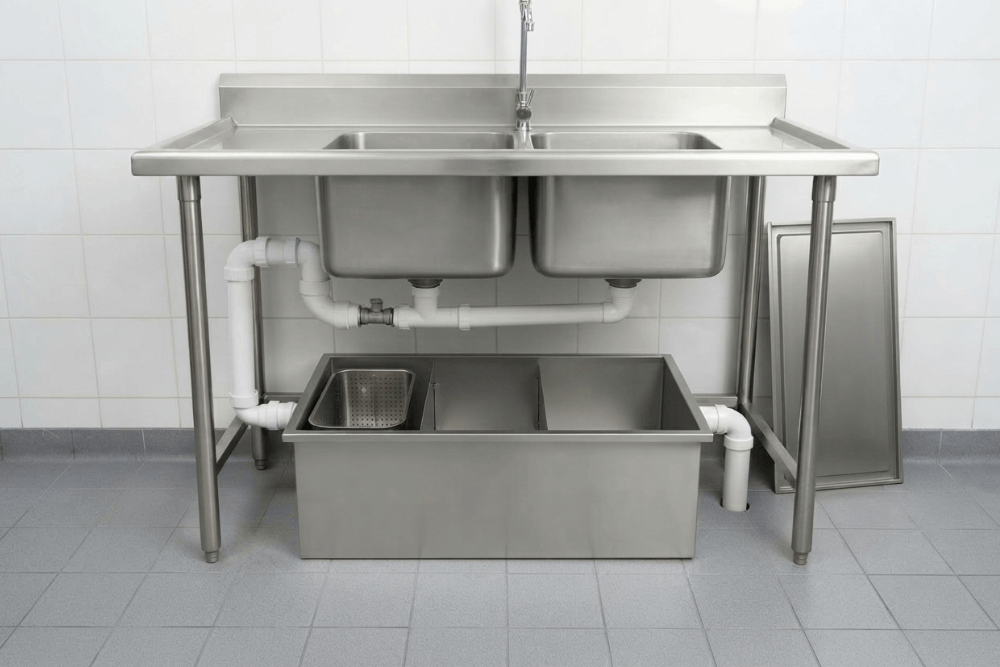
When a Kitchen Needs Grease Trap Installation
Every food establishment in Dubai that sends kitchen wastewater to the sewer needs a grease trap that meets Dubai Municipality’s specifications, and a new kitchen can’t open without one. Existing kitchens need a new or modified trap when DM’s guideline says so: after a change of ownership, a permitted remodel, or when the current trap is undersized or defective.
The second group catches people out. DM’s grease trap sizing methodology allows existing facilities to keep a trap that works, but lets the authority require a compliant replacement within 30 days of written notice when one of the triggers below applies. If you’re buying or leasing a unit that used to be a restaurant, the trap belongs in your due diligence, not your snag list.
| Situation | Why it matters | What to do |
|---|---|---|
| New restaurant, café or cloud kitchen fit-out | Required before the kitchen can open | Size with the DM formula at design stage, before drainage is laid |
| Taking over an existing food outlet | DM can require a compliant trap after a change of ownership | Check the existing trap against your concept, not the previous tenant’s |
| Kitchen remodel that needs a permit | Also a listed trigger for a new or modified trap | Resize if sinks, equipment or hours change |
| Trap undersized, defective or beyond repair | DM can issue a written notice to replace | Replace to the size the formula gives today |
| Grease still reaching the drains after regular cleaning | Often a sign of an undersized trap or missing flow control | Resize, or add flow control and cleaning under an undertaking |
New restaurant, café or cloud kitchen fit-out
- Why it matters
- Required before the kitchen can open
- What to do
- Size with the DM formula at design stage, before drainage is laid
Taking over an existing food outlet
- Why it matters
- DM can require a compliant trap after a change of ownership
- What to do
- Check the existing trap against your concept, not the previous tenant’s
Kitchen remodel that needs a permit
- Why it matters
- Also a listed trigger for a new or modified trap
- What to do
- Resize if sinks, equipment or hours change
Trap undersized, defective or beyond repair
- Why it matters
- DM can issue a written notice to replace
- What to do
- Replace to the size the formula gives today
Grease still reaching the drains after regular cleaning
- Why it matters
- Often a sign of an undersized trap or missing flow control
- What to do
- Resize, or add flow control and cleaning under an undertaking
A trap that suited the outgoing tenant may be too small for you. DM sizes traps on the kitchen type, opening hours, meals per day and fixtures, so a café lease taken over by a fast-food operator trading eighteen hours a day can land two or three sizes higher in DM’s table. The next section shows the arithmetic.
Before taking over, have the kitchen drain line checked as well. A drain camera survey shows whether the pipe between the sinks and the trap is already half full of set grease, which a new trap won’t fix.
Grease Trap Types: Under-Sink, Floor-Standing and Underground
The type of grease trap follows from the capacity DM’s formula gives you and the space you have. Under-sink units cover the smallest kitchens, floor-standing traps cover most cafeterias and small restaurants, and underground interceptors take anything from about 800 litres up. Automatic units are an option where a kitchen is busy but short of space.
We supply and install all four types, in stainless steel, PVC and GRP.
| Type | Typical capacity | Suits | What to plan for |
|---|---|---|---|
| Under-sink trap | About 30 to 110 L | Coffee shops, juice bars, single-sink kiosks | Fits inside the unit; needs frequent emptying; flow control and venting matter most here |
| Floor-standing (above-ground) trap | About 110 to 800 L | Cafeterias, smaller restaurants, cloud kitchens with a back room | No excavation; takes floor space; lid must stay accessible and sealed |
| Underground interceptor | 800 L up to 6,000 L and more | Full-service restaurants, hotels, food courts, catering units | Excavation and a tanker route for pump-outs; built outside the kitchen where possible |
| Automatic grease removal unit (GRU) | Rated by flow rather than volume | Busy kitchens with no room or access for frequent pump-outs | Needs a power supply; skimmed grease goes into a container that staff empty |
Under-sink trap
- Typical capacity
- About 30 to 110 L
- Suits
- Coffee shops, juice bars, single-sink kiosks
- What to plan for
- Fits inside the unit; needs frequent emptying; flow control and venting matter most here
Floor-standing (above-ground) trap
- Typical capacity
- About 110 to 800 L
- Suits
- Cafeterias, smaller restaurants, cloud kitchens with a back room
- What to plan for
- No excavation; takes floor space; lid must stay accessible and sealed
Underground interceptor
- Typical capacity
- 800 L up to 6,000 L and more
- Suits
- Full-service restaurants, hotels, food courts, catering units
- What to plan for
- Excavation and a tanker route for pump-outs; built outside the kitchen where possible
Automatic grease removal unit (GRU)
- Typical capacity
- Rated by flow rather than volume
- Suits
- Busy kitchens with no room or access for frequent pump-outs
- What to plan for
- Needs a power supply; skimmed grease goes into a container that staff empty
“Type A, B, C, D” labels
Dubai suppliers sell traps as Type A, B, C or D, built to Dubai Municipality specifications. The labels are useful shorthand, but they don’t map to one fixed size across every supplier. DM’s own sizing document, for example, gives 430 litres as an example of a Type B trap and 600 litres as a Type C, while some supplier catalogues describe Type B as anything from 50 to 500 litres. Always compare traps by working capacity in litres and rated flow, not by letter.
Materials
Stainless steel is the usual choice for under-sink units inside the kitchen, because it can be cleaned in place and doesn’t absorb odour. PVC and GRP are lighter and don’t corrode, which suits floor-standing and underground traps. Concrete interceptors still exist in older buildings; they work, but cracked walls let wastewater out and groundwater in, so a failing one is usually replaced with a prefabricated unit rather than patched.
Automatic grease removal units
An automatic unit separates grease the same way a passive trap does, then skims it off into a removable container on a timer, so the grease doesn’t build up in the tank. It suits a busy kitchen in a unit where there is no room for the interceptor the formula calls for, or no tanker access for frequent pump-outs. It still has to be approved for your kitchen, it needs power, and someone has to empty and clean it on schedule.
How Dubai Municipality Sizes a Grease Trap
Dubai Municipality sizes a grease trap with a score, not by floor area or seat count. The score is a criteria score (fixtures × kitchen type × hours × meals) multiplied by the total tap flow and a drain pipe score, and DM’s table converts that number into a minimum capacity between 60 and 6,000 litres.
Score = (fixtures × kitchen type × hours × meals) × tap flow × pipe score
The tables below are taken from DM’s grease trap sizing methodology. Every sink and fixture that drains to the trap counts, including meat, fish and chicken washing sinks. Rules of thumb such as “litres per meal” circulate widely, but they are not how DM decides, and the approval is checked against this method.
1. Sinks and fixtures score
| Fixture | Score |
|---|---|
| 1 sink | 2 |
| 2 to 4 sinks | 3 |
| 5 to 6 sinks | 4 |
| More than 6 sinks | 5 |
| Each dishwashing machine | +1 |
| Each indirect sink | +1 |
| Each kettle or pan washing point | +1.5 |
| Each mop sink, hand wash basin or floor drain | +0.5 |
1 sink
- Score
- 2
2 to 4 sinks
- Score
- 3
5 to 6 sinks
- Score
- 4
More than 6 sinks
- Score
- 5
Each dishwashing machine
- Score
- +1
Each indirect sink
- Score
- +1
Each kettle or pan washing point
- Score
- +1.5
Each mop sink, hand wash basin or floor drain
- Score
- +0.5
2. Kitchen type factor
| Kitchen | Factor |
|---|---|
| Coffee shop | 0.5 |
| Cafeteria, supermarket, butchery | 0.7 |
| Bakery or confectionery | 1.0 |
| Restaurant (standard) | 1.1 |
| Restaurant (fine dining) | 1.2 |
| Restaurant (fast food) | 1.3 |
| Hotel, mall, hospital, catering or public kitchen | 1.4 |
| Accommodation kitchen | 1.6 |
Coffee shop
- Factor
- 0.5
Cafeteria, supermarket, butchery
- Factor
- 0.7
Bakery or confectionery
- Factor
- 1.0
Restaurant (standard)
- Factor
- 1.1
Restaurant (fine dining)
- Factor
- 1.2
Restaurant (fast food)
- Factor
- 1.3
Hotel, mall, hospital, catering or public kitchen
- Factor
- 1.4
Accommodation kitchen
- Factor
- 1.6
3 and 4. Hours of operation and meals per day
| Hours open | Score | Meals per day | Factor |
|---|---|---|---|
| 8 hours or less | 0.7 | Under 200 | 1.0 |
| 9 to 12 hours | 1.0 | 200 to 500 | 1.2 |
| 13 to 16 hours | 1.5 | 501 to 1,000 | 1.4 |
| 17 to 24 hours | 2.0 | 1,001 to 2,000 | 1.6 |
| Over 2,000 | 1.8 |
8 hours or less
- Score
- 0.7
- Meals per day
- Under 200
- Factor
- 1.0
9 to 12 hours
- Score
- 1.0
- Meals per day
- 200 to 500
- Factor
- 1.2
13 to 16 hours
- Score
- 1.5
- Meals per day
- 501 to 1,000
- Factor
- 1.4
17 to 24 hours
- Score
- 2.0
- Meals per day
- 1,001 to 2,000
- Factor
- 1.6
- Score
- Meals per day
- Over 2,000
- Factor
- 1.8
5. Tap flow (litres per minute)
| Taps of this size | ½ inch (DN15) | ¾ inch (DN20) |
|---|---|---|
| 1 | 13.8 | 27.0 |
| 2 | 18.6 | 37.2 |
| 3 | 22.8 | 45.0 |
| 4 | 25.2 | 50.4 |
| 5 | 30.0 | 60.0 |
| 6 | 36.0 | 72.0 |
| 7 | 42.0 | 84.0 |
| 8 | 48.0 | 96.0 |
| 9 | 54.0 | 108.0 |
| 10 | 60.0 | 120.0 |
| More than 10 | 6 × number of taps | 12 × number of taps |
1
- ½ inch (DN15)
- 13.8
- ¾ inch (DN20)
- 27.0
2
- ½ inch (DN15)
- 18.6
- ¾ inch (DN20)
- 37.2
3
- ½ inch (DN15)
- 22.8
- ¾ inch (DN20)
- 45.0
4
- ½ inch (DN15)
- 25.2
- ¾ inch (DN20)
- 50.4
5
- ½ inch (DN15)
- 30.0
- ¾ inch (DN20)
- 60.0
6
- ½ inch (DN15)
- 36.0
- ¾ inch (DN20)
- 72.0
7
- ½ inch (DN15)
- 42.0
- ¾ inch (DN20)
- 84.0
8
- ½ inch (DN15)
- 48.0
- ¾ inch (DN20)
- 96.0
9
- ½ inch (DN15)
- 54.0
- ¾ inch (DN20)
- 108.0
10
- ½ inch (DN15)
- 60.0
- ¾ inch (DN20)
- 120.0
More than 10
- ½ inch (DN15)
- 6 × number of taps
- ¾ inch (DN20)
- 12 × number of taps
If a kitchen has taps of different sizes, add the flow for each size group.
6. Drain pipe score
| Pipe to the trap | Score |
|---|---|
| 2 inches or less | 2 |
| Over 2 up to 4 inches | 2.5 |
| 5 to 6 inches | 3 |
| 7 inches or more | 3.5 |
2 inches or less
- Score
- 2
Over 2 up to 4 inches
- Score
- 2.5
5 to 6 inches
- Score
- 3
7 inches or more
- Score
- 3.5
7. Score to minimum capacity
| Score | Minimum capacity |
|---|---|
| Under 30 | 60 L |
| 31 – 50 | 110 L |
| 51 – 100 | 200 L |
| 101 – 250 | 430 L |
| 251 – 400 | 600 L |
| 400 – 650 | 800 L |
| 651 – 850 | 1,300 L |
| 851 – 1,100 | 1,800 L |
| 1,101 – 1,350 | 2,500 L |
| 1,351 – 1,500 | 3,000 L |
| 1,501 – 1,800 | 3,500 L |
| 1,801 – 2,100 | 4,000 L |
| 2,101 – 2,500 | 5,500 L |
| Over 2,500 | 6,000 L |
Under 30
- Minimum capacity
- 60 L
31 – 50
- Minimum capacity
- 110 L
51 – 100
- Minimum capacity
- 200 L
101 – 250
- Minimum capacity
- 430 L
251 – 400
- Minimum capacity
- 600 L
400 – 650
- Minimum capacity
- 800 L
651 – 850
- Minimum capacity
- 1,300 L
851 – 1,100
- Minimum capacity
- 1,800 L
1,101 – 1,350
- Minimum capacity
- 2,500 L
1,351 – 1,500
- Minimum capacity
- 3,000 L
1,501 – 1,800
- Minimum capacity
- 3,500 L
1,801 – 2,100
- Minimum capacity
- 4,000 L
2,101 – 2,500
- Minimum capacity
- 5,500 L
Over 2,500
- Minimum capacity
- 6,000 L
Three worked examples
These are our own calculations using DM’s tables, for typical Dubai kitchens. Your fixture schedule decides your answer, which is why we run it on your drawings before quoting.
Coffee shop, 14 hours a day
Fixtures: 2 sinks (3) + dishwasher (1) + hand wash (0.5) = 4.5
Criteria: 4.5 × 0.5 (coffee shop) × 1.5 (14 h) × 1.0 (150 meals) = 3.375
Flow: 3 taps at ½ inch = 22.8 L/min; 2-inch drain = score 2
Score: 3.375 × 22.8 × 2 = 153.9
Band 101–250: minimum 430 litres
Cafeteria taken over by a fast-food operator
Fixtures: 2 sinks (3) + hand wash (0.5) + floor drain (0.5) = 4
As a cafeteria, 16 h, 250 meals: 4 × 0.7 × 1.5 × 1.2 = 5.04
Flow: 2 taps at ½ inch = 18.6 L/min; 2-inch drain = score 2
Score: 5.04 × 18.6 × 2 = 187.5 → 430 litres
Same kitchen as fast food, 18 h: 4 × 1.3 × 2.0 × 1.2 = 12.48
Score: 12.48 × 18.6 × 2 = 464.3
Band 400–650: minimum 800 litres, nearly double
Delivery-only cloud kitchen, 18 hours a day
Fixtures: 3 sinks (3) + dishwasher (1) + 2 hand washes (1) + mop sink (0.5) + floor drain (0.5) = 6
Criteria: 6 × 1.3 (scored as fast food) × 2.0 (18 h) × 1.4 (600 meals) = 21.84
Flow: 5 taps at ½ inch = 30 L/min; 4-inch drain = score 2.5
Score: 21.84 × 30 × 2.5 = 1,638
Band 1,501–1,800: minimum 3,500 litres, an underground interceptor
The cloud kitchen result surprises most operators. Long hours, high meal counts and a four-inch drain push a small back-of-house unit into interceptor territory. DM’s activity list has no separate cloud kitchen category, so check which kitchen type your licence falls under; it moves the factor, and the size, more than anything else on the sheet.
A note on DM’s own document: its printed worked examples use slightly different factors from its own tables in places. We apply the table values, and the Building Permits Department confirms the size when it approves the drawings.
When the fixture schedule isn’t known
DM allows a fallback based on the kitchen drain alone: 800 litres for a 3-inch pipe, 2,000 litres for a 4-inch pipe, and 4,000 to 9,000 litres above that. Accommodation kitchens without a layout are sized by meals per day instead, from 400 litres below 100 meals to more than 4,000 litres above 2,000. Preparing the full fixture list gives a size matched to your kitchen rather than to the pipe.
When the right size won’t fit
Plenty of Dubai units have no room for the trap the formula calls for. DM’s methodology allows a smaller trap in that case, provided the owner signs an undertaking letter to fit a flow control device and to clean more often, so the smaller trap is emptied as often as the full-size one would need. This route matters most for small units in malls and towers, where space is tight, and we prepare the undertaking along with the sizing sheet.
Size and cleaning go together
DM’s capacity table assumes the trap is cleaned at least twice a month. Separately, DM’s sewerage design guidelines set 12 weeks as the longest allowed gap between pump-outs, and require a full pump-out once floating grease passes 10% of the trap’s depth, settled solids pass 20%, or the two together pass 25%. A trap sized to the formula but cleaned every two or three months is being cleaned far less often than its size assumes, and is likely to pass those limits between visits. Plan the cleaning contract at the same time as the trap.
Where the Grease Trap Goes and What Connects to It
Dubai Municipality’s sewerage design guidelines ask for grease separators as close as possible to the outlet from the premises, in the open where possible, away from traffic and readily accessible for cleaning. Only kitchen wastewater goes through it. Toilets and urinals must never drain into a grease trap, and neither should rainwater.
Every grease-bearing fixture, nothing else
The trap should collect every sink, dishwasher, pan-wash point and floor drain in the cooking and washing areas. A single prep sink left connected straight to the drain is enough to put grease into the line past the trap. Hand wash basins and floor drains count in DM’s formula, so they belong on the trap. Toilets, showers and air conditioning condensate belong on a separate branch.
Hot water and dishwashers
Water hot enough to keep fat liquid carries it straight past the baffles, and the fat sets further down the pipe instead. DM’s sewerage guidelines cap the temperature of discharge to the public sewer at 45°C for the same reason. A commercial dishwasher draining its hot rinse directly into a small under-sink trap is a common cause of a trap that is “cleaned regularly” while the drain beyond it still blocks. Where the layout allows, the dishwasher drain should join upstream with enough pipe run, or the trap should be sized for the combined flow.
Flow control and venting
A small trap only works at or below its rated flow. When several sinks empty at once, the flow can exceed the rating and push grease through. A flow control fitting on the inlet limits the flow to what the trap can handle, and an air vent stops the trap from being siphoned empty. On under-sink units, these two fittings decide whether the trap does its job.
Access for cleaning
An underground interceptor needs a route for the cleaning tanker and its hose, and a cover that can be lifted without moving kitchen equipment. An under-sink unit needs a lid that opens fully without dismantling the cabinet. A trap that is awkward to open gets cleaned less often, and cleaning frequency is part of the compliance, not an extra.
Design Details to Check Before You Accept a Quote
DM’s sewerage design guidelines set out how a grease interceptor should be built and tested. Most quotes don’t mention any of it. Use this table to ask the questions that separate a trap that passes inspection and works from one that only passes inspection.
| Detail | DM guideline | Why it matters |
|---|---|---|
| Liquid depth (interceptor tanks) | Between 760 mm and 1,800 mm | Too shallow and grease doesn’t have room to separate; too deep and solids are hard to remove |
| Inlet pipe | At least 100 mm diameter | Smaller inlets back up during peak washing |
| Inlet to outlet drop | 50 to 100 mm between the inverts | Keeps flow moving through without short-circuiting |
| Outlet baffle or tee | Opening 150 to 300 mm above the tank floor, rising at least 125 mm above the water line | Draws water from the clear middle layer, not the grease on top or the sludge below |
| Covers | Water-tight, air-tight and secured against unauthorised opening | Stops odour escaping and keeps the trap sealed between cleanings |
| Efficiency | At least 80% grease removal, with independent laboratory test results | The certificate is what shows the trap works at its rated flow |
| Watertightness test | Vacuum test, or filled and held for 8 to 10 hours with no drop in level | A leaking trap sends grease into the ground and draws groundwater in |
Liquid depth (interceptor tanks)
- DM guideline
- Between 760 mm and 1,800 mm
- Why it matters
- Too shallow and grease doesn’t have room to separate; too deep and solids are hard to remove
Inlet pipe
- DM guideline
- At least 100 mm diameter
- Why it matters
- Smaller inlets back up during peak washing
Inlet to outlet drop
- DM guideline
- 50 to 100 mm between the inverts
- Why it matters
- Keeps flow moving through without short-circuiting
Outlet baffle or tee
- DM guideline
- Opening 150 to 300 mm above the tank floor, rising at least 125 mm above the water line
- Why it matters
- Draws water from the clear middle layer, not the grease on top or the sludge below
Covers
- DM guideline
- Water-tight, air-tight and secured against unauthorised opening
- Why it matters
- Stops odour escaping and keeps the trap sealed between cleanings
Efficiency
- DM guideline
- At least 80% grease removal, with independent laboratory test results
- Why it matters
- The certificate is what shows the trap works at its rated flow
Watertightness test
- DM guideline
- Vacuum test, or filled and held for 8 to 10 hours with no drop in level
- Why it matters
- A leaking trap sends grease into the ground and draws groundwater in
The depth and baffle figures apply to interceptor tanks. Compact under-sink units are factory-built to their own design, so for those the checks are the rated flow, the efficiency certificate, the sealed lid and the flow control fitting. Wastewater leaving any trap should also stay within DM’s limit for non-mineral fats and oils entering the sewer, 100 mg/L, which a correctly sized and cleaned trap is designed to achieve.
Grease Trap Approvals: Who Signs Off What
Three Dubai Municipality departments deal with a grease trap at different stages. Building Permits sets the type and size for the activity, Building Control monitors the installation until the kitchen opens, and Food Safety oversees cleaning and maintenance after that. The kitchen layout, with the trap on it, is approved by Food Safety before construction starts.
We prepare the sizing sheet and the grease trap submission, handle it through approval, and coordinate the inspection. If you are working with a fit-out consultant, we supply them the sizing and trap details for their drawings.
| Who | Decides or checks | What it means for you |
|---|---|---|
| Landlord, mall or master developer | Consent to the works and the trap location | Usually the first hard stop in a mall or tower |
| DM Food Safety Department | Kitchen layout approval, before construction starts | The trap must appear on the approved drawings |
| DM Building Permits Department | The type and size of trap for the activity | This is where the sizing sheet is checked |
| DM Building Control Department | Monitors the installation until the kitchen opens | Inspects against the approved type and size |
| DM Food Safety (after opening) | Cleaning and maintenance of the trap | Cleaning records are checked on inspection |
Landlord, mall or master developer
- Decides or checks
- Consent to the works and the trap location
- What it means for you
- Usually the first hard stop in a mall or tower
DM Food Safety Department
- Decides or checks
- Kitchen layout approval, before construction starts
- What it means for you
- The trap must appear on the approved drawings
DM Building Permits Department
- Decides or checks
- The type and size of trap for the activity
- What it means for you
- This is where the sizing sheet is checked
DM Building Control Department
- Decides or checks
- Monitors the installation until the kitchen opens
- What it means for you
- Inspects against the approved type and size
DM Food Safety (after opening)
- Decides or checks
- Cleaning and maintenance of the trap
- What it means for you
- Cleaning records are checked on inspection
Free zones and some master communities have their own authorities for fit-out permits, such as Trakhees, Dubai Development Authority and DMCC, so the approval route depends on where the unit is. Civil Defence approval for the kitchen is a separate process again. The sizing method is the same wherever the trap goes.
The most expensive mistake is fixing the drainage before the trap is sized. Once the floor is screeded and the sink positions are set, there is often no room left for the trap the formula calls for, and the only options are breaking the floor or the undertaking route with more frequent cleaning.
Buying a Grease Trap: What to Ask a Supplier
We supply grease traps as well as installing them: stainless under-sink units, PVC and GRP floor-standing traps, underground interceptors and automatic grease removal units. Whether you buy from us or elsewhere, ask these seven questions before you pay. A trap that is cheap because it is undersized or uncertified costs more once DM asks for it to be replaced.
| Ask for | Why |
|---|---|
| Working capacity in litres | The figure DM’s table is compared against; ignore “Type” letters and US-gallon model names |
| Rated flow | Must be at least the tap flow from the formula; otherwise a flow control device is needed |
| Efficiency test certificate | Independent lab results showing at least 80% removal |
| Approval for use in Dubai | Ask which DM specification the model is built to |
| Outside dimensions and lid clearance | Decides whether it fits under the sink, in the store room or in the ground |
| Material and wall thickness | Stainless grade for indoor units; PVC or GRP wall thickness for floor and underground units |
| Strainer basket and seals | A removable solids basket and replaceable lid gasket, with spares available locally |
Working capacity in litres
- Why
- The figure DM’s table is compared against; ignore “Type” letters and US-gallon model names
Rated flow
- Why
- Must be at least the tap flow from the formula; otherwise a flow control device is needed
Efficiency test certificate
- Why
- Independent lab results showing at least 80% removal
Approval for use in Dubai
- Why
- Ask which DM specification the model is built to
Outside dimensions and lid clearance
- Why
- Decides whether it fits under the sink, in the store room or in the ground
Material and wall thickness
- Why
- Stainless grade for indoor units; PVC or GRP wall thickness for floor and underground units
Strainer basket and seals
- Why
- A removable solids basket and replaceable lid gasket, with spares available locally
Under-sink units are often sold by US-gallon model names, such as a “15” or “25” referring to US gallons. A US gallon is 3.785 litres, so a 25-gallon unit holds about 95 litres, less than the 110-litre band in DM’s table. Convert before you compare. For restaurants with larger kitchens, our commercial plumbing team handles the rest of the kitchen drainage alongside the trap.
How We Install a Grease Trap
A grease trap installation runs from fixture count to inspection in eight steps. Sizing and approval come first, because the trap that DM approves is the trap that has to go in. On site, an under-sink unit takes a few hours, a floor-standing trap about a day, and an underground interceptor longer because of excavation.
- 1
Site visit and fixture count
We list every sink, dishwasher, wash point and floor drain, measure the taps and the drain pipe, and note your kitchen type, opening hours and expected meals per day. For a new fit-out we work from your layout drawings.
- 2
Sizing sheet
We run Dubai Municipality's formula and give you the minimum capacity, the trap type that fits your space, and, where the full size won't fit, the undertaking route with a flow control device.
- 3
Submission and approval
We prepare the grease trap submission, handle it through approval, and obtain the landlord or mall consent where the works need it.
- 4
Supply
We supply the approved trap with its efficiency certificate and product details, sized in litres to match the approval.
- 5
Prepare the connection
The kitchen drain is checked, and jetted clear where old grease has built up, so the new trap isn't fed a line that is already half blocked. Underground interceptors get their excavation and bedding at this stage.
- 6
Install and connect
The trap is set level and connected so that every grease-bearing fixture drains through it and nothing else does, with the flow control fitting, vent and sealed, lockable cover in place.
- 7
Test
Watertightness is tested, then water is run through at full flow from every fixture to check the trap holds its level, doesn't back up, and discharges clear water.
- 8
Inspection and handover
We coordinate the inspection and hand over the approval, the product certificate, the installation record and a cleaning schedule matched to the trap's size.
Step five matters more than it looks. A kitchen line that has carried grease for years often has a thick layer set inside it. Connecting a new trap to that pipe leaves the blockage where it was. We clear it first with hydro-jetting where the check shows it’s needed.
Grease Trap Installation Cost in Dubai
Grease trap installation in Dubai costs AED 1,000 to 2,500 for an under-sink unit and AED 4,500 to 12,000 for a floor-standing trap of 200 to 500 litres, supplied and installed. Underground interceptors and automatic units are quoted after a survey, and the sizing assessment is free when we do the installation.
| Work | Typical price |
|---|---|
| Sizing assessment using DM's formula | Free when we install |
| Under-sink trap (up to about 110 L), supplied and installed | AED 1,000 – 2,500 |
| Floor-standing trap, 200 – 500 L, supplied and installed | AED 4,500 – 12,000 |
| Underground interceptor, 800 L and above | Quoted after survey |
| Automatic grease removal unit | Quoted after survey |
| Replacing an existing trap on the same connections | From AED 800, plus the trap |
| Removal and disposal of the old trap | Quoted separately |
Sizing assessment using DM's formula
- Typical price
- Free when we install
Under-sink trap (up to about 110 L), supplied and installed
- Typical price
- AED 1,000 – 2,500
Floor-standing trap, 200 – 500 L, supplied and installed
- Typical price
- AED 4,500 – 12,000
Underground interceptor, 800 L and above
- Typical price
- Quoted after survey
Automatic grease removal unit
- Typical price
- Quoted after survey
Replacing an existing trap on the same connections
- Typical price
- From AED 800, plus the trap
Removal and disposal of the old trap
- Typical price
- Quoted separately
Within each range, the price follows the capacity, the material (stainless steel costs more than PVC), how far the trap sits from the fixtures, and how much of the kitchen drain has to be re-routed so every grease-bearing fixture runs through it. A replacement on existing connections sits at the bottom; a trap moved to a new position with new drain runs sits at the top.
Underground interceptors are priced after a survey because excavation, the ground conditions, reinstating paving and the tanker access route vary from site to site more than the tank itself does. Removing and disposing of an old trap is also priced separately, since an old concrete interceptor and a plastic under-sink unit are very different jobs.
Cleaning, Records and Keeping the Trap Compliant
Once the kitchen opens, the trap moves under Dubai Municipality’s Food Safety Department, and what inspectors check is cleaning: a contract with an approved contractor, records of each visit, and proof that the waste went to an approved facility.
Set the cleaning schedule on the day the trap goes in. DM’s capacity table assumes at least two cleanings a month, and a trap that fills faster than it is emptied starts passing grease into the drain long before it overflows. Our grease trap cleaning and disposal service covers the scheduled visits, the disposal documents and emergency call-outs.
Keep the installation paperwork with those records: the approval, the trap’s capacity and certificate, and the sizing sheet. If you later change the menu, extend opening hours or add sinks, run the formula again. The trap was sized for the kitchen you had on the day of approval.
Grease Trap Installation FAQ
How much does grease trap installation cost in Dubai?
What size grease trap does my restaurant need?
Does a small café or coffee shop need a grease trap?
I'm taking over an existing restaurant. Can I keep the grease trap?
What if there isn't enough space for the size DM requires?
What is the difference between Type A, B, C and D grease traps?
Can a grease trap be installed inside the kitchen?
Can the dishwasher drain into the grease trap?
Do you handle the Dubai Municipality approval?
How long does grease trap installation take?
How often will the new trap need cleaning?
What warranty comes with a grease trap installation?
Size It Before the Floor Goes Down
Send us your kitchen layout, or a list of your sinks, dishwasher and floor drains, with your opening hours and expected meals per day. We’ll run DM’s formula and tell you the capacity, the trap that fits, and the installed price.
Grease trap installation across Dubai, including: