Legionella Risk Assessment and Water Testing in Dubai
We carry out Legionella risk assessments and water testing for buildings, hotels, staff accommodation and villas across Dubai, following Dubai Municipality’s Legionella control guideline. We survey the water system, take the samples, have them analysed by an accredited laboratory, and set up the monitoring that keeps you compliant.
Because we are plumbers, we can also carry out the fixes a report calls for, from cutting out dead legs to cleaning tanks. That quote is always kept separate from the assessment, and you are free to use any contractor for it.
20–45°C
Where Legionella multiplies
1,000 cfu/L
DM Legionella limit
AED 150–350
Per sample tested
Who Needs a Legionella Risk Assessment in Dubai?
In Dubai, buildings used by the public or by many residents need a Legionella risk assessment under Dubai Municipality’s Technical Guidelines for Legionella Control in Water Systems (DM-HSD-GU44-LCWS2). The guideline covers water systems in hotels, non-medical professional premises, educational institutes, commercial, government and residential buildings, and labour accommodation, and violations are enforceable under Local Order No. 11 of 2003 on public health and community safety.
The duty sits with whoever controls the building: the owner, the landlord or the management company. In practice that means an assessment of every water system on the premises, control measures based on what it finds, and records that are kept up to date and reviewed, especially after the water system is changed.
| Premises | Under the DM guideline | Why the risk is real there |
|---|---|---|
| Hotels and hotel apartments | Named in the guideline’s scope | Many rooms, showers used irregularly, often cooling towers and water features |
| Residential buildings and towers | Named in the guideline’s scope | Shared tanks, long pipe runs, empty apartments between tenants |
| Staff and labour accommodation | Named in the guideline’s scope | Many showers used at once, warm tanks, heavy summer use |
| Schools and educational institutes | Named in the guideline’s scope | Weeks of closure in summer, then sudden heavy use |
| Offices, malls and commercial buildings | Commercial buildings are in scope | Cooling towers, water features, rarely used washrooms |
| Gyms, spas, salons and clinics (non-medical) | Professional non-medical premises are in scope | Showers, spa pools and steam, used by the public |
| Private villas | Not listed in the scope | Not required, but sensible after long absences or where residents are elderly or unwell |
Hotels and hotel apartments
- Under the DM guideline
- Named in the guideline’s scope
- Why the risk is real there
- Many rooms, showers used irregularly, often cooling towers and water features
Residential buildings and towers
- Under the DM guideline
- Named in the guideline’s scope
- Why the risk is real there
- Shared tanks, long pipe runs, empty apartments between tenants
Staff and labour accommodation
- Under the DM guideline
- Named in the guideline’s scope
- Why the risk is real there
- Many showers used at once, warm tanks, heavy summer use
Schools and educational institutes
- Under the DM guideline
- Named in the guideline’s scope
- Why the risk is real there
- Weeks of closure in summer, then sudden heavy use
Offices, malls and commercial buildings
- Under the DM guideline
- Commercial buildings are in scope
- Why the risk is real there
- Cooling towers, water features, rarely used washrooms
Gyms, spas, salons and clinics (non-medical)
- Under the DM guideline
- Professional non-medical premises are in scope
- Why the risk is real there
- Showers, spa pools and steam, used by the public
Private villas
- Under the DM guideline
- Not listed in the scope
- Why the risk is real there
- Not required, but sensible after long absences or where residents are elderly or unwell
Healthcare facilities follow their own regulator’s requirements as well, and should check which apply to them. For everyone else on the list, an assessment is the starting point: it shows where the risk sits and what has to be monitored.
If you manage several buildings, our preventive maintenance guide for property managers shows how Legionella monitoring fits into a wider maintenance schedule.
Why Dubai Water Systems Grow Legionella
Legionella bacteria multiply in water between 20°C and 45°C, and people catch Legionnaires’ disease by breathing in fine droplets of contaminated water, from a shower, a tap, a spa pool or the spray from a cooling tower. Drinking the water is not the usual route. In Dubai, the “cold” side of many water systems spends the summer inside that 20°C to 45°C range.
Warm cold water
Rooftop tanks in a UAE summer routinely hold water above 40°C, which is warm enough for the bacteria and nowhere near hot enough to kill them. The pipes that run across roofs and through ceiling voids warm up too. A building can have a perfectly set water heater and still carry most of its Legionella risk on the cold side. Our water tank chiller page explains how far tank temperatures can realistically be brought down.
Water that doesn’t move
Still water loses its disinfectant and lets a film build up on pipe and tank walls, which shelters bacteria. Dubai buildings have a lot of it: apartments empty between tenants, hotel rooms unoccupied through the low season, schools closed all summer, guest bathrooms nobody uses, and “dead legs”, sections of pipe left capped off after a renovation where water never flows at all.
Sprays and aerosols
Showers, spa pools, water features, misting fans and cooling towers all turn water into droplets fine enough to breathe in. Cooling towers matter most because their spray can travel beyond the building. Between late 2016 and 2017, the European Centre for Disease Prevention and Control tracked a series of Legionnaires’ cases in travellers who had visited Dubai; its June 2017 update reported that hotels and possible high-risk sites such as cooling plants and major fountains had been assessed and that no single source had been found. Diffuse risk across many systems is exactly what a building-by-building assessment is meant to control.
Who is most at risk
Anyone can catch Legionnaires’ disease, but older people, smokers, heavy drinkers and people with cancer, diabetes or chronic lung or kidney disease are at higher risk. That is why staff accommodation and buildings with elderly residents deserve the closest attention.
What a Legionella Risk Assessment Covers
A Legionella risk assessment is a survey of every water system on the premises that identifies where bacteria could grow and spread, and sets out how to control and monitor it. It covers stored water, hot water, pipework, outlets, and any system that makes spray, from showers to cooling towers.
| Area | What the survey looks at |
|---|---|
| Water storage | Tanks and break tanks: condition, lids and screens, sediment, temperature, and whether the size matches daily use |
| Hot water | Water heaters and calorifiers: storage temperature, return temperature, recirculation, and how long outlets take to run hot |
| Pipework | A schematic of the system, dead legs, uninsulated runs, and temperatures at the nearest and furthest outlets on each branch |
| Outlets | Rarely used taps and showers, scaled showerheads and aerators, and thermostatic mixing valves |
| Spray and feature systems | Cooling towers and evaporative condensers, fountains and water features, misting systems, swimming pools and spa pools |
| Management | Who is responsible, the logbook, cleaning and disinfection records, and previous test results |
Water storage
- What the survey looks at
- Tanks and break tanks: condition, lids and screens, sediment, temperature, and whether the size matches daily use
Hot water
- What the survey looks at
- Water heaters and calorifiers: storage temperature, return temperature, recirculation, and how long outlets take to run hot
Pipework
- What the survey looks at
- A schematic of the system, dead legs, uninsulated runs, and temperatures at the nearest and furthest outlets on each branch
Outlets
- What the survey looks at
- Rarely used taps and showers, scaled showerheads and aerators, and thermostatic mixing valves
Spray and feature systems
- What the survey looks at
- Cooling towers and evaporative condensers, fountains and water features, misting systems, swimming pools and spa pools
Management
- What the survey looks at
- Who is responsible, the logbook, cleaning and disinfection records, and previous test results
What you receive
A written assessment with a risk rating for each system and the reasons for it; a schematic of the water system; a layout of sampling points chosen from the survey, which Dubai Municipality’s guideline asks for; a control scheme stating what is checked, how often and by whom; and log sheets for recording temperatures, flushing, cleaning and results. The report is written for the person who has to act on it, not only for an inspector.
What the survey often finds
Common findings in Dubai buildings include rooftop tanks too warm in summer and overdue for cleaning. They also include water heaters turned down to save electricity or to stop scalding complaints, pipe stubs left behind after a kitchen or bathroom was moved, showers in staff rooms or guest suites that nobody uses, and mixing valves never serviced since handover. All of them can be fixed.
When to review it
Review the assessment whenever the water system changes, such as a new tank, a new heater, a renovation or a change in how the building is used, and whenever monitoring shows control has slipped. Beyond that, review it regularly; a report written once and left in a drawer protects nobody.
Temperature and Flushing Targets
Legionella control comes down to temperature and movement. In Dubai that means hot water stored at 60°C or above and circulated between 50°C and 60°C, cold water below 20°C all the way to the outlets, and weekly flushing of any tap or shower that isn’t used.
| What | Target | Why |
|---|---|---|
| Hot water storage | 60°C or above | Kills Legionella in the heater; the bacteria don’t survive above 60°C |
| Hot water circulation and outlets | Between 50°C and 60°C throughout | Keeps the whole hot side above the growth range |
| Cold water, tanks to every outlet | Below 20°C | Keeps the cold side below the growth range; the hardest target in a Dubai summer |
| Unoccupied rooms and rarely used outlets | Run taps and showers at least weekly, and before rooms are reoccupied | Replaces stale water before anyone breathes it in |
| Showerheads and taps | Cleaned regularly and disinfected at least quarterly | Scale and film on showerheads shelter bacteria at the point of spray |
| Drinking-water tanks | Cleaned and disinfected at least twice a year | Removes the sediment and film where bacteria grow |
Hot water storage
- Target
- 60°C or above
- Why
- Kills Legionella in the heater; the bacteria don’t survive above 60°C
Hot water circulation and outlets
- Target
- Between 50°C and 60°C throughout
- Why
- Keeps the whole hot side above the growth range
Cold water, tanks to every outlet
- Target
- Below 20°C
- Why
- Keeps the cold side below the growth range; the hardest target in a Dubai summer
Unoccupied rooms and rarely used outlets
- Target
- Run taps and showers at least weekly, and before rooms are reoccupied
- Why
- Replaces stale water before anyone breathes it in
Showerheads and taps
- Target
- Cleaned regularly and disinfected at least quarterly
- Why
- Scale and film on showerheads shelter bacteria at the point of spray
Drinking-water tanks
- Target
- Cleaned and disinfected at least twice a year
- Why
- Removes the sediment and film where bacteria grow
Targets as applied under Dubai Municipality’s Legionella and drinking-water guidelines, consistent with UK HSE guidance on hot and cold water systems.
The cold-water problem
Hot water is easy: set the heater correctly and keep the circulation running. Cold water below 20°C is the target Dubai buildings struggle with, because rooftop tanks and pipes sit in the sun. The practical answer is a combination: insulate tanks and exposed pipes, keep tanks sized so water turns over quickly, chill where the risk justifies it, and sample more often where temperatures can’t be held. Our water tank installation page covers insulated tanks and sizing.
Hot enough, without scalding
Water at 60°C scalds quickly, which is why heaters get turned down. The correct fix is to keep the heater and circulation hot and fit thermostatic mixing valves as close as possible to outlets used by children, older people or patients. Those valves need regular checks, because the warm water between the valve and the outlet sits in the growth range.
Water Testing in Dubai: What Is Sampled and How
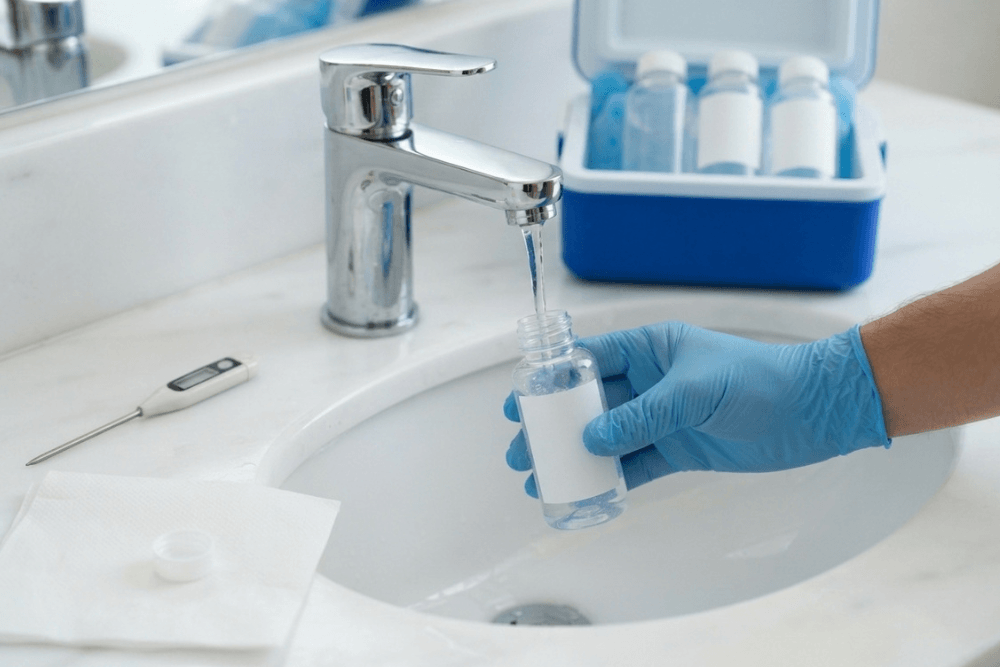
Water testing for Legionella control means taking samples from the points the risk assessment identifies, usually tanks, water heaters, and the nearest and furthest outlets on each branch, and having them analysed by an accredited laboratory. We take the samples and on-site readings; the laboratory runs the analysis and issues the results.
| Test | What it shows | Notes |
|---|---|---|
| Legionella | The bacteria that cause Legionnaires’ disease | The DM guideline sets a limit of 1,000 cfu per litre; culture results usually take about a week or more |
| Total bacteria count | General bacterial level in the water | DM’s guideline treats overall bacterial levels as a more effective monitoring tool than Legionella results alone |
| Coliforms and E. coli | Signs of contamination entering the system | Should be absent from drinking water |
| Pseudomonas aeruginosa | A bacterium that thrives in warm, wet fittings | Useful for pools, spa pools and some commercial premises |
| On-site readings | Temperature, free chlorine, pH | Taken at every sampling point; low chlorine and warm water together point to where bacteria will grow |
Legionella
- What it shows
- The bacteria that cause Legionnaires’ disease
- Notes
- The DM guideline sets a limit of 1,000 cfu per litre; culture results usually take about a week or more
Total bacteria count
- What it shows
- General bacterial level in the water
- Notes
- DM’s guideline treats overall bacterial levels as a more effective monitoring tool than Legionella results alone
Coliforms and E. coli
- What it shows
- Signs of contamination entering the system
- Notes
- Should be absent from drinking water
Pseudomonas aeruginosa
- What it shows
- A bacterium that thrives in warm, wet fittings
- Notes
- Useful for pools, spa pools and some commercial premises
On-site readings
- What it shows
- Temperature, free chlorine, pH
- Notes
- Taken at every sampling point; low chlorine and warm water together point to where bacteria will grow
How the samples are taken
Samples go into sterile bottles containing a chemical that neutralises chlorine, so the disinfectant doesn’t keep killing bacteria on the way to the lab and hide the true count. At outlets, two kinds of sample answer two different questions. A first-draw sample, taken the moment the tap opens, shows the condition of the tap or shower itself. A sample taken after flushing shows the water arriving from the system. Samples are kept cool, labelled with the point, time and temperature, and delivered to the laboratory with a record of who handled them.
How often
The risk assessment sets the routine frequency, and many building operators in Dubai sample quarterly. Some events call for sampling regardless of the schedule: a new or substantially altered water system, which Dubai Municipality’s drinking-water guideline also asks for; after disinfection, to confirm it worked; after a long shutdown, such as a school holiday or a closed hotel floor; after a positive result; and after any suspected case of illness linked to the premises.
Drinking-water testing
The same visit can include a drinking-water check on the tank and a kitchen tap. It answers a different question from a Legionella test, whether the water is fit to drink rather than whether the system is controlled, and it is a sensible check after a tank is cleaned or replaced. Our water tank cleaning service offers it as an add-on.
Reading Your Legionella Results
Dubai Municipality’s Legionella guideline sets a limit of 1,000 colony-forming units per litre. A result above that means the system needs action straight away. Results between 100 and 1,000 are within the Dubai limit but are treated as a warning under UK guidance, and are a reason to look closely at that part of the system.
| Result | What it means | What to do |
|---|---|---|
| Not detected, or below 100 cfu/L | Control is working | Keep monitoring on schedule |
| 100 to 1,000 cfu/L | Within the DM limit, but UK guidance treats this as a warning | Resample, check temperatures and flushing at that outlet and on that branch |
| Above 1,000 cfu/L | Exceeds the DM limit | Act now: review controls, clean and disinfect the affected part of the system, resample to confirm, record everything |
| High total bacteria, Legionella low | General hygiene slipping | An early warning; find the cause before Legionella follows |
| One outlet positive, others clear | A local problem | Usually a scaled showerhead, a dead leg or an unused outlet near that point |
| Several outlets or a tank positive | A system problem | Temperatures, tank condition or circulation across the building need attention |
Not detected, or below 100 cfu/L
- What it means
- Control is working
- What to do
- Keep monitoring on schedule
100 to 1,000 cfu/L
- What it means
- Within the DM limit, but UK guidance treats this as a warning
- What to do
- Resample, check temperatures and flushing at that outlet and on that branch
Above 1,000 cfu/L
- What it means
- Exceeds the DM limit
- What to do
- Act now: review controls, clean and disinfect the affected part of the system, resample to confirm, record everything
High total bacteria, Legionella low
- What it means
- General hygiene slipping
- What to do
- An early warning; find the cause before Legionella follows
One outlet positive, others clear
- What it means
- A local problem
- What to do
- Usually a scaled showerhead, a dead leg or an unused outlet near that point
Several outlets or a tank positive
- What it means
- A system problem
- What to do
- Temperatures, tank condition or circulation across the building need attention
After a positive result
Disinfection alone doesn’t fix a positive result; it resets the count while the cause stays in place. The order matters: find why the bacteria grew there (usually temperature, stagnation or a dirty tank), correct it, disinfect the affected part of the system, and resample to show control is back. Disinfection is done chemically, with chlorine at a raised concentration, or thermally, by raising the hot water temperature and running each outlet. For drinking-water tanks, Dubai Municipality’s guideline sets 50 mg/L of chlorine for disinfection.
Keep every result, including the good ones, in the logbook. A run of clean results is your evidence that the controls work; a single result on its own proves very little either way.
Cooling Towers, Water Features and Pools
Any system that turns water into spray belongs in the risk assessment, not only the taps and showers. Cooling towers, fountains, spa pools and misting fans each have their own controls, and Dubai Municipality sets bacteria limits for cooling water systems specifically. We assess and sample all of them as part of the same survey.
| System | What we assess | Why it matters |
|---|---|---|
| Cooling towers and evaporative condensers | Drift eliminators, water treatment and dosing records, cleaning and disinfection history, sampling for Legionella and aerobic bacteria | DM limits: Legionella 1,000 cfu/L; aerobic bacteria 10,000 cfu/ml |
| Fountains and water features | Spray and splash zones, filtration, disinfection, how often water is changed and the basin cleaned | Features that make spray must be kept clean and tested under DM guidance |
| Spa pools, jacuzzis and hot tubs | Water temperature, disinfectant levels, filtration and backwash routine, bather load, cover and surround cleaning | Warm, aerated and shared: the highest-risk water many buildings have |
| Swimming pools | Disinfectant and pH control, filtration, balance tanks, showers on the pool deck | Pool showers are often the risk point, not the pool itself |
| Misting and irrigation sprays | Where the supply comes from, how long water stands in the lines, when the system runs | Terrace misting fans can spray stale, warm water straight at people |
Cooling towers and evaporative condensers
- What we assess
- Drift eliminators, water treatment and dosing records, cleaning and disinfection history, sampling for Legionella and aerobic bacteria
- Why it matters
- DM limits: Legionella 1,000 cfu/L; aerobic bacteria 10,000 cfu/ml
Fountains and water features
- What we assess
- Spray and splash zones, filtration, disinfection, how often water is changed and the basin cleaned
- Why it matters
- Features that make spray must be kept clean and tested under DM guidance
Spa pools, jacuzzis and hot tubs
- What we assess
- Water temperature, disinfectant levels, filtration and backwash routine, bather load, cover and surround cleaning
- Why it matters
- Warm, aerated and shared: the highest-risk water many buildings have
Swimming pools
- What we assess
- Disinfectant and pH control, filtration, balance tanks, showers on the pool deck
- Why it matters
- Pool showers are often the risk point, not the pool itself
Misting and irrigation sprays
- What we assess
- Where the supply comes from, how long water stands in the lines, when the system runs
- Why it matters
- Terrace misting fans can spray stale, warm water straight at people
Cooling towers
A cooling tower works by spraying warm water through moving air, which is exactly the combination Legionella exploits, and its drift can carry beyond the building. Control depends on a continuous water treatment programme, drift eliminators in good condition, and regular cleaning and disinfection with records to show it. The sampling results are read against DM’s limits of 1,000 cfu per litre for Legionella and 10,000 cfu per millilitre for aerobic bacteria.
Water features in public areas
Dubai Municipality’s safety requirements for water features in public areas ask for features that produce spray to be maintained and kept clean, for water to be tested according to DM’s technical guidelines, and for the owner or management to have an emergency plan for incidents. Decorative fountains in lobbies and malls are easy to forget in an assessment because nobody drinks from them, but people walk through their spray every day.
Spa pools
A spa pool keeps water warm, aerates it into a fine mist at the surface, and shares it between many people, so it needs tight control of disinfectant, filtration and cleaning between uses. In gyms and hotels, the spa pool is often among the highest-risk systems on the premises, and the report treats it that way.
From Report to Repair: The Plumbing Fixes
Almost every action in a Legionella risk assessment is plumbing work: changing water temperatures, removing pipework where water stands still, cleaning tanks and servicing outlets. Laboratories and consultancies write these actions down; we can also carry them out, and close each finding with a record of what was done.
| Finding | The fix |
|---|---|
| Rooftop tank too warm in summer | Insulate and shade the tank, keep it sized to daily use, add a chiller where the risk justifies it |
| Tank dirty or overdue for cleaning | Empty, clean and disinfect; repair lids and screens |
| Hot water stored below 60°C | Reset the heater, repair the thermostat, or replace an undersized heater |
| Hot water slow to arrive; cool return pipes | Install or repair recirculation and balance the loop |
| Dead legs | Cut the pipe back to the tee and cap it, so no still water is left behind |
| Outlets that are rarely used | Set a weekly flushing routine, or remove the outlet if it isn’t needed |
| Scaled showerheads and aerators | Descale and disinfect at least quarterly; replace heads that can’t be cleaned |
| Thermostatic mixing valves not serviced | Service or replace, and check the temperature at the outlet |
| Hot and cold pipes run together without insulation | Insulate both, so the cold pipe isn’t warmed by the hot one |
| Cooling towers and water features | Cleaning, disinfection and a water treatment programme, with records |
Rooftop tank too warm in summer
- The fix
- Insulate and shade the tank, keep it sized to daily use, add a chiller where the risk justifies it
Tank dirty or overdue for cleaning
- The fix
- Empty, clean and disinfect; repair lids and screens
Hot water stored below 60°C
- The fix
- Reset the heater, repair the thermostat, or replace an undersized heater
Hot water slow to arrive; cool return pipes
- The fix
- Install or repair recirculation and balance the loop
Dead legs
- The fix
- Cut the pipe back to the tee and cap it, so no still water is left behind
Outlets that are rarely used
- The fix
- Set a weekly flushing routine, or remove the outlet if it isn’t needed
Scaled showerheads and aerators
- The fix
- Descale and disinfect at least quarterly; replace heads that can’t be cleaned
Thermostatic mixing valves not serviced
- The fix
- Service or replace, and check the temperature at the outlet
Hot and cold pipes run together without insulation
- The fix
- Insulate both, so the cold pipe isn’t warmed by the hot one
Cooling towers and water features
- The fix
- Cleaning, disinfection and a water treatment programme, with records
Assessment and repairs kept separate
An assessor who also profits from the repairs has an obvious conflict of interest, and UK practice expects assessors to be independent of the remedial work they recommend. So the assessment report never includes a repair price. If you want us to carry out the work, we quote it separately after the report is issued, and you are free to use any contractor you choose. Either way, we resample once the work is done so you can see that it worked.
Villas: Summer Travel, Empty Homes and Vulnerable Residents
Private villas aren’t in the scope of Dubai Municipality’s Legionella guideline, but one very Dubai situation creates real risk: the house left empty for weeks in summer. Water sits warm in the rooftop tank and pipes while its chlorine fades, and the first shower after landing sends that water into the air of a closed bathroom.
When you come back after weeks away
- 1Turn the water heater back on and let it heat fully before anyone showers; if it has a temperature setting, make sure it is at 60°C.
- 2Open a window and run each cold tap until the water runs as cool as it gets, then each hot tap until it runs fully hot. Start with the tap nearest the tank and work outwards.
- 3Run each shower the same way, with the bathroom door closed behind you and without standing under the spray, so you aren’t breathing in the first water out.
- 4Don’t forget the outside tap, the laundry, the maid’s room and guest bathrooms.
- 5If the house was empty for several weeks in summer, or anyone in the household is elderly or unwell, book a tank clean and a water test.
The same routine suits holiday homes between guests and any villa with a guest wing that stays closed for months. If you are planning a long absence, ask a neighbour or your maintenance company to run the taps and showers once a week while you are away.
For households with an elderly or seriously ill member, a one-off check makes sense even without a long absence: a tank clean, the heater set correctly, and a sample from the tank and the most-used shower tells you where you stand.
How Our Assessment and Testing Works
A Legionella risk assessment runs from collecting existing records to a written report with laboratory results and a control scheme. The survey and sampling are done in one visit for most premises; the report follows once the laboratory results are in.
- 1
Gather what exists
We collect drawings, previous assessments, the logbook, cleaning records and past results, so the survey starts from what is already known.
- 2
Survey every water system
Tanks, water heaters, pipework, outlets, mixing valves, and any cooling towers, water features, pools or spa pools are inspected and mapped on a schematic.
- 3
Take temperature readings
Temperatures are measured at tanks, heaters, return pipes and the nearest and furthest outlets on each branch, to show where control holds and where it doesn't.
- 4
Take samples
Samples are taken at the points the survey identifies, in sterile bottles, with on-site temperature, chlorine and pH readings, and sent to an accredited laboratory with a handling record.
- 5
Write the assessment
You receive the risk rating for each system with the reasons, the schematic, the sampling point layout, a control scheme stating what is checked, how often and by whom, and log sheets.
- 6
Report the results
Laboratory results are added to the report with what each result means and which actions are urgent.
- 7
Quote repairs separately
If you want us to carry out the remedial work, we quote it separately from the assessment. You are free to use any contractor.
- 8
Monitor and review
On a monitoring contract we carry out the scheduled checks, keep the logbook current, and review the assessment when the system changes or results slip.
Legionella Monitoring Contracts
A risk assessment is only useful if the checks it sets are carried out. On a monitoring contract we carry out the routine checks, keep the logbook ready for inspection, and flag anything drifting out of range before it becomes a failed result.
| Frequency | Check |
|---|---|
| Monthly | Temperatures at tanks, heaters, returns and sentinel outlets recorded in the logbook |
| Weekly (by site staff, checked by us) | Flushing of unused outlets and unoccupied rooms |
| Quarterly | Showerheads and taps cleaned and disinfected; sampling as set by the assessment |
| Twice a year | Drinking-water tanks cleaned and disinfected |
| On any change | Assessment reviewed after new equipment, renovations or a change of use |
Monthly
- Check
- Temperatures at tanks, heaters, returns and sentinel outlets recorded in the logbook
Weekly (by site staff, checked by us)
- Check
- Flushing of unused outlets and unoccupied rooms
Quarterly
- Check
- Showerheads and taps cleaned and disinfected; sampling as set by the assessment
Twice a year
- Check
- Drinking-water tanks cleaned and disinfected
On any change
- Check
- Assessment reviewed after new equipment, renovations or a change of use
The exact schedule comes from your assessment; a staff accommodation block with warm tanks needs closer attention than an office with little hot water use. Buildings on a contract can combine the visits with tank cleaning, so the building is disturbed less often.
Legionella Testing and Risk Assessment Prices
Legionella testing costs AED 150 to 350 per sample, analysed by an accredited laboratory. Risk assessments and monitoring contracts are quoted after a survey, because the price depends on the size of the premises, the number of water systems and how many sampling points the assessment needs.
| Service | Price |
|---|---|
| Laboratory test, per sample (Legionella or total bacteria count) | AED 150 – 350 |
| Legionella risk assessment | Quoted after survey |
| Monitoring contract (temperatures, sampling, logbook) | Quoted after survey |
| Remedial plumbing work | Quoted separately after the report |
Laboratory test, per sample (Legionella or total bacteria count)
- Price
- AED 150 – 350
Legionella risk assessment
- Price
- Quoted after survey
Monitoring contract (temperatures, sampling, logbook)
- Price
- Quoted after survey
Remedial plumbing work
- Price
- Quoted separately after the report
When comparing quotes, ask how many outlets will be surveyed, how many samples are included and from where, whether cooling towers, features and pools are covered, and what the report contains. A low price that samples two taps in a forty-apartment building doesn’t tell you much about the building.
Legionella Risk Assessment FAQ
Is a Legionella risk assessment a legal requirement in Dubai?
Does my villa need a Legionella risk assessment?
How much does Legionella testing cost in Dubai?
How long do Legionella test results take?
What is the acceptable Legionella level in Dubai?
How often should water be tested for Legionella?
Can you catch Legionnaires' disease from drinking water?
What temperature kills Legionella?
If you do the assessment, will you also do the repairs?
Do you assess cooling towers, fountains and pools?
What should I do when I return to a villa that has been empty?
How often should a Legionella risk assessment be reviewed?
Know Your Water System Before an Inspector Does
Tell us the type of building, the number of units or rooms, and whether it has cooling towers, pools or water features. We’ll scope the assessment and sampling and send you a quote.
Legionella assessments across Dubai, including: