Roof & Ceiling Leak Detection Dubai
A ceiling stain is a symptom. The leak that caused it is almost never directly above where the stain appears. Water entering a flat roof through a membrane breach flows horizontally along the underside of the waterproof layer until it finds a path downward.
By the time a stain is visible inside a room, the water entry point on the roof may be two, three, or even five metres away. This is exactly why patching the roof directly above a ceiling stain so rarely fixes the problem permanently.
2-8m
Typical stain-to-entry distance
4
Detection methods available
All
Flat roof membrane types
Why Flat Roof Membranes Fail So Quickly in Dubai
Most roofing professionals working in the UAE will tell you the climate here is harder on flat roof membranes than almost anywhere else. UV intensity in Dubai is consistently high throughout the year. Membrane materials rated for twenty years in a northern European climate show meaningful degradation in under ten years in Dubai from UV exposure alone.
Add the thermal cycling. A flat roof surface in Dubai can reach sixty degrees Celsius on a summer afternoon and drop to fifteen at night in January. That daily and seasonal temperature range causes the membrane material to expand, contract, and flex continuously, fatiguing lap joints, stressing sealant details around penetrations, and opening cracks along parapet wall edges.
Most Dubai buildings have flat roof membranes installed when the building was constructed and never systematically surveyed since. By the time a ceiling stain prompts a call, the membrane may have been failing for a season or two already.
A ceiling stain that appears or worsens during or after rainfall
A stain that reappears in the same location after painting over
Water dripping from a ceiling during or after heavy rain
Damp patches on the top section of internal walls near the roof edge
Mould appearing on ceiling corners near parapet walls
Stain position that has shifted between rain events
A ceiling stain after previous roof patching attempts
Plumbing Sources vs. Roof Sources: Getting the Diagnosis Right
Not every ceiling stain comes from a roof fault. Before a roof membrane survey is carried out, we establish whether the water source is the roof or a plumbing fault above the ceiling. A roof source typically produces a stain that appears or worsens during or after rainfall. A plumbing source, a leaking supply pipe or drain above the ceiling, produces a stain independent of weather conditions. Getting this distinction right at the start saves unnecessary survey work.
Detection Methods for Roof and Ceiling Leaks
Electronic Leak Detection on Flat Roof Membranes
The most accurate available method for locating breaches in waterproof membranes on flat roofs. A low-voltage electrical current is applied uniformly across the roof deck surface. The membrane itself doesn't conduct electricity. Where the membrane is breached and moisture is present at or near the deck surface, conductivity increases sharply, identifying the breach location precisely. This works on all flat roof membrane types: modified bitumen, single-ply TPO, PVC and EPDM, and liquid-applied polyurethane systems.
Thermal Imaging
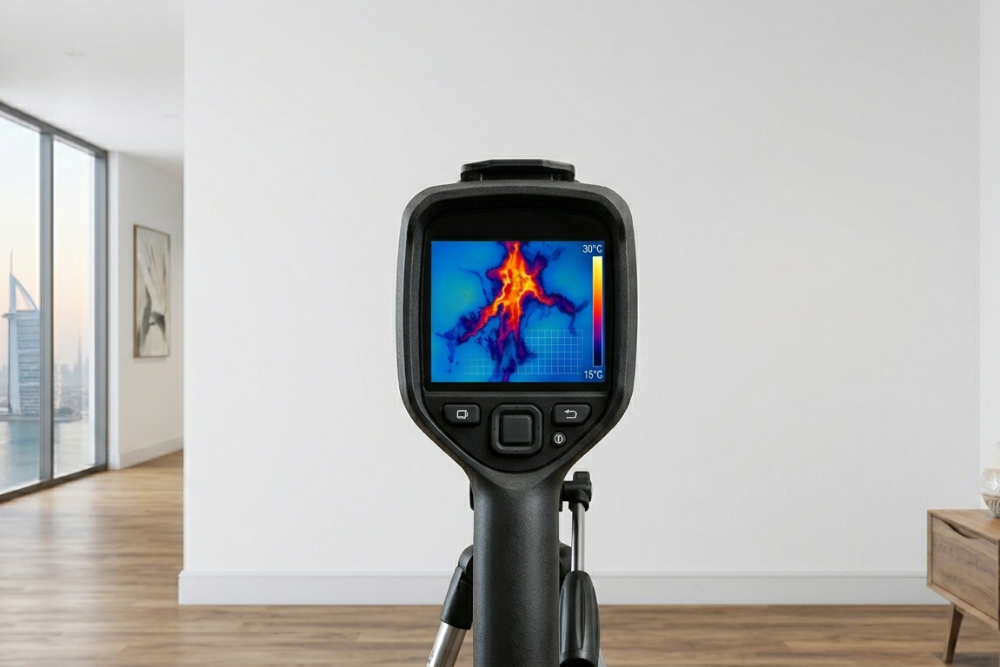
Thermal imaging cameras detect the temperature difference between dry and moisture-saturated materials. After rainfall or roof washing, moisture-saturated areas of the roof build-up retain heat differently from dry areas, producing a visible thermal contrast. Inside ceiling voids, thermal imaging maps the distribution of moisture, showing how water has travelled from the entry point to the visible stain location.
Moisture Meter Mapping
Moisture meters provide direct quantitative readings of moisture content in building materials. Taking readings at a systematic grid of points across the ceiling and upper wall surfaces produces a moisture map identifying zones of active wetting versus areas merely drying from historical events.
Flood Testing
For roof areas where electronic detection can't achieve a reliable result, green roof overlays or heavily ballasted surfaces, controlled flood testing is used. The roof area is temporarily bunded and flooded with water while the ceiling below is monitored for any response, confirming whether a specific roof area is the water source.
Roof Structure Types We Work With
The right membrane and detection approach depends on what's actually under it. A concrete flat roof and a warehouse's metal sheet roof need genuinely different treatment.
Flat Concrete Roofs
The standard for Dubai villas, apartments, and office buildings. Torch-applied modified bitumen and liquid-applied polyurethane systems both work well on concrete decks, with the choice usually coming down to existing membrane condition and whether a full recoat or targeted repair is the better fit.
Metal & Steel Sheet Roofs
Common on warehouses, factories, and industrial sheds, a different substrate entirely from concrete. EPDM rubber membranes and specific metal-roof coating systems are typically better suited here than bitumen products designed for concrete decks, since metal roofs move and expand differently under Dubai's heat.
Sandwich Panel Roofs
Insulated panel roofing used on some commercial and light industrial buildings has its own detail requirements at panel joints and fixings, points that need specific attention during both detection and repair since they behave differently from a continuous membrane surface.
Common Roof Leak Scenarios We Handle
Repeated Ceiling Stains After Previous Patching
The most frequent situation we encounter on roof leak calls is a property where the roof has already been patched once or twice without lasting resolution. The stain reappears after the next rainfall because the patch was applied at the wrong location, directly above the stain rather than at the actual membrane breach. Electronic detection identifies the real entry point, which may be several metres from where previous patches were applied.
Parapet Wall and Coping Failures
The coping detail at the top of a parapet wall takes the full force of Dubai's UV and thermal cycling. Sealant joints between coping units fail, coping tiles lift, and water enters the wall structure from above. From there it tracks down through the parapet, across the roof build-up, and into the building interior at a location often well away from the parapet itself.
HVAC Condensate Pooling
Rooftop HVAC condensers generate condensate during operation. Blocked or inadequately graded drainage allows condensate to pond on the roof surface around unit bases, continuously accelerating membrane degradation. We survey roof drainage as part of every commercial roof leak investigation.
Roof Membrane Repair Options
The electronic survey result determines which repair approach actually fits, from a single small patch to a broader membrane recoat, rather than a default answer applied regardless of what's found.
Localised Membrane Patch
For a single confirmed breach in an otherwise sound membrane, a targeted patch matched to the membrane type seals the specific fault without disturbing the surrounding area.
Coping & Parapet Resealing
Where the breach is at a coping joint or parapet detail, the sealant and flashing at that specific junction is renewed, addressing the actual failure point rather than the membrane field itself.
Penetration Detail Repair
HVAC units, pipe penetrations, and roof drains all have a sealed detail where they pass through the membrane. A failed detail here is repaired individually rather than assuming the whole membrane needs attention.
Section Overlay or Full Recoat
Where electronic detection reveals multiple breach points across a wider area, a section overlay or full membrane recoat may be the more durable answer, and we'll say so honestly rather than patching a membrane that's genuinely reaching the end of its service life.
Roof and Ceiling Leak Detection Process
A structured survey approach that moves from diagnosis to confirmed fault location without authorising any destructive work until the entry point is known.
Source diagnosis
The pattern of staining and its relationship to rainfall events is reviewed. The floor above the affected ceiling is checked for plumbing sources that might explain the leak independently of the roof, avoiding an expensive roof survey when the actual source is a supply pipe.
Ceiling void inspection
Where accessible, the ceiling void above the stained area is inspected directly. The direction of water flow, highest moisture concentration, and any visible structural water pathways are recorded, indicating the direction toward the actual entry point.
Thermal imaging survey
The roof surface and ceiling void are surveyed with a thermal camera. Moisture-saturated areas appear at a different temperature from dry surrounding materials, mapping moisture distribution and identifying the zone most likely to contain the breach.
Electronic membrane survey
The flat roof membrane is surveyed using electronic detection equipment, walking the roof systematically and identifying every point where conductivity indicates a breach. All fault locations are marked on the membrane surface.
Moisture meter grid
Readings are taken at a grid of points on the ceiling and upper walls, confirming the extent of moisture saturation in the materials below the entry point.
Written report
A full report documents the confirmed entry point locations, survey methods used, thermal images and moisture meter data, and recommended repair scope, suitable for insurance claims and contractor briefings.
Membrane repair
Roof membrane repairs at confirmed breach locations are carried out using materials appropriate to the membrane type. The repaired area is retested electronically after repair to confirm the breach is sealed.
Roof Leak Detection & Repair Cost
Roof survey pricing is based on roof area. Membrane repair costs depend on membrane type and the number of breach locations confirmed.
| Service | Typical Dubai Price Range |
|---|---|
| Electronic flat roof membrane survey (per 100m²) | AED 600 - 1,200 |
| Thermal imaging survey | AED 400 - 800 |
| Combined electronic + thermal survey | AED 800 - 1,800 |
| Moisture meter mapping (ceiling and walls) | AED 300 - 600 |
| Targeted membrane repair at confirmed location | AED 500 - 2,500 |
| Written survey report (insurance standard) | Included |
Electronic flat roof membrane survey (per 100m²)
- Typical Dubai Price Range
- AED 600 - 1,200
Thermal imaging survey
- Typical Dubai Price Range
- AED 400 - 800
Combined electronic + thermal survey
- Typical Dubai Price Range
- AED 800 - 1,800
Moisture meter mapping (ceiling and walls)
- Typical Dubai Price Range
- AED 300 - 600
Targeted membrane repair at confirmed location
- Typical Dubai Price Range
- AED 500 - 2,500
Written survey report (insurance standard)
- Typical Dubai Price Range
- Included
Benefits of Electronic Roof Leak Detection
Finds the real entry point
Electronic detection identifies the membrane breach directly on the roof surface, not by working backward from the stain inside, which is almost never directly below the entry point.
No membrane strip-out
Targeted repair at the confirmed breach location avoids costly large-scale membrane replacement on sections that are still sound.
All membrane types
Electronic detection works on all flat roof membrane types used in Dubai: modified bitumen, single-ply, liquid-applied, and green roof systems.
Insurance-grade documentation
Written survey report with thermal images and moisture meter data suitable for insurance claims and building maintenance records.
Stops repeated patching failures
Patching the wrong area because the stain and entry point are in different locations is the most common cause of repeated roof repair failures. Electronic detection ends the cycle.
Prevents structural deterioration
Continuous water ingress through a roof membrane causes concrete degradation and steel reinforcement corrosion over time. Early detection prevents these structural consequences.
Why Choose Quick Fix Dubai for Roof Leak Detection
From single-storey villas to full-floor commercial units and hotel rooftop areas, the survey methodology is the same regardless of scale: find the entry point accurately before opening anything.
Electronic detection specialists
Electronic membrane detection is a specialist technique. Our team is trained and experienced on all flat roof membrane types common in Dubai construction.
Thermal imaging included
Thermal imaging is included on all roof leak surveys. It maps moisture distribution in the ceiling void and helps understand how far water has spread from the entry point.
Stops the repeat patching cycle
For properties that have been through multiple failed patch attempts, electronic detection identifies the actual breach point so the repair is finally in the right place.
Residential and commercial
Villa roofs, commercial flat roofs, hotel rooftop areas, school buildings, and retail centre roofs across Dubai.
Insurance-grade reports
Written survey reports prepared to the standard required by insurance adjusters and building management teams, including thermal images and moisture meter data.
Emergency response available
For active water ingress causing damage to occupied spaces, same-day emergency surveys are available.
Roof & Ceiling Leak Detection Across Dubai
Villas, commercial flat roofs, hotel rooftop areas, and school buildings across every area of Dubai.
Roof & Ceiling Leak Detection FAQ
The ceiling stain appears every time it rains. Is it definitely a roof leak?
How far can the water entry point be from the ceiling stain?
Can you detect leaks under green roof systems and planted terraces?
How quickly after rainfall can you do the survey?
We've had the roof patched twice and the leak keeps coming back. What should we do?
Can a roof leak cause structural damage to the building?
Does the roof need to be cleared of equipment for the survey?
What repair options are available once a roof membrane breach is confirmed?
How do I know if my roof needs a full recoat rather than a patch repair?
Can roof repair work be done without disrupting building operations below?
Do you survey metal or warehouse roofs, or only concrete villa roofs?
Does the type of roof structure affect which detection method you use?
Find the Real Entry Point, Not Just Where the Stain Appears
Patching above a ceiling stain without knowing where the water actually entered the building isn't a roof repair, it's a delay. Our electronic detection finds the breach location directly on the membrane surface, so the repair resolves the problem rather than postponing it.
Licensed & insured. All areas of Dubai.