Plumbing Snagging Inspection in Dubai: Test It Before You Sign
A plumbing snagging inspection tests every tap, drain, toilet, water heater and concealed pipe in a new Dubai property before you accept handover, then records each defect in a report the developer's contractor can act on. For jointly owned property, Dubai law keeps plumbing defects with the developer for one year from handover.
Most snagging companies cover the whole unit, and plumbing becomes one line on a long list. We only inspect plumbing and drainage, with the water running under load for long enough that slow faults show up. Want the full-unit snag too? Book both: a general inspector for finishes and joinery, and us for the systems that cause water damage.
11
Plumbing tests per property
1 yr
Developer liability for sanitary installations
AED 250+
Fixed price, confirmed before booking
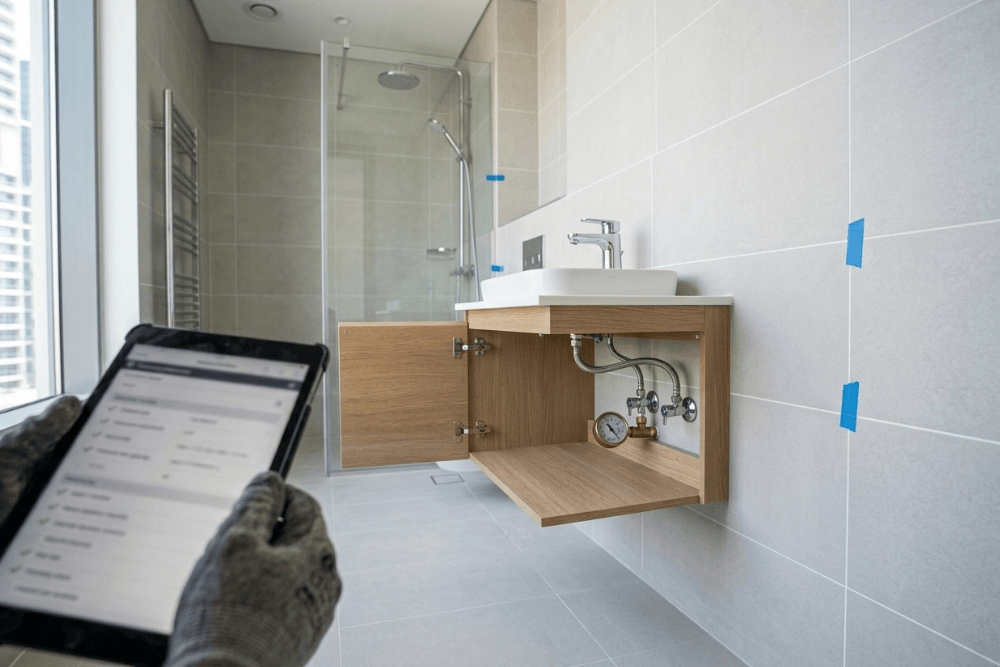
What a Plumbing Snagging Inspection Covers (and What It Doesn't)
A plumbing snagging inspection is a functional test of a property's water supply, hot water, drainage and sanitary fittings, carried out before or at handover. Every defect is recorded with its location, a photo and the repair the developer owes you. It covers less ground than a full property snag, but it goes much deeper on the systems that leak.
Snagging started as a finishing check: walk through the unit and list whatever looks wrong. That works for paint and doors, because those defects are visible. Plumbing defects are mostly invisible in an empty unit. A pipe joint inside a wall holds until pressure has sat on it for a few hours. A shower floor looks level until water runs across it. A drain looks clear until the grout slurry the tilers washed down it settles at the first bend.
What we test
- Cold and hot water supply at every outlet, including guest WCs, laundry and garden taps
- Water heater installation, isolation valves and relief valve discharge
- Concealed pipework, using a pressure hold and a water meter test
- Drains, traps, floor gullies and the fall of shower and wet-room floors
- Toilets, concealed cisterns and pan connections
- Moisture around showers, baths and vanity units after a timed run
- AC condensate drain connections and balcony or terrace drains
- Villa plant: water tanks, float valves, booster pumps and inspection chambers
Not part of this inspection
- Paint, plaster and general tiling finish (grout gaps and silicone at wet areas are in scope)
- Doors, windows, wardrobes and kitchen joinery
- Sockets, lighting and the distribution board
- AC cooling performance
- Structural cracks and façade defects
We say this upfront because it changes who you hire. If you're taking handover of a three-bedroom apartment and want one report that covers everything, a full snagging company is the right choice. Where we fit is alongside that company as the plumbing specialist, or on our own when plumbing is the main worry: a villa with tanks and pumps, a unit where a neighbour has already reported leaks, or an investor unit you'll never live in yourself.
Why Plumbing Snags Cost More Than Cosmetic Ones
Plumbing defects cost more than cosmetic snags because water spreads before anyone sees it. A scratched door stays a scratched door. A weeping joint behind a bathroom wall soaks the blockwork, lifts the skirting and stains the ceiling below. Once the one-year liability period closes, that repair is your bill, not the developer's.
The damage travels
In an apartment, a leak often shows up in the unit below first. That means your neighbour is the first to notice, and the argument over whose pipe it is starts after the damage is done. Our guide to why water leaks through Dubai ceilings shows how far water moves before it appears.
Access means breaking things
Supply pipes in Dubai apartments run through blockwork and under screed. Fixing a failed fitting means cutting tiles that may be discontinued by the time the leak appears. At snagging stage, the contractor still has the tile batch and the tilers on site.
The clock is short
Structural defects get ten years. Plumbing installations get one. Many plumbing faults need months of daily use to show: a drain that slowly builds up, a cistern valve that starts passing. Nobody tests properly at handover or checks again before month twelve? Those faults fall outside the window.
The cheapest moment to fix any plumbing defect in a new building is before the contractor leaves site. Every week after that, the repair gets harder to arrange and easier to dispute.
The Plumbing Snagging Checklist: 11 Tests We Run
Our plumbing snagging checklist runs 11 tests across supply, hot water, concealed pipework, drainage, sanitary fittings and villa plant. A quick look isn't enough: each test runs water under realistic load for a set time. Most plumbing defects in new Dubai properties only appear once pressure and flow have been on the system for a while.
| Test | What it catches | What a pass looks like |
|---|---|---|
| 1. Supply & flow at every outlet | Debris in aerators, partly closed valves, kinked hoses | Every outlet runs clear; matching fittings give matching flow |
| 2. Simultaneous-use test | Undersized branch pipes, pressure valve set too low, weak booster | Shower pressure holds when a second shower and the kitchen tap open |
| 3. Hot water & mixers | Reversed hot and cold, unstable mixer temperature, long waits | Hot on the left everywhere; temperature stays steady under demand |
| 4. Water heater installation | Relief valve with no discharge route, seized valves, no drip tray | Relief valve piped to a drain; valves turn; unit secure and reachable |
| 5. Pressure hold & meter test | Weeping joints inside walls and under screed | No gauge drop over the hold; meter still with every outlet closed |
| 6. Drain flow & fall | Slow drains, back-falls, ponding shower floors | Water clears with no standing puddles and no gurgling nearby |
| 7. Traps, gullies & smells | Missing or shallow traps, venting faults | Trap seals hold while other fixtures drain; no sewer smell |
| 8. Toilets & concealed cisterns | Passing fill valves, leaking pan connectors, no service access | Cistern refills and stops; dry base; valves reachable through the plate |
| 9. Wet-area moisture | Leaks at shower valves, tray edges and bath wastes | No rising moisture on nearby walls or ceilings after a timed run |
| 10. Drain CCTV | Grout slurry, cement and debris left by construction | Clear bore through to the inspection chamber |
| 11. External drains, condensate & villa plant | Blocked balcony drains, untrapped AC lines, float valves, pump cycling | Outlets clear; condensate trapped; tank stops filling; pump holds pressure |
1. Supply & flow at every outlet
- What it catches
- Debris in aerators, partly closed valves, kinked hoses
- What a pass looks like
- Every outlet runs clear; matching fittings give matching flow
2. Simultaneous-use test
- What it catches
- Undersized branch pipes, pressure valve set too low, weak booster
- What a pass looks like
- Shower pressure holds when a second shower and the kitchen tap open
3. Hot water & mixers
- What it catches
- Reversed hot and cold, unstable mixer temperature, long waits
- What a pass looks like
- Hot on the left everywhere; temperature stays steady under demand
4. Water heater installation
- What it catches
- Relief valve with no discharge route, seized valves, no drip tray
- What a pass looks like
- Relief valve piped to a drain; valves turn; unit secure and reachable
5. Pressure hold & meter test
- What it catches
- Weeping joints inside walls and under screed
- What a pass looks like
- No gauge drop over the hold; meter still with every outlet closed
6. Drain flow & fall
- What it catches
- Slow drains, back-falls, ponding shower floors
- What a pass looks like
- Water clears with no standing puddles and no gurgling nearby
7. Traps, gullies & smells
- What it catches
- Missing or shallow traps, venting faults
- What a pass looks like
- Trap seals hold while other fixtures drain; no sewer smell
8. Toilets & concealed cisterns
- What it catches
- Passing fill valves, leaking pan connectors, no service access
- What a pass looks like
- Cistern refills and stops; dry base; valves reachable through the plate
9. Wet-area moisture
- What it catches
- Leaks at shower valves, tray edges and bath wastes
- What a pass looks like
- No rising moisture on nearby walls or ceilings after a timed run
10. Drain CCTV
- What it catches
- Grout slurry, cement and debris left by construction
- What a pass looks like
- Clear bore through to the inspection chamber
11. External drains, condensate & villa plant
- What it catches
- Blocked balcony drains, untrapped AC lines, float valves, pump cycling
- What a pass looks like
- Outlets clear; condensate trapped; tank stops filling; pump holds pressure
1. Supply and flow at every outlet
We open every outlet in the property, including the ones owners forget: the guest WC basin, the maid's room, the laundry tap and a villa's garden taps. The first minute of flow shows whether debris is present. New systems often carry pipe shavings, sand and fitting debris, which lodge in aerators and cartridge screens.
After that, we compare flow between like-for-like fittings with a timed fill. Two basins in the same bathroom should fill a jug in roughly the same time. When one takes noticeably longer, the cause is usually a partly closed isolation valve, a kinked flexible hose behind the vanity, or a blocked cartridge filter. The contractor can fix any of these in minutes now; later, you'd pay a callout. For how pressure problems are traced after handover, see our page on diagnosing low water pressure.
2. Simultaneous-use test
A single tap tells you very little about how the home will behave at 7am. We open the master shower, then a second shower, then the kitchen tap, and watch what happens to the first. A sharp drop points to three likely causes: undersized branch pipework, a pressure-reducing valve set too low for that floor, or, in a villa, a booster pump that can't keep up.
In towers, pressure depends on the floor and on which pressure zone your unit sits in. A reading that's normal on the 30th floor can be a defect on the 12th. We record the actual result, so the developer's MEP team has something specific to check against their design rather than a note that just says “low pressure”.
3. Hot water, mixers and hot/cold orientation
Every mixer gets tested for three things:
- Hot is on the left.
- The temperature stays stable when another part of the house draws water.
- Hot water arrives without a long wait.
Reversed feeds show up on new builds more often than you'd expect. They matter most on thermostatic shower valves, which may not regulate properly, or safely, if the supplies are swapped.
A long wait for hot water in a far bathroom usually comes down to where the heater sits and how long the pipe run is. In a large villa, that can be a design point that calls for a hot water recirculation pump rather than a defect, and our report says which it is.
4. Water heater installation
We check the heater as an installation, not as an appliance. Four points matter:
- The pressure and temperature relief valve needs a safe discharge route, usually piped to a drain, not left open inside a false ceiling.
- Inlet isolation valves must turn.
- The unit must be fixed securely and reachable for service.
- A heater above a ceiling needs a drip tray with a drain, because a failed tank in that position empties into the room below.
We also note the thermostat setting; 55 to 60°C is the range we recommend for Dubai homes. Appliance faults such as a dead heating element go on the list too. Some of those fall under the manufacturer's warranty rather than the developer's liability, and we flag which is which. Our water heater installation page covers what a correct install looks like.
5. Concealed pipe pressure hold and meter test
This is the test that finds the leaks you'd otherwise discover a year later through the ceiling below. It has two parts:
- With every outlet closed, we watch the water meter. On a sealed system it shouldn't move.
- We isolate the concealed runs we can reach and hold them under pressure on a gauge for a set period.
A needle that creeps down means water is escaping somewhere between the valve and the outlets. That's usually at a fused joint or a threaded adapter behind a mixer. Found at snagging, the contractor opens the wall at their own cost.
In some towers the meter sits in a locked service room. If the building team can't open it, the pressure hold carries the result on its own. Where a drop shows but the location isn't obvious, we note it for the developer. We can also pinpoint it with non-invasive leak detection methods before anyone breaks a tile.
6. Drain flow and fall
Drains get tested with volume, not a splash. We fill basins and baths and release them together, and run showers for several minutes. We're watching for three things:
- Water that pools instead of running to the outlet.
- Drains that slow down once the pipe is full.
- Gurgling or bubbling from a nearby fitting, which usually points to a venting problem.
Shower trays and wet-room floors get extra attention. A floor that falls toward the door instead of the drain isn't cosmetic. It pushes water against the threshold and the edge of the waterproofing every day the shower is used.
7. Traps, floor gullies and smells
Every trap holds a small pool of water that blocks sewer gas. In a new unit left sealed through a Dubai summer, that water evaporates, which is why many handovers smell faintly of sewage. A dry trap that refills and stays full isn't a defect.
These are defects:
- A trap that loses its seal again when a nearby basin drains.
- A floor gully with no trap at all.
- A smell that persists once every trap is full.
We refill everything, drain fixtures in combination, and check again. Our article on why a Dubai home can smell of sewage explains the difference between a dry trap and a venting fault.
8. Toilets and concealed cisterns
Concealed cisterns are standard in Dubai new builds, and they're the hardest fitting to repair once the wall is tiled. We flush each toilet repeatedly and watch for a continuous trickle into the pan. We also check the base and the wall behind with dry tissue for seepage from the pan connector.
Then we confirm the cistern's isolation valve and fill valve can be reached through the flush-plate opening. If the plate has been fitted so the internals can't come out, every future repair means breaking tiles. That's worth writing down on day one. Our guide to toilets that run constantly covers the dye test you can repeat yourself later in the year.
9. Wet-area moisture checks
We can't see the waterproofing membrane under a finished floor, and any inspector who claims to is overstating what an inspection can do. What we can do is load the area with water and look for the consequences.
After a timed shower run, we check the surrounding surfaces with a moisture meter and a thermal camera: adjacent walls, skirting and the back of vanity units. Where access allows, we also check the ceiling of the room below or the unit's own false ceiling. A reading that rises next to a shower valve or bath waste is a specific, repairable finding, not a vague “possible waterproofing issue”.
10. Drain CCTV on main lines
Construction leaves debris in drains: tile adhesive, grout slurry washed down floor gullies, cement, off-cuts and packaging. It rarely causes a blockage on day one. Instead, it settles at bends and joints and catches whatever follows.
A camera run shows whether the line is clear and correctly jointed. On apartments, we survey what's accessible from within the unit. On villas, we run from the house to the boundary inspection chamber. The equipment and reporting are the same as our standalone CCTV drain survey.
11. External drains, AC condensate and villa plant
Balcony and terrace drains get a bucket test, because building debris often ends up in them. AC condensate lines should connect to the drainage system through a trap. An untrapped line can pull drain smells into the air handler, and a disconnected one drips inside the ceiling. Our AC condensate drain page explains the setup.
On villas, we add the plant:
- The tank's float valve must shut off before water reaches the overflow.
- Tank lids should seal.
- The booster pump should build pressure and then rest. If it cycles on and off with every outlet closed, that points to a leak or a pressure vessel fault.
- We lift inspection-chamber covers to check for debris and damaged benching.
New tanks also carry construction dust. We'll recommend tank cleaning and disinfection before the household drinks or bathes from it.
Plumbing Defects Common in New Dubai Handovers
The plumbing defects that come up most in new Dubai handovers are construction debris in drains, reversed hot and cold supplies, heater relief valves with nowhere to discharge, shower floors that fall the wrong way, and concealed cisterns fitted without service access. Each one is quick for the contractor to fix before handover and disruptive for you to fix after it.
| Defect | Why it matters | The fix to insist on |
|---|---|---|
| Grout or cement in drains | Slow drains and blockages months after move-in | Jetting plus a camera re-run to prove the line is clear, not a plunger |
| Reversed hot and cold feeds | Thermostatic valves can't regulate; scald risk | Re-pipe at the valve so hot is on the left, not a swapped handle |
| Relief valve with no discharge pipe | Heater releases hot water into the ceiling void | A proper discharge pipe run to a drain |
| Shower or wet floor falling away from the drain | Standing water at the threshold and the membrane edge | Re-lay to the correct fall, not a bead of silicone at the door |
| Concealed cistern without service access | Every future valve change means breaking tiles | Refit so the internals come out through the flush plate |
| Weeping joint behind a mixer | Damp wall, then mould, then tile failure | Open up, replace the fitting, pressure-test again in your presence |
| Seized or missing isolation valves under sinks | No way to stop a burst flexi hose without shutting off the whole unit | Working quarter-turn valves on every supply |
Grout or cement in drains
- Why it matters
- Slow drains and blockages months after move-in
- The fix to insist on
- Jetting plus a camera re-run to prove the line is clear, not a plunger
Reversed hot and cold feeds
- Why it matters
- Thermostatic valves can't regulate; scald risk
- The fix to insist on
- Re-pipe at the valve so hot is on the left, not a swapped handle
Relief valve with no discharge pipe
- Why it matters
- Heater releases hot water into the ceiling void
- The fix to insist on
- A proper discharge pipe run to a drain
Shower or wet floor falling away from the drain
- Why it matters
- Standing water at the threshold and the membrane edge
- The fix to insist on
- Re-lay to the correct fall, not a bead of silicone at the door
Concealed cistern without service access
- Why it matters
- Every future valve change means breaking tiles
- The fix to insist on
- Refit so the internals come out through the flush plate
Weeping joint behind a mixer
- Why it matters
- Damp wall, then mould, then tile failure
- The fix to insist on
- Open up, replace the fitting, pressure-test again in your presence
Seized or missing isolation valves under sinks
- Why it matters
- No way to stop a burst flexi hose without shutting off the whole unit
- The fix to insist on
- Working quarter-turn valves on every supply
The right-hand column matters as much as the list. The quickest way for a contractor to close a snag is often to hide it: silicone over a weeping joint, a swapped handle instead of swapped pipes, a drain rodded just enough to pass a jug of water. At the de-snag visit, we check how each item was fixed, not only whether it looks fixed.
A defect list also needs to be specific to be useful. “Bathroom leaking” gets a contractor to site with no idea what to bring. “Gauge drop on the hot supply to the master shower, moisture rising on the wall behind the valve” gets the right person, with the right parts, to the right wall.
The One-Year Plumbing Clock: What Dubai Law Gives You
Article 40 of Dubai Law No. 6 of 2019 covers jointly owned property. Under it, the developer must repair or replace defective installations for one year from the date your unit is handed over to you. The law says these installations include sanitary and sewerage installations. Structural defects carry a separate ten-year liability, counted from the project's completion certificate.
For plumbing, the one-year period is what matters. Four details are easy to get wrong:
It runs from your handover, not the building's completion
The completion-certificate date applies to structural defects, and some guides mix the two up. There is one exception: if an owner refuses to take possession, the one-year period is counted from the completion certificate instead.
Report in writing, inside the year
A defect you mention to site staff over the phone isn't evidence. Email the snag list to the developer's handover or customer-care team, keep the acknowledgement, and do the same for anything new that appears during the year.
Check your SPA for the terms that apply to you
Law No. 6 of 2019 covers jointly owned property, which includes apartments and many community villas. Some sale agreements give longer MEP cover than the legal minimum. A villa outside a jointly owned scheme may rely on its contract terms instead. Your SPA and handover documents tell you which applies.
Signing records the condition you accepted
Signing the handover form doesn't cancel the statutory period, but it does record what you accepted. A defect you could have spotted and didn't list is harder to argue later. If you have to sign before repairs are done, reference your snag list on the form.
Where each plumbing check fits in the handover year
| Moment | What happens | Your plumbing action |
|---|---|---|
| Handover notice | The developer opens the inspection window | Book the inspection; confirm water and power will be on |
| Inspection day | Snag list compiled | Submit it in writing before, or with, the acceptance form |
| Rectification | The contractor fixes the listed items | Ask how each item was fixed, not only whether it was |
| De-snag visit | Re-inspection of repaired items | Retest fixed items and repeat the pressure hold |
| Months 1 to 10 | Daily use of the property | Report anything new in writing as soon as it appears |
| Month 11 | Last full month inside the one-year period | Second inspection; send the final list before the year ends |
Handover notice
- What happens
- The developer opens the inspection window
- Your plumbing action
- Book the inspection; confirm water and power will be on
Inspection day
- What happens
- Snag list compiled
- Your plumbing action
- Submit it in writing before, or with, the acceptance form
Rectification
- What happens
- The contractor fixes the listed items
- Your plumbing action
- Ask how each item was fixed, not only whether it was
De-snag visit
- What happens
- Re-inspection of repaired items
- Your plumbing action
- Retest fixed items and repeat the pressure hold
Months 1 to 10
- What happens
- Daily use of the property
- Your plumbing action
- Report anything new in writing as soon as it appears
Month 11
- What happens
- Last full month inside the one-year period
- Your plumbing action
- Second inspection; send the final list before the year ends
This section summarises Article 40 of Law No. 6 of 2019 as published on the Government of Dubai legislation portal. It is general information, not legal advice. For a dispute with a developer, speak to a property lawyer or raise it with the Real Estate Regulatory Agency (RERA) at the Dubai Land Department.
When to Book: Before You Sign, After an Empty Summer, and Month 11
Book a plumbing snag between the developer's handover notice and the day you sign the acceptance form. Then book a second check around month 11, before the one-year liability for plumbing installations ends. For a unit that stood empty after handover, run the systems first, because a dry trap or stale heater water can look like a defect when it isn't one.
Before you sign
Confirm the water will be on
When you book the slot, ask the developer's handover team two things: will the water supply be live, and will the water heater and any pumps have power? Plumbing can't be tested dry. Some units at handover are on a temporary supply, or the DEWA connection hasn't been activated yet. That turns a plumbing inspection into a visual walkround.
If supply won't be available on your date, ask in writing for a slot when it will be. Allow a few hours for an apartment and longer for a villa with plant.
After an empty period
Run everything before judging smells
A unit left empty for months after handover will have dry traps and stale water sitting in the tank and heater. Flush every outlet for several minutes and run the heater through a full cycle before deciding anything is wrong.
In a unit that's been empty, a smell of rotten eggs from the hot water usually comes from stagnant water in the heater, not a fault. Our guide to water that smells of rotten eggs explains why.
Month 11
Catch what only daily use reveals
Some faults need months of use to appear: a fill valve that starts passing, a drain that slows as a film builds on leftover debris, a heater thermostat that struggles through its first summer.
A check at month 11 leaves time to report in writing before the year closes. We repeat the meter test and pressure hold, run the drains under load again, and confirm every item from the first report stayed fixed.
Tenants and landlords of newly handed-over units benefit from the same inspection at move-in. It records the condition of the plumbing before anyone lives there, which settles most later arguments about who caused what.
What's in the Plumbing Snag Report
Each defect in the report gets five things:
- its location
- a photo
- the test that found it
- a severity rating
- a plain description of the correct repair
It's written so the developer's contractor can act on it without a site meeting. You receive it as a PDF you can email straight to the developer's customer-care team.
Example entry (illustrative)
Item: P-07 · Master bathroom, shower valve
Tests: 5 (pressure hold) and 9 (wet-area moisture)
Finding: Gauge dropped during the hold period. Moisture reading rising on the wall behind the valve after a timed shower run. Photos 23 to 25.
Severity: High (active leak inside a wet wall)
Required repair: Open the wall at the valve body, replace the failed fitting, pressure-test before re-tiling, and use tiles from the original batch.
High
Active leak, scald risk, or a sanitary fault that affects health.
Medium
Will cause damage or failure with normal use if left alone.
Low
A function or fitting issue with no damage risk.
When the developer reports the work complete, a de-snag visit retests every repaired item. We can quote it together with the first inspection, so you know the full cost before you book.
Plumbing Snagging vs. a Full Property Snagging Company
A full snagging company inspects everything in the unit, so plumbing gets a share of the visit. A plumbing snag spends the whole visit on water supply, hot water and drainage. Choose:
- a full snag if you want one report for the whole unit
- a plumbing snag if water systems are the main risk
- both if you want each part done in depth
| Full property snag | Plumbing snag (Quick Fix Dubai) | |
|---|---|---|
| Scope | The whole unit: finishes, joinery, electrical, AC and plumbing | Water supply, hot water, drainage, sanitary fittings and villa plant |
| How plumbing is checked | Usually visual plus basic function: run the tap, flush the toilet | Timed load tests, pressure hold, meter test, moisture mapping and CCTV |
| Who the report is written for | The developer's snagging team | The developer's MEP contractor, with the repair method stated |
| After the liability period | The inspector's role ends | We can carry out repairs the developer no longer owes |
| Best suited to | Apartments where you want one report for everything | Villas with tanks and pumps, units with leak history nearby, investor units |
Scope
- Full property snag
- The whole unit: finishes, joinery, electrical, AC and plumbing
- Plumbing snag (Quick Fix Dubai)
- Water supply, hot water, drainage, sanitary fittings and villa plant
How plumbing is checked
- Full property snag
- Usually visual plus basic function: run the tap, flush the toilet
- Plumbing snag (Quick Fix Dubai)
- Timed load tests, pressure hold, meter test, moisture mapping and CCTV
Who the report is written for
- Full property snag
- The developer's snagging team
- Plumbing snag (Quick Fix Dubai)
- The developer's MEP contractor, with the repair method stated
After the liability period
- Full property snag
- The inspector's role ends
- Plumbing snag (Quick Fix Dubai)
- We can carry out repairs the developer no longer owes
Best suited to
- Full property snag
- Apartments where you want one report for everything
- Plumbing snag (Quick Fix Dubai)
- Villas with tanks and pumps, units with leak history nearby, investor units
Resale and Older Properties: No Liability Period, More Reason to Test
On a resale property, the developer's one-year liability for plumbing has usually expired, so any defect you inherit is yours to fix. A plumbing inspection before you complete the purchase turns hidden problems into negotiating points. A leak found under test can be repaired by the seller or priced into the deal.
The tests are the same, with a different emphasis. Older Dubai units show age-related faults that new builds don't:
- corroded copper with pinhole leaks
- mineral scale narrowing older pipework
- heaters near the end of their service life
- drain lines with years of grease build-up
The age of the building is a good guide to what to expect, and our article on what your building's age says about its pipes walks through it by decade.
If you're renting rather than buying, our pre-move-in plumbing checklist covers the checks a tenant can do alone on key-collection day. If the only concern is the drainage on a purchase, a pre-purchase drain camera survey on its own may be enough.
Plumbing Snagging Inspection Cost in Dubai
Plumbing snagging inspection
AED 250 – 450
Fixed price confirmed before you book
A plumbing snagging inspection costs AED 250 to 450 in Dubai. Where your property sits in that range depends on three things, which we confirm before quoting:
- the property type and size
- whether it has villa plant such as tanks and pumps
- whether you want drain CCTV included
Send us your unit details and handover date by phone or WhatsApp. We'll confirm a fixed price before you book.
Apartment size
Bedroom and bathroom count. More wet areas mean more fittings to load-test and more concealed runs to pressure-hold.
Townhouse or villa plant
Tanks, float valves, booster pumps, external drainage, inspection chambers and garden taps all add time.
Drain CCTV
Optional on apartments, where access within the unit is limited. Recommended on villas, where the run to the boundary chamber is yours.
Follow-up visits
The de-snag re-inspection and a month-11 check can be quoted with the first visit, so the whole year is priced upfront.
Where We Carry Out Plumbing Snagging
We inspect across Dubai, including newer communities such as Arjan, DAMAC Hills and Town Square. These area pages carry local plumbing notes:
Plumbing Snagging Inspection FAQ
What is plumbing snagging?
How long does a developer have to fix plumbing defects in Dubai?
How much does a plumbing snagging inspection cost in Dubai?
Should I do the snagging inspection before or after signing the handover form?
Can you test the plumbing if the water isn't connected yet?
Do you inspect the whole property or only the plumbing?
How long does a plumbing snagging inspection take?
Is a month-11 plumbing inspection worth it?
Will you repair the defects you find?
Why does my new apartment smell of sewage at handover?
Book Your Plumbing Snag Before You Sign
Tell us the community, unit type and your handover date. We'll confirm the price, remind you to check the water will be on, and send the report in a format your developer can act on.