Water Tank Chiller Supply and Installation in Dubai
A water chiller for your water tank cools the stored water so the cold tap runs cold in July and August. We supply, install and service tank chillers for villas and buildings across Dubai, in cooling-only and heat-and-cool models, and we also supply fan-type tank coolers where a chiller is more than you need.
This page covers what temperature a chiller can realistically reach, how to size one to your tank, and what it adds to your DEWA bill, so you can decide before summer whether a chiller, a fan cooler or insulation is the right fix for your tank.
20°C
DM cold-water guideline
79 kWh
To cool 1,000 IG by 15°C
AED 275–515
2-ton unit, July electricity
Why Tank Water Gets So Hot, and What a Chiller Does
A rooftop water tank in Dubai sits in full sun on a roof that heats up far beyond the air temperature, and the water inside takes on that heat through the tank walls and lid. By July, stored tank water in the UAE routinely goes past 40°C, which is why the cold tap runs hot in the afternoon.
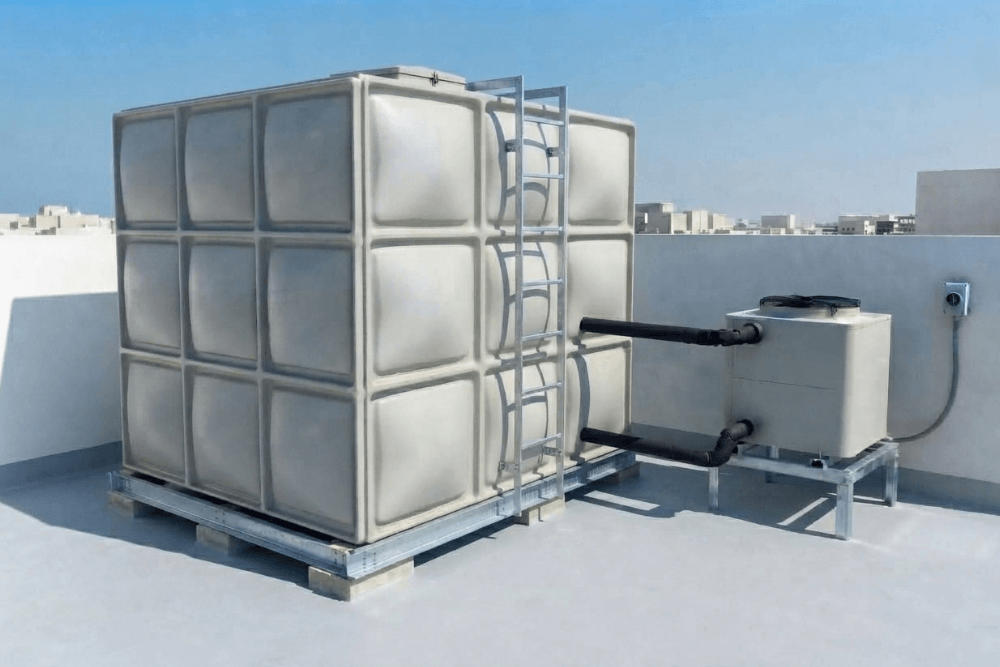
A tank chiller is a small refrigeration unit that sits beside the tank. A pump draws water from the tank, passes it through the chiller’s heat exchanger, and returns it a few degrees colder. A thermostat stops the unit when the tank reaches the temperature you set and starts it again as the tank warms. The heat taken out of the water is thrown off to the outside air by the unit’s fan, much like the outdoor unit of an air conditioner.
A chiller cools the water in the tank. It doesn’t cool the pipe between the tank and your taps, which on many villas runs across the open roof and holds enough water for the first seconds of every shower. Insulating that pipe, covered on our water tank installation page, is part of doing the job properly.
What Temperature Should a Water Tank Chiller Aim For?
For most Dubai villas, set a tank chiller to hold the water between 20°C and 25°C. That is cold enough to feel like cold water, and it keeps the tank below the temperature range where Legionella bacteria grow fastest. Going below 20°C, the figure in Dubai Municipality’s drinking-water guideline, is possible but costs noticeably more in electricity on an exposed roof.
| Tank temperature | What the guidance says | In practice |
|---|---|---|
| Below 20°C | Dubai Municipality’s guideline for storing and distributing cold drinking water; UK HSE guidance says Legionella stays dormant below this | Reachable, but a unit holding a rooftop tank here through July works hard and costs the most to run |
| 20°C to 25°C | US CDC guidance: Legionella can grow from 20°C and grows best from 25°C to 45°C | The practical target for most villas: cold enough to feel cold, and below the fastest-growth band |
| 25°C to 28°C | The range many domestic units are sold to hold | Comfortable showers at a lower running cost, but at the edge of the growth band |
| Above 40°C | Where exposed rooftop tank water routinely ends up in a UAE summer | Uncomfortable, and well inside the growth band, yet nowhere near hot enough to kill bacteria |
Below 20°C
- What the guidance says
- Dubai Municipality’s guideline for storing and distributing cold drinking water; UK HSE guidance says Legionella stays dormant below this
- In practice
- Reachable, but a unit holding a rooftop tank here through July works hard and costs the most to run
20°C to 25°C
- What the guidance says
- US CDC guidance: Legionella can grow from 20°C and grows best from 25°C to 45°C
- In practice
- The practical target for most villas: cold enough to feel cold, and below the fastest-growth band
25°C to 28°C
- What the guidance says
- The range many domestic units are sold to hold
- In practice
- Comfortable showers at a lower running cost, but at the edge of the growth band
Above 40°C
- What the guidance says
- Where exposed rooftop tank water routinely ends up in a UAE summer
- In practice
- Uncomfortable, and well inside the growth band, yet nowhere near hot enough to kill bacteria
Sources: DM technical guideline DM-HSD-GU17-DW2; UK HSE guidance on Legionella in hot and cold water systems; US CDC Legionella control toolkit.
A chiller helps hygiene, but doesn’t replace cleaning
Heat is one of three things that let bacteria build up in a tank; the others are still water and the film that forms on tank walls. A chiller deals with the first. Dubai Municipality still expects tanks to be cleaned and disinfected at least twice a year, and a chilled tank that is never cleaned is only a cooler dirty tank. Our water tank cleaning service can be scheduled around the chiller’s pre-summer service.
About the “below 25°C” rule
You may read online that Dubai Municipality requires cold water tanks to be kept below 25°C. The DM guideline we have checked gives 20°C as the figure for cold water storage and distribution. For homes it is guidance to aim for rather than a threshold anyone inspects; buildings, hotels and healthcare premises should check the requirements that apply to them.
Why not colder?
Every degree below the air temperature costs more to hold. Water held at 15°C while the air outside is 45°C is fighting a 30-degree difference all afternoon. For showers and washing, most people find 22°C to 25°C cold enough in August, and the running cost at that setting is far lower than at 18°C.
Chiller or Cheaper Fix? Comparing the Options
A tank chiller is the only option that makes rooftop tank water cold in a Dubai summer and keeps it there. Fan coolers, insulation and shade all reduce the heat, for far less money, but none of them brings the water below the outside temperature on a humid August afternoon. Most villas get the best result from insulation plus a correctly sized chiller.
| Option | What it does | Limits | Best for |
|---|---|---|---|
| Tank chiller | Holds the water at the temperature you set, typically 20°C to 28°C | Highest to buy and to run; needs power, roof space and a yearly service | Anyone who wants the cold tap to run cold through July and August |
| Fan-type tank cooler | Blows outside air through the space above the water, venting trapped hot air and cooling by evaporation | Low cost and low power; works least well on humid summer days | Smaller tanks, tighter budgets, and tanks that are already shaded |
| Insulated tank (PUF) | Slows the heat getting in; no running cost | Doesn’t cool water that is already warm | Every exposed tank, and any tank being replaced |
| Shade over the tank | Cuts direct sun on the lid and walls | Limited on its own | A cheap first step on any rooftop |
| Underground tank with a pump | Coolest passive storage | Needs a pump; the rooftop tank still heats up | Villas that already have one: draw on it more |
Tank chiller
- What it does
- Holds the water at the temperature you set, typically 20°C to 28°C
- Limits
- Highest to buy and to run; needs power, roof space and a yearly service
- Best for
- Anyone who wants the cold tap to run cold through July and August
Fan-type tank cooler
- What it does
- Blows outside air through the space above the water, venting trapped hot air and cooling by evaporation
- Limits
- Low cost and low power; works least well on humid summer days
- Best for
- Smaller tanks, tighter budgets, and tanks that are already shaded
Insulated tank (PUF)
- What it does
- Slows the heat getting in; no running cost
- Limits
- Doesn’t cool water that is already warm
- Best for
- Every exposed tank, and any tank being replaced
Shade over the tank
- What it does
- Cuts direct sun on the lid and walls
- Limits
- Limited on its own
- Best for
- A cheap first step on any rooftop
Underground tank with a pump
- What it does
- Coolest passive storage
- Limits
- Needs a pump; the rooftop tank still heats up
- Best for
- Villas that already have one: draw on it more
Fan-type tank coolers, fairly assessed
We supply fan coolers as well as chillers, and they have a place. A fan cooler is a small blower, often a couple of hundred watts, fitted to the tank so it pushes outside air through the space above the water. That does two things: it vents the air trapped under the lid, which can get far hotter than the air outside, and it evaporates a little water from the surface, which cools what is left.
Evaporation slows down as humidity rises, and Dubai’s summer humidity regularly passes 80%. So a fan cooler takes the edge off in the dry heat of early summer and on shaded tanks, but it won’t make the water cold in August. Because it moves outside air into a drinking-water tank, the air filter on the intake has to be kept clean and the tank opening screened, or dust and insects follow the air in.
Insulate first, then chill
Every watt of heat that insulation keeps out is a watt the chiller doesn’t have to remove. An insulated tank, shade and insulated rooftop pipes let a smaller chiller do the same job, run fewer hours and cost less on the DEWA bill. If your tank is due for replacement, specify an insulated GRP tank at the same time; our water tank installation page covers insulation thickness and what each option achieves.
How a Water Chiller for a Water Tank Works
A water tank chiller works like an air conditioner that cools water instead of air. It has four main parts: a compressor, a condenser coil with a fan that throws heat to the outside air, a heat exchanger where the tank water is cooled, and a circulation pump with a thermostat that decides when it all runs.
Two layouts
Most villa systems are external circulation units: the chiller sits on the roof beside the tank, and a pump moves water out of the tank, through the chiller and back. A few systems instead put a cooling coil inside the tank, connected to an outdoor unit. The external layout is easier to service because nothing inside the tank needs attention.
Where the water goes in and out
Cold water sinks and warm water rises, so a tank being chilled forms layers. The pipe that feeds your house leaves near the bottom of the tank, which is where the coldest water collects. The chiller should return its cooled water to that lower zone and draw from a point far enough away that it isn’t simply re-cooling its own return. Get this wrong and the chiller runs for hours while the house still gets warm water.
Heat-and-cool models
Some units can reverse the cycle and warm the tank in winter. In Dubai that is a small comfort benefit for a few weeks a year rather than a reason to choose a model; many households simply switch the chiller off from November to March. If you are choosing between otherwise similar units, the cooling performance at high outside temperatures matters far more.
Sizing a Tank Chiller: Tons, Litres and Cool-Down Time
Size a water tank chiller so it can bring a hot tank down to your set temperature overnight, in about eight to ten hours, with capacity left over for the heat the tank picks up during the day. One “ton” of cooling removes 3.5 kW of heat. Cooling water by 15°C takes about 17.4 kWh for every 1,000 litres.
Hours to cool a full tank by 15°C (for example, from 40°C to 25°C)
| Tank | Heat to remove | 1.5 ton | 2 ton | 3 ton | 5 ton |
|---|---|---|---|---|---|
| 500 IG (2,273 L) | 40 kWh | 7.5 h | 5.6 h | 3.8 h | 2.3 h |
| 1,000 IG (4,546 L) | 79 kWh | 15 h | 11.3 h | 7.5 h | 4.5 h |
| 2,000 IG (9,092 L) | 159 kWh | 30 h | 22.5 h | 15 h | 9 h |
| 3,000 IG (13,638 L) | 238 kWh | 45 h | 33.8 h | 22.5 h | 13.5 h |
500 IG (2,273 L)
- Heat to remove
- 40 kWh
- 1.5 ton
- 7.5 h
- 2 ton
- 5.6 h
- 3 ton
- 3.8 h
- 5 ton
- 2.3 h
1,000 IG (4,546 L)
- Heat to remove
- 79 kWh
- 1.5 ton
- 15 h
- 2 ton
- 11.3 h
- 3 ton
- 7.5 h
- 5 ton
- 4.5 h
2,000 IG (9,092 L)
- Heat to remove
- 159 kWh
- 1.5 ton
- 30 h
- 2 ton
- 22.5 h
- 3 ton
- 15 h
- 5 ton
- 9 h
3,000 IG (13,638 L)
- Heat to remove
- 238 kWh
- 1.5 ton
- 45 h
- 2 ton
- 33.8 h
- 3 ton
- 22.5 h
- 5 ton
- 13.5 h
Our calculation: litres × 4.186 kJ per kg per °C × 15°C, divided by the unit’s rated capacity (1 ton = 3.517 kW). Real units deliver somewhat less than their rating in extreme heat, so treat these as best-case times.
Reading the table
A chiller has two jobs. The first is the pull-down: cooling a tank that has been sitting in the sun. The second is holding: removing the heat that keeps coming in through the tank walls, plus the warm water that refills the tank every time you use some. An exposed tank in August gains heat all day, so a chiller that can only just manage the pull-down will fall behind by mid-afternoon.
On a 1,000-gallon tank, a 2-ton unit needs over 11 hours for the pull-down alone. A 3-ton unit does it in about seven and a half, which leaves room for the daytime load on an exposed tank. Insulate the tank and the holding load drops, and a 2-ton unit becomes reasonable. These are starting points; the survey decides.
Treat “up to 2,000 gallons” with care
Chillers are often sold as suitable for tanks “up to” a certain size. The table shows why that needs context: a 2-ton unit working flat out for a whole day can only just remove the heat needed to cool a hot 2,000-gallon tank by 15°C once, with nothing left for the day’s heat gain. It can keep an already cool, insulated tank of that size cool. It can’t rescue a hot, exposed one. Ask any supplier what temperature the unit will hold, on your tank, in August.
What we look at on the survey
Tank size and material, whether it is insulated or shaded, how much water the household uses a day (which sets how much warm water refills the tank), the temperature you want, the roof space and electrical supply, and whether there is an underground tank feeding the rooftop one. Those decide the capacity, not the tank size alone.
Water Tank Chiller Running Cost on Your DEWA Bill
A 2-ton tank chiller running 8 to 12 hours a day in July adds roughly 600 to 1,100 kWh to the month’s electricity, about AED 275 to 515 at DEWA’s top residential rate. The biggest levers on that figure are the temperature you set, whether the tank is insulated, and when the unit runs.
Worked example: 2-ton chiller in July
Electricity drawn: about 1.2–1.5 kW per ton in extreme heat = 2.4–3.0 kW
Running 8–12 hours a day × 31 days = 595–1,116 kWh
DEWA top slab 38 fils + 6 fils fuel surcharge = 44 fils, + 5% VAT
= about AED 275 to 515 for the month
The top slab applies because many villas already use more than 6,000 kWh a month in summer, so every extra kWh the chiller uses is billed at that rate. If your household stays in a lower slab, the cost is lower. The fuel surcharge changes monthly, so check the figure on your latest bill.
The electricity figure per ton is an estimate. One ton of cooling moves 3.5 kW of heat but needs only around 1.0 to 1.5 kW of electricity, and air-cooled units sit at the upper end of that in very high outdoor temperatures. Your unit’s data sheet gives its rating; ask for the figure at a high outdoor temperature, not only at standard test conditions.
How to bring the cost down
Set 24°C to 25°C, not 18°C. The smaller the gap between the tank and the outside air, the less heat leaks back in, and the fewer hours the unit runs.
Run it at night. A chiller works more efficiently when the outside air is cooler, and a full tank of cold water holds its temperature for hours. Letting the unit pull the tank down overnight and in the early morning, rather than fighting the 3 pm heat, costs less for the same result.
Insulate and shade the tank. Less heat coming in means fewer running hours, every day of the season.
Keep the condenser clean. Dust on the outdoor coil makes the unit work harder for the same cooling. Rooftop units in Dubai collect dust quickly, which is why the April service matters.
Installing a Tank Chiller on a Dubai Roof
A tank chiller installation needs a level base beside the tank, open air around the unit, two insulated pipes to the tank and a dedicated electrical circuit. The details that decide whether it works well are where the pipes join the tank, how well they are insulated, and where the unit sits relative to bedroom windows.
Pipes that don’t sweat
On a Dubai summer night at 35°C and 80% humidity, the dew point is about 31°C. Any pipe carrying water colder than that will run with condensation unless it is insulated, and that water drips onto the roof waterproofing day after day. Chilled pipework is fully insulated with a UV-resistant covering, joints included. The same insulation stops the cooled water warming up again on its way back to the tank.
Airflow and noise
The unit throws its heat into the air around it, so it needs open space on the fan side and can’t be boxed in or tucked against a parapet wall; a unit breathing its own hot air works harder and cools less. Its sound is similar to an air conditioner’s outdoor unit, so we place it away from your bedroom windows and your neighbours’. Some master communities have rules on visible rooftop equipment; check before installation.
Electrics
A chiller runs on its own circuit from the distribution board, with an isolator beside the unit so it can be switched off safely for servicing. It shouldn’t be plugged into an existing rooftop socket. Larger units may need a three-phase supply, which is worth confirming before choosing a model.
Base and weight
The unit sits on a frame or base that spreads its weight and keeps it clear of the roof covering, so rainwater can drain underneath and the waterproofing isn’t crushed. Access matters too: the unit has to get onto the roof, and larger ones may need a crane.
How We Install a Water Tank Chiller
A water tank chiller installation runs from a survey of the tank and roof to a commissioning check that records the temperature drop across the unit. The survey is the step that matters most, because it decides the size.
- 1
Survey the tank and roof
We record the tank's size, material, insulation and shade, the household's daily water use, the roof space and access, and the electrical supply, and note where the pipe from the tank to the house runs.
- 2
Recommend a unit
We size the chiller from the survey, not the tank size alone, and tell you what temperature it will hold in August. Where a fan cooler or insulation would do the job, we say so.
- 3
Prepare the base and power
The unit gets a level frame or base that spreads its weight and protects the roof covering, and a dedicated electrical circuit with an isolator beside the unit.
- 4
Make the tank connections
Suction and return connections are fitted to the tank with drinking-water-safe seals, positioned so cooled water reaches the zone the house draws from.
- 5
Mount, pipe and valve
The chiller and pump are mounted and piped with isolation valves and a strainer ahead of the heat exchanger, keeping the runs short.
- 6
Insulate the pipework
Every chilled pipe is insulated with UV-resistant insulation so it doesn't drip condensation onto the roof or gain heat on the way back to the tank.
- 7
Commission
The circuit is filled and bled of air, the thermostat set, and the temperature drop across the unit and its current draw measured and recorded.
- 8
Hand over
You get the settings, advice on running it overnight to save electricity, and the date of the first pre-summer service.
Servicing a Tank Chiller: the April Check
Service a water tank chiller once a year in April, before the heat arrives, and rinse the condenser coil after dusty spells in summer. A chiller that fails in July usually shows signs in April: a dirty coil, a pump strainer half blocked, or a unit drawing more current than when it was installed.
| When | What | How often |
|---|---|---|
| April, before the heat | Condenser coil cleaned, refrigerant pressures and current draw checked, pump strainer cleaned, thermostat and sensor checked, electrical connections tightened | Every year |
| After a dusty spell | Condenser coil rinsed | As needed in summer |
| Pipe insulation | Checked for sun damage and gaps that let pipes sweat | At the April service |
| October or November | Unit switched off, or changed to heating on heat-and-cool models | End of season |
| Tank cleaning | Tank emptied, cleaned and disinfected | At least twice a year (DM guideline) |
April, before the heat
- What
- Condenser coil cleaned, refrigerant pressures and current draw checked, pump strainer cleaned, thermostat and sensor checked, electrical connections tightened
- How often
- Every year
After a dusty spell
- What
- Condenser coil rinsed
- How often
- As needed in summer
Pipe insulation
- What
- Checked for sun damage and gaps that let pipes sweat
- How often
- At the April service
October or November
- What
- Unit switched off, or changed to heating on heat-and-cool models
- How often
- End of season
Tank cleaning
- What
- Tank emptied, cleaned and disinfected
- How often
- At least twice a year (DM guideline)
Booking the chiller service and a tank cleaning for the same visit means the tank is emptied only once, and the chiller starts the summer cooling clean water.
Chiller Running but the Water Still Warm?
When a tank chiller runs but the water stays warm, the cause is usually one of four things: the unit is too small for an exposed tank, its condenser coil is dirty, the pipework lets it re-cool its own water, or the warmth is coming from the pipe between the tank and the taps rather than from the tank itself. A thermometer in the tank and another at the tap usually tell you which.
| What you notice | Likely cause | What fixes it |
|---|---|---|
| Tank cold, but the tap still runs warm for a while | The pipe from the tank to the house sits in the sun | Insulate or reroute that pipe |
| Unit runs all afternoon and the tank never reaches the set point | Undersized for an exposed tank, or a set point far below the air temperature | Insulate and shade the tank, raise the set point to 24–25°C, or add capacity |
| Tank cools slowly even at night | Dirty condenser coil, or the unit breathing its own hot air | Clean the coil; clear space around the fan side |
| Water leaving the unit is cold but the tank stays warm | Return pipe too close to the suction, so the chiller re-cools its own water | Move the return towards the outlet zone of the tank |
| Flow through the unit has dropped | Pump strainer blocked with tank sediment | Clean the strainer; book a tank clean if it keeps blocking |
| Unit trips or stops on a fault code | High pressure from heat and dust, low refrigerant, or an electrical fault | Call for service; don’t keep resetting it |
| Water drips around the pipes on the roof | Condensation on chilled pipes with missing insulation | Replace the insulation, joints included |
Tank cold, but the tap still runs warm for a while
- Likely cause
- The pipe from the tank to the house sits in the sun
- What fixes it
- Insulate or reroute that pipe
Unit runs all afternoon and the tank never reaches the set point
- Likely cause
- Undersized for an exposed tank, or a set point far below the air temperature
- What fixes it
- Insulate and shade the tank, raise the set point to 24–25°C, or add capacity
Tank cools slowly even at night
- Likely cause
- Dirty condenser coil, or the unit breathing its own hot air
- What fixes it
- Clean the coil; clear space around the fan side
Water leaving the unit is cold but the tank stays warm
- Likely cause
- Return pipe too close to the suction, so the chiller re-cools its own water
- What fixes it
- Move the return towards the outlet zone of the tank
Flow through the unit has dropped
- Likely cause
- Pump strainer blocked with tank sediment
- What fixes it
- Clean the strainer; book a tank clean if it keeps blocking
Unit trips or stops on a fault code
- Likely cause
- High pressure from heat and dust, low refrigerant, or an electrical fault
- What fixes it
- Call for service; don’t keep resetting it
Water drips around the pipes on the roof
- Likely cause
- Condensation on chilled pipes with missing insulation
- What fixes it
- Replace the insulation, joints included
Measure before you blame the unit. Fill a glass from the tank’s own drain or sample point and check its temperature, then run the kitchen cold tap for two minutes and check again. If the tank is at 24°C and the tap starts at 38°C before settling, the chiller is doing its job and the pipe is the problem. If the tank itself is warm, look at the unit, its coil and its pipework.
Relocating a unit that was boxed in, or re-piping a return that was fitted in the wrong place, often fixes a “weak” chiller without replacing it.
Water Tank Chiller Prices in Dubai
Water tank chiller prices in Dubai follow the market and vary with capacity, model and the installation, so we give a fixed, written quote after the survey rather than a range that may not apply to your roof. Fan-type tank coolers cost a fraction of a chiller, and we quote those the same way.
The quote includes the unit, circulation pump, tank connections, pipework and insulation, connection to an isolator beside the unit, and commissioning with recorded readings.
Priced separately where needed: a new electrical circuit or three-phase supply from the distribution board, a crane lift, and tank insulation or replacement.
What moves the price: the capacity in tons, cooling-only or heat-and-cool, the length of the pipe run, and access to the roof. When comparing quotes, compare the temperature each unit is expected to hold on your tank in August, and its electricity draw in extreme heat, not only the purchase price; the running cost over a few summers can exceed the price difference between two units.
Buildings, Staff Accommodation, Hotels and Spas
Larger sites use the same principle at a bigger scale: higher-capacity units, often several tanks, and a service schedule written into the building’s maintenance plan. Staff accommodation, gyms and spas, where many people shower in the afternoon, feel the difference most.
For hotels, healthcare premises and other buildings with a water safety plan, the tank temperature is part of Legionella control rather than comfort, and 20°C is the figure to design to. That usually means insulated tanks as well as chillers. See our commercial plumbing page for how we schedule work around a business.
Water Tank Chiller FAQ
What size chiller do I need for my water tank?
How much electricity does a water tank chiller use?
What temperature should I set my tank chiller to?
Is a fan-type tank cooler as good as a chiller?
Will a chiller make my tap water cold straight away?
Can a chiller be added to my existing tank?
Where does the chiller go, and is it noisy?
Do I still need to clean the tank if I have a chiller?
Can a tank chiller heat the water in winter?
How often does a water tank chiller need servicing?
How much does a water tank chiller cost in Dubai?
What warranty comes with a tank chiller installation?
Cold Water Next Summer Starts Before April
Send us a photo of your tank, its size if you know it, and a note of whether it is insulated or shaded. We’ll tell you whether a chiller, a fan cooler or insulation is the right fix, and quote it installed.
Tank chiller installation across Dubai, including: