Tap, Mixer and Shattaf Repair and Installation in Dubai
Most tap problems in Dubai come down to one worn part: a washer, a ceramic cartridge, an O-ring, a scaled aerator, or on a shattaf, the hose or angle valve. Where the water appears tells you which, and the right part fixes it for AED 150 to 350 in most homes. New taps, mixers and shattaf sets are fitted with isolation valves and tested for leaks.
We repair and install kitchen and basin taps, exposed and concealed shower mixers, thermostatic valves, shattafs, boiling-water and filtered taps, and garden taps, and we supply the parts and fittings. Want to try a simple drip yourself first? Our dripping tap guide walks you through it.
AED 150+
Tap or shattaf repair
4 parts
Where every shattaf fails
Parts in
We supply taps and spares
Find the Fault: Where Is the Water Coming From?
Where the water appears tells you which part has failed. A drip from the spout means a worn washer or cartridge. Water at the base of the spout or under the handle means worn O-rings or cartridge seals. Water in the cabinet below comes from a hose or valve under the worktop, not the tap itself.
| What you see | Likely cause | Usual fix |
|---|---|---|
| Drips from the spout after it's turned off | Worn washer (multi-turn tap) or worn ceramic discs (quarter-turn or lever tap) | Washer or cartridge replacement |
| Water seeps from the base of the spout | Worn O-rings on a swivel spout | O-ring kit |
| Water appears under the handle or lever | Worn cartridge seals or a loose cartridge nut | Cartridge reseated or replaced |
| Water in the cabinet under the sink | Flexible tail, isolation valve or a connection under the worktop | Hose or valve replacement (see below) |
| One tap runs weak, the others are fine | Scaled aerator, scaled cartridge, or a partly closed isolation valve | Descale or replace aerator or cartridge; open the valve |
| Lever feels stiff or gritty | Scale on the ceramic discs | Cartridge cleaned or replaced |
| Shower temperature swings or drifts | Scale in a thermostatic cartridge, or unbalanced hot and cold supply | Thermostatic insert serviced or replaced; pressure checked |
| Cold tap runs warm, or hot runs cold | Crossflow between hot and cold through a mixer | Check valves replaced; pressures balanced |
| Shattaf leaks at the wall | Angle valve thread or spindle, or a perished hose washer | Re-seal or replace the angle valve; new washer |
Drips from the spout after it's turned off
- Likely cause
- Worn washer (multi-turn tap) or worn ceramic discs (quarter-turn or lever tap)
- Usual fix
- Washer or cartridge replacement
Water seeps from the base of the spout
- Likely cause
- Worn O-rings on a swivel spout
- Usual fix
- O-ring kit
Water appears under the handle or lever
- Likely cause
- Worn cartridge seals or a loose cartridge nut
- Usual fix
- Cartridge reseated or replaced
Water in the cabinet under the sink
- Likely cause
- Flexible tail, isolation valve or a connection under the worktop
- Usual fix
- Hose or valve replacement (see below)
One tap runs weak, the others are fine
- Likely cause
- Scaled aerator, scaled cartridge, or a partly closed isolation valve
- Usual fix
- Descale or replace aerator or cartridge; open the valve
Lever feels stiff or gritty
- Likely cause
- Scale on the ceramic discs
- Usual fix
- Cartridge cleaned or replaced
Shower temperature swings or drifts
- Likely cause
- Scale in a thermostatic cartridge, or unbalanced hot and cold supply
- Usual fix
- Thermostatic insert serviced or replaced; pressure checked
Cold tap runs warm, or hot runs cold
- Likely cause
- Crossflow between hot and cold through a mixer
- Usual fix
- Check valves replaced; pressures balanced
Shattaf leaks at the wall
- Likely cause
- Angle valve thread or spindle, or a perished hose washer
- Usual fix
- Re-seal or replace the angle valve; new washer
The type of tap matters as much as the symptom. A tap that turns several times from off to fully on uses a rubber washer that squeezes against a seat. A tap that goes from off to full in a quarter or half turn, and every single-lever mixer, uses a ceramic cartridge, with two polished discs that slide over each other. Washers are cheap and universal. Cartridges are specific to the brand and often the model, which is why knowing what's fitted before a visit saves a second trip.
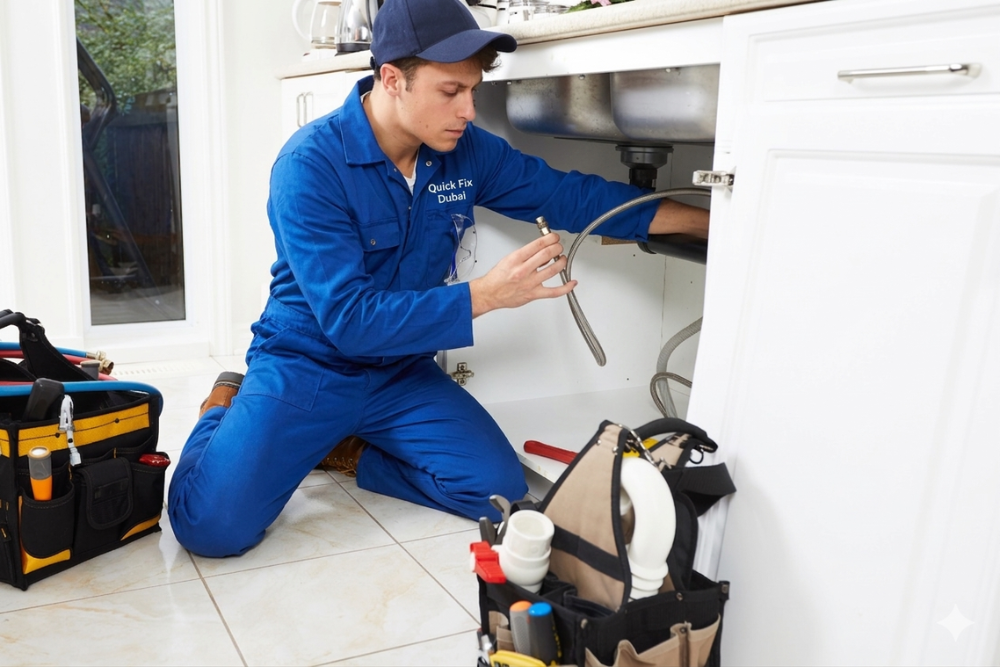
Water in the cabinet under a sink deserves quick attention. The flexible hoses that connect taps to the isolation valves are among the most common causes of sudden indoor floods, and a hose that weeps at a crimp today can split tomorrow. If you find water there and can't see where it starts, close the isolation valves under the sink and call. For water appearing somewhere you can't trace at all, our residential leak detection finds hidden leaks without opening walls.
Shattaf Repair and Installation: The Four Parts That Fail
A shattaf, also called a bidet spray or health faucet, is four parts: an angle valve on the wall, a flexible hose, a trigger head and a wall bracket. Each fails in its own way, and the angle valve and hose washers cause most leaks. Fixing the right part usually costs AED 150 to 300, and a complete new set fitted costs AED 200 to 450.
The angle valve
The small valve on the wall that feeds the hose. It's the most common leak point: at the thread into the wall, where sealing tape or compound has failed, or around the spindle when the valve is turned. It's also the valve that lets you shut the shattaf off, so it needs to turn freely.
The hose
The hose sits under pressure all day, held back only by the trigger. Plastic hoses harden and split, and cheap braided hoses fail at the crimped ends. A stainless steel braided hose with brass ends lasts far longer. The washers at each end perish and cause most drips at the connections.
The trigger head
Scale builds up on the trigger's internal seal and spray holes, so the head drips, sticks or sprays unevenly. Some heads can be cleaned; most are cheap enough that replacing the head is the practical fix.
The wall bracket
When the head keeps falling out, the bracket's clip or spring has weakened. When the whole bracket is loose, its wall plugs have failed, often from repeated knocks. Either way, a replacement bracket fixes it.
Why shattaf hoses keep bursting on some floors
A shattaf is the one fitting in the bathroom that holds back full supply pressure around the clock with nothing but a small trigger seal. On the lower floors of a tower pressure zone, or in a villa with a strong booster pump, that pressure can sit well above what hoses and triggers are comfortable with. The result is a hose that splits every few months. Replacing the hose again only resets the clock. The lasting fix is bringing the pressure down, either for the whole home or with a small point-of-use valve for the shattaf alone. Our pressure reducing valve page shows how to check your pressure in five minutes.
Close the shattaf valve before you travel
If you're leaving the home empty for more than a few days, turn the shattaf's angle valve off. With it closed, the hose and trigger carry no pressure at all, and the most likely source of a flood in an empty apartment is gone. It takes seconds, and it's the single most useful habit for anyone who spends summers away from Dubai.
Choosing a shattaf that lasts
Shattaf sets sell from under AED 40 to a few hundred. The differences that matter:
- A metal trigger head, or good-quality ABS, rather than thin plastic that cracks.
- A stainless steel braided hose with brass nuts, 1.2 to 1.5 metres long.
- A proper brass angle valve, not a plastic one.
- For warm water, a shattaf fed from a small mixer valve. A thermostatic mixer limits the temperature, which matters for children and older users.
We supply and fit complete sets, or fit one you've bought. Where a hot and cold shattaf mixer is being added to a bathroom that only has a cold feed, it needs a new hot supply, which is usually part of a larger job such as a bathroom renovation.
Hard Water, Scale and Spare Parts
Scale shortens the life of every tap in Dubai. It collects in aerators, on ceramic cartridge discs and inside thermostatic inserts, so taps drip, stiffen or lose flow years before they wear out. Regular descaling helps, and buying a brand whose cartridges are sold in the UAE turns the eventual repair into a part rather than a new tap.
The aerator, the small mesh screen at the end of the spout, is usually the first thing to clog. It unscrews by hand or with a coin-slot key on most taps. Soaking it in white vinegar for an hour and brushing it clean restores the flow in most cases, and a new one costs very little. Shower heads and shattaf triggers respond to the same treatment.
Cartridges are a different matter. Scale between the ceramic discs makes a lever feel gritty and eventually stops it closing fully, and cleaning a cartridge only buys time. The practical fix is a new cartridge, which is where the brand you chose years ago matters. Well-known brands sell replacement cartridges through local distributors, so the repair is quick. Unbranded taps often have no spares at all, and a worn cartridge means a new tap.
If every tap and shower head in the home scales quickly, treat the water rather than the taps. A water softener protects every fitting, the water heater and the shower screen at once.
Shower Mixers: Exposed, Concealed and Thermostatic
Most shower mixer faults can be fixed from the front without breaking tiles. On concealed and thermostatic mixers, the cartridge, diverter and thermostatic insert all come out once the lever and trim are removed. Only a failure of the valve body itself, which sits inside the wall, means opening the tiles around it.
| Mixer type | Where the valve is | What can be repaired without opening the wall |
|---|---|---|
| Exposed mixer (bar or wall-mounted) | Valve body sits outside the wall | Everything is reachable; cartridges, diverters and even the whole mixer can be changed without touching tiles |
| Concealed manual mixer | Valve body inside the wall; only the lever and trim show | The cartridge and diverter come out from the front after the trim is removed; the body itself needs the wall opened |
| Concealed thermostatic mixer | Body in the wall with a thermostatic insert that holds a set temperature | The thermostatic insert and flow cartridge come out from the front; they are brand-specific parts |
Exposed mixer (bar or wall-mounted)
- Where the valve is
- Valve body sits outside the wall
- What can be repaired without opening the wall
- Everything is reachable; cartridges, diverters and even the whole mixer can be changed without touching tiles
Concealed manual mixer
- Where the valve is
- Valve body inside the wall; only the lever and trim show
- What can be repaired without opening the wall
- The cartridge and diverter come out from the front after the trim is removed; the body itself needs the wall opened
Concealed thermostatic mixer
- Where the valve is
- Body in the wall with a thermostatic insert that holds a set temperature
- What can be repaired without opening the wall
- The thermostatic insert and flow cartridge come out from the front; they are brand-specific parts
A diverter, the part that switches water between the overhead shower, the hand shower and a bath spout, is a common failure on its own. When water comes out of two outlets at once, or the switch won't stay in position, the diverter cartridge is usually the cause, and it's replaced from the front.
A body failure is rarer but more serious: water leaking at a joint inside the wall, usually found as damp on the other side of the wall or on the ceiling below. Concealed bodies are brand and model specific, and a different brand's trim won't fit the existing body. A replacement body therefore means opening the tiles around it, fitting and pressure-testing the new body, and reinstating the tiles. Spare tiles from the original batch make the patch invisible. Where the bathroom is dated anyway, many owners use the opening as the start of a bathroom renovation.
Bath fillers, bath spouts, shower trays and enclosures are covered on our bathtub and shower repair page.
Kitchen Taps: Choosing, Fitting and Pull-Out Sprays
Before buying a kitchen tap, check five things: how many holes the sink or worktop has, how thick the worktop is, whether a pull-out spray has room to drop below the sink, whether the tails will reach the isolation valves, and what pressure the kitchen gets. Most failed kitchen tap installations fail on one of these, not on the tap.
Number of holes
A single-hole sink or worktop takes a monobloc mixer. An older sink with two or three holes needs a matching tap or a cover plate over the spare holes.
Worktop thickness
Stone and quartz worktops are thick. Every tap specifies the maximum deck thickness its fixing will clamp; check it before buying.
Clearance for a pull-out spray
A pull-out or pull-down hose drops into the cabinet when the spray is used. It needs a clear run below the sink, away from the waste pipe and bins, with its counterweight fitted.
Tail length and connections
Most mixers come with fixed flexible tails. They have to reach the isolation valves without stretching or kinking, and the valves themselves should turn freely before the new tap goes on.
Water pressure
If the kitchen is fed by gravity from a roof tank, check the tap's minimum working pressure. Some mixers are designed for mains pressure and run weakly on a gravity supply.
Replacing a kitchen mixer usually takes under an hour when the isolation valves work. Seized valves are common in Dubai kitchens, and they're replaced at the same visit, because a new tap on a valve that won't close leaves you with no way to stop a future leak without shutting off the whole home.
Boiling-Water, Filtered and Outdoor Taps
Boiling-water taps need a tank and an electrical socket under the sink, and a filter in hard-water areas. Filtered drinking-water taps need either a separate tap hole or a three-way mixer. Outdoor taps need a sound valve and connection. Each is a short job once the space under the sink or at the wall is planned for it.
Boiling-water taps
A boiling-water tap draws from a small insulated tank under the sink, which needs cabinet space and a switched socket installed by an electrician. In Dubai's hard water, the manufacturer's scale filter is worth fitting from the start, because scale inside the tank is what shortens its life.
Filtered and RO taps
A reverse osmosis unit under the sink delivers through its own small tap, which needs a hole in the sink or worktop. Stone worktops need a proper diamond core drill. A three-way mixer, which delivers hot, cold and filtered water from one spout, avoids the extra hole.
Outdoor and garden taps
Villa garden taps sit in the sun all year, so washers and handles harden quickly. A tap that drips, or one where the pipe behind it has worked loose from the wall, is replaced with a brass tap on a properly fixed backplate.
Temperature Problems and Crossflow
A cold tap that runs warm, or a hot tap that runs cold, is often crossflow: hot and cold water meeting inside a mixer, and the side with higher pressure pushing into the other. It happens when the two supplies arrive at different pressures and the mixer's check valves have failed. A shower that drifts in temperature is usually a scaled thermostatic insert.
In a mixer, hot and cold water share a chamber. Most mixers have small check valves in their inlets that stop one supply flowing back into the other. When those wear, or when one side runs at much higher pressure than the other, water crosses over. A typical result is lukewarm water from the cold tap in another room.
The fix has two parts: replacing the failed check valves or cartridge, and looking at why the two sides differ in the first place. A water heater fed through a pressure reducing valve while the cold side runs at full pressure, for example, will always push one way. On thermostatic showers, the manufacturer specifies how closely the hot and cold pressures must match. Outside that range, the temperature swings whenever another tap opens.
Summer adds a Dubai-specific twist. Cold water from a roof tank, or from pipes in a hot ceiling void, can arrive warm by itself, so a thermostatic mixer may have little cold water to work with. That's a supply problem rather than a valve fault, and it's worth ruling out before replacing anything.
Basin Taps and Wall-Mounted Mixers
A basin tap has to match the basin as well as the plumbing. A countertop vessel basin needs a tall mixer or a wall-mounted spout, a standard basin takes a normal-height tap, and the spout must reach far enough into the bowl that water doesn't run down the back or splash over the edge. Wall-mounted mixers also have a concealed body, like a shower.
The most common complaint after a new basin tap goes in is splashing. It usually means the spout is too short for the bowl or aimed at the drain from too great a height. Before buying, compare the spout's reach with the distance from the tap hole to the centre of the basin, and on a vessel basin, check that the spout clears the rim.
Wall-mounted basin mixers look clean on a vanity, but the valve body sits in the wall, just like a concealed shower mixer. That means it has to be set to the finished tile line when the bathroom is built, and its cartridge is serviced from the front. Swapping a wall-mounted mixer for a different brand usually means changing the body in the wall as well, so it's best chosen as part of a renovation rather than as a later upgrade.
A pop-up waste that won't hold water, or a basin that drains slowly, is a drainage question rather than a tap one. The fix is in the waste and trap under the basin, covered on our sink and basin plumbing page.
Tap Repairs in Rented Homes: Who Pays?
In a Dubai rental, repairs from normal wear, such as a worn washer, a scaled cartridge or a perished shattaf hose, normally fall to the landlord, because the tenancy law places maintenance with the landlord unless the contract says otherwise. Damage caused by misuse, such as a lever forced past its stop or a trigger dropped and cracked, can be the tenant's.
Many tenancy contracts set a small threshold below which minor repairs are the tenant's to arrange, so check yours first. Whoever pays, report a dripping tap or a weeping hose early and in writing. A slow drip is cheap to fix now and becomes a water damage dispute if it runs for months into a cabinet or through a ceiling.
Our landlord plumbing maintenance guide sets out the usual split between landlord and tenant in more detail. Keep the invoice for any tap repair: a record of the part replaced and why settles most disagreements later.
Repair or Replace Your Tap?
Repair a tap when the body is sound and the worn part is available: a washer, cartridge, O-ring or diverter. Replace it when the body is cracked or corroded, the finish is peeling, no spare parts exist for the brand, or the same tap keeps failing. A good-quality tap should be repairable for many years.
Repair when
- The tap drips, stiffens or loses flow, but the body is intact.
- Cartridges or washers are available for the brand.
- The finish is in good condition and you like the tap.
- It's a concealed mixer, where the parts come out from the front.
Replace when
- The body is cracked, corroded or leaking from the casting.
- The brand is unknown and no cartridge matches.
- Chrome is peeling or pitted, which gets worse and harbours scale.
- It has needed repair more than once in a year.
How We Repair or Fit a Tap
Every tap job follows the same order: identify the tap and the fault, isolate the supply, repair or replace, clean the connections, then test under full pressure with every lever and diverter operated. The isolation valves are checked first, because a valve that won't close has to be replaced before anything else.
- 1
Identify the tap and the fault
Check where the water appears, what type of tap or mixer it is, and its brand, so the right part is brought or ordered.
- 2
Isolate the supply
Close the isolation valves under the sink or behind the access panel; replace any valve that won't close before going further.
- 3
Repair or replace
Fit the new washer, cartridge, O-rings, diverter or shattaf part, or install the new tap or mixer with correctly sized tails and sealed connections.
- 4
Clean the connections
Remove old sealant and debris from threads and seats, so new seals seat properly and don't weep.
- 5
Test under pressure
Reopen the supply, run hot and cold, operate every lever and diverter, and check every connection above and below the worktop for leaks.
- 6
Show you the shut-off
Point out the isolation valves for each tap and the shattaf, so you can close them yourself in future.
To help us bring the right part first time, send a photo of the tap and, for a mixer, the brand name printed on it or on the trim plate. For a concealed shower mixer, a photo with the lever removed shows the cartridge type.
Tap, Mixer and Shattaf Prices in Dubai
Tap and mixer repairs in Dubai cost AED 150 to 350 in labour, with parts extra. Shattaf repairs cost AED 150 to 300 with standard parts, and a complete shattaf set fitted costs AED 200 to 450. A new basin or kitchen mixer supplied and fitted costs AED 400 to 1,200, depending on the tap.
| Work | Typical price |
|---|---|
| Tap or mixer repair: washer, cartridge, O-ring or aerator (labour; parts extra) | AED 150 - 350 |
| Shattaf repair: hose, trigger, bracket or angle valve (standard parts included) | AED 150 - 300 |
| Shattaf set supplied and installed | AED 200 - 450 |
| Angle or isolation valve replacement | AED 120 - 250 |
| Flexible hose replacement | AED 150 - 350 |
| Basin or kitchen mixer fitted (your tap) | AED 150 - 300 |
| Basin or kitchen mixer supplied and fitted (mid-range) | AED 400 - 1,200 |
| Concealed shower mixer cartridge or thermostatic insert (labour; part extra) | AED 250 - 500 |
| Concealed mixer body replacement, including local tile opening | AED 800 - 2,500 |
| Boiling-water or filtered tap installation (labour) | AED 450 - 900 |
| Outdoor or garden tap replacement | AED 150 - 350 |
Tap or mixer repair: washer, cartridge, O-ring or aerator (labour; parts extra)
- Typical price
- AED 150 - 350
Shattaf repair: hose, trigger, bracket or angle valve (standard parts included)
- Typical price
- AED 150 - 300
Shattaf set supplied and installed
- Typical price
- AED 200 - 450
Angle or isolation valve replacement
- Typical price
- AED 120 - 250
Flexible hose replacement
- Typical price
- AED 150 - 350
Basin or kitchen mixer fitted (your tap)
- Typical price
- AED 150 - 300
Basin or kitchen mixer supplied and fitted (mid-range)
- Typical price
- AED 400 - 1,200
Concealed shower mixer cartridge or thermostatic insert (labour; part extra)
- Typical price
- AED 250 - 500
Concealed mixer body replacement, including local tile opening
- Typical price
- AED 800 - 2,500
Boiling-water or filtered tap installation (labour)
- Typical price
- AED 450 - 900
Outdoor or garden tap replacement
- Typical price
- AED 150 - 350
Cartridges and thermostatic inserts vary most in price, because they're made for one brand and model. We'll tell you the part price before fitting it. Where a repair would cost close to a new mid-range tap, we'll say so, and you can choose.
Tap, Mixer and Shattaf FAQ
How much does tap repair cost in Dubai?
How much does it cost to install a shattaf in Dubai?
Why does my shattaf hose keep bursting?
Why does my tap keep dripping after I turn it off?
Can a concealed shower mixer be repaired without breaking tiles?
Can I buy my own tap and have you fit it?
Will any kitchen tap fit my sink?
Why does my cold tap run warm?
Should I turn off my shattaf when I travel?
How long does it take to replace a mixer tap?
One Worn Part, Fixed Properly
Send a photo of the tap, mixer or shattaf and tell us where the water appears. We'll bring the right part, fix it, and show you how to shut it off next time.