Search this exact question and almost everything you'll find talks about wells: well casings, well caps, groundwater decay, aquifer bacteria. None of it applies to you. Dubai has no private residential well water. Everything coming out of your tap started as desalinated seawater, piped by DEWA, and stored in a tank somewhere on or under your property before it reaches your faucet. That last part, the tank, is almost always where a rotten egg smell in Dubai actually starts, and it's the one cause every well-water guide skips entirely.
This article covers what that smell actually is, a quick test to narrow down whether it's your tank, your water heater, or something else, and what Dubai Municipality's own rules already say you should be doing about it, whether you've smelled anything yet or not.
!Quick answer
Run the cold tap, then the hot tap, separately. If only hot water smells, it's your water heater's anode rod. If cold water smells too, it's your storage tank, and it's almost certainly overdue for the cleaning Dubai Municipality already requires every six months. Neither cause means your water is unsafe; both are routine maintenance fixes, not emergencies.
What That Smell Actually Is (Briefly)
The rotten egg smell in water is caused by hydrogen sulfide gas, a byproduct of bacteria that thrive in stagnant, low-oxygen water. These bacteria occur naturally in trace amounts almost everywhere water sits still for a while, and they produce hydrogen sulfide as part of their normal metabolism, the same gas responsible for the smell of actual rotting eggs, which is why the association is so immediate and unmistakable.
At the concentrations typically found in household water, hydrogen sulfide is unpleasant rather than dangerous. It's not something you want to drink, cook with, or shower in regularly, but a rotten egg smell on its own doesn't mean your water is contaminated with something harmful. What it does mean is that water has been sitting somewhere it shouldn't be sitting for very long, without enough movement or oxygen to keep those bacteria in check. Finding and fixing that stagnant point is the entire task ahead of you, and where that point actually is depends on one simple test.
Do You Actually Need to Test the Water?
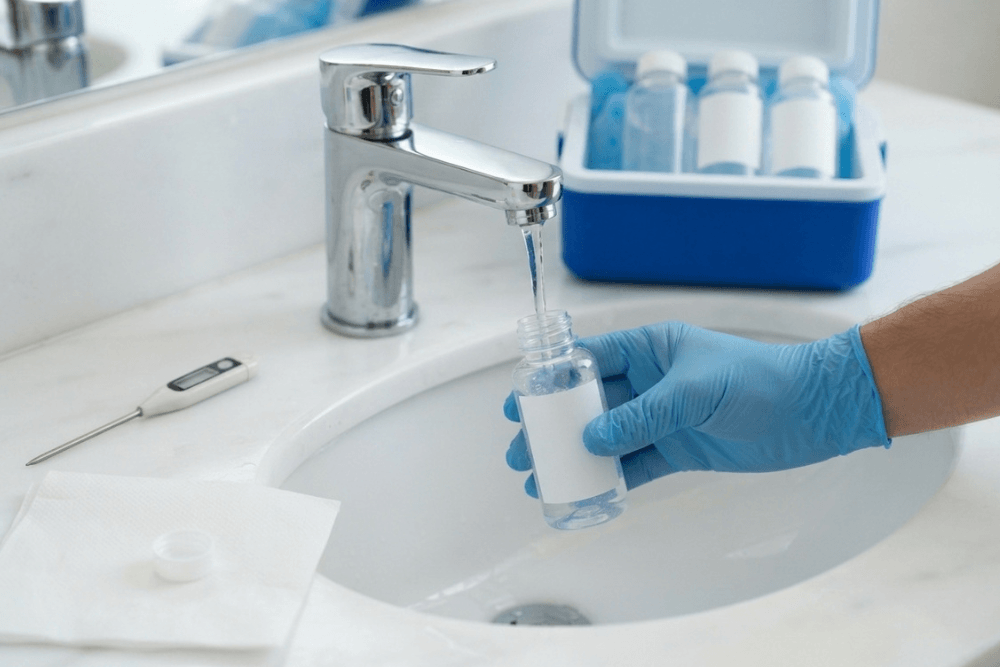
For most households, no, not as a first step. The hot/cold test below tells you where the smell is coming from, and once you know that, the fix is a known maintenance task, tank cleaning or anode rod replacement, rather than something that needs a lab to confirm. Formal water testing is worth doing in narrower situations: if the smell is unusually strong, appeared suddenly with no clear trigger like a missed cleaning cycle, is accompanied by visible discoloration or particles, or if you specifically want documented water quality results for a landlord, tenant, or insurance conversation. A professional tank inspection will typically flag whether formal testing is actually warranted in your specific case rather than leaving you to guess.
The Hot/Cold Test
Run your cold tap for thirty seconds, smell it, then run the hot tap for thirty seconds and smell that separately, since which one carries the smell tells you almost everything about where to look next. This single test is the fastest way to rule two-thirds of the possible causes in or out before you touch anything.
| Where the smell shows up | What it usually means |
|---|---|
| Hot water only | Your water heater, almost always the anode rod reacting with sulfate-reducing bacteria inside the tank |
| Cold water only, or both hot and cold equally | Your storage tank, rooftop or underground, not the water heater |
| Both, but noticeably stronger from one specific fixture | A localized issue at that fixture rather than the whole supply, worth checking that tap's aerator and any nearby standing water before assuming a whole-tank problem |
If it's hot water only, skip ahead to the water heater section below, that's a narrower, faster fix and doesn't need the rest of this diagnostic process. If it's both, or cold water specifically, keep reading, because that points squarely at your building's storage tank rather than anything happening inside the heater itself.
Both Taps Smell? It's Almost Certainly Your Storage Tank
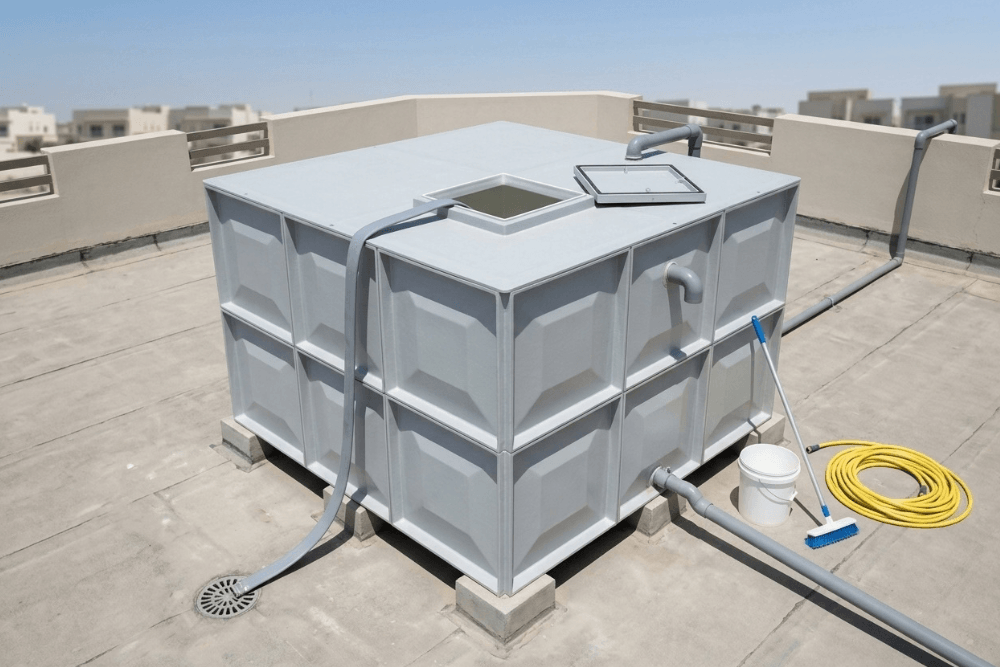
If cold water carries the smell, and hot water carries it too or even more strongly, the source is upstream of your water heater entirely, and in a Dubai property that almost always means the storage tank, whether that's a rooftop tank on a villa, an underground tank feeding an apartment building, or both in a larger property with a two-stage system. Dubai property professionals report a rotten egg or sulfur smell as one of the standard warning signs building managers and cleaning companies use to flag a tank overdue for servicing, alongside cloudiness, unusual tint, and visible particles in the water.
The mechanism is straightforward once you know to look for it. A storage tank holds a large volume of water that isn't constantly flowing, and any water sitting for extended periods, especially in Dubai's heat, gives the same sulfate-reducing bacteria responsible for the rotten egg smell in a water heater plenty of opportunity to establish themselves in sediment, biofilm on the tank walls, or organic debris that's found its way in through a poorly sealed lid or vent. Warmer standing water accelerates bacterial activity generally, and a rooftop tank exposed to direct Dubai sun for months at a time is about as close to ideal breeding conditions as this kind of bacteria gets.
This is also why the smell often gets worse gradually rather than appearing all at once. A tank doesn't go from clean to contaminated overnight; sediment and organic matter build up slowly with every cycle of use, and the smell tends to cross from faint to obviously noticeable only once that buildup has reached a certain threshold, which is part of why so many households only notice it well after the underlying problem actually started.
Tank material changes how fast this happens, and it's worth knowing which you have. Older Dubai villas commonly use concrete underground tanks, and concrete is porous by nature, which gives bacteria and mineral deposits more surface texture to cling to than a smoother material does, so a concrete tank generally needs cleaning more often to stay ahead of the same buildup. Newer builds and most apartment towers use plastic, fiberglass, or GRP (glass-reinforced plastic) tanks instead, which are non-porous and comparatively easier to keep clean, though they're not immune to the same bacterial growth if left on the same schedule as a concrete tank without ever actually being serviced. If you don't know which type your property has, that's a reasonable first question for whoever handles your tank cleaning, since it affects how strictly you should treat the six-month minimum as a true minimum rather than room to stretch it further.
Timing Cleaning Around Dubai's Seasons
Scheduling matters more than most residents assume, because bacterial activity tracks temperature, and a rooftop tank absorbing direct summer sun runs hotter than one during the cooler winter months. A tank that was clean at its winter service can reasonably develop a stronger smell by the end of a Dubai summer than the same tank would over an equivalent stretch of milder weather, simply because heat accelerates the same bacterial process throughout. If your household is on the strict six-month cycle and you get to choose the timing, scheduling one cleaning to land just before peak summer, rather than mid-summer or just after, gives the tank its freshest state heading into the months where buildup happens fastest. This isn't a requirement, Dubai Municipality's rule is every six months regardless of season, but it's a genuinely useful optimization if you have any flexibility in when the two annual visits fall.
Dubai Municipality's 6-Month Rule (and Why It Exists)
Dubai Municipality requires residential water tanks to be professionally cleaned and disinfected at least once every six months, a mandatory minimum rather than a suggestion, with hotels, hospitals, schools, and labour accommodation held to a stricter three-month cycle given their higher occupancy and higher stakes if something goes wrong. This isn't a rule invented for marketing purposes; it exists specifically because the conditions described above, warm standing water plus time, reliably produce exactly the kind of bacterial buildup that causes a rotten egg smell, cloudy water, and worse.
Compliance isn't optional and non-compliance is enforced, with penalties reported to start in the region of AED 2,000 for a first offense and escalate from there for repeated violations, alongside the more immediate cost of living with contaminated-smelling water in the meantime. Cleaning has to be carried out by a Municipality-approved provider using approved disinfectants, and proper documentation of the service should be kept, both because it's the compliant thing to do and because it's the first thing worth asking building management for if you're a tenant trying to establish whether the six-month cycle has actually been followed on your building.
If you've never had your tank cleaned on this schedule, or you don't actually know when it was last done, that's the single most useful thing to establish before spending money on anything else. A smell that's been building for months because a scheduled cleaning was missed isn't a mystery to diagnose further, it's a maintenance item that's overdue. Our regular water tank cleaning service follows this same Municipality-recommended cadence and is the direct fix for a cold-water or both-taps rotten egg smell traced to the tank.
What Happens If You Ignore It
A rotten egg smell that's left untreated doesn't stay at the same severity; it tends to worsen as sediment and bacterial buildup continue accumulating with every cycle of use, and the practical consequences extend beyond the smell itself. Hydrogen sulfide dissolved in water is mildly corrosive to metal, which over time can contribute to blackened silverware, discolored copper or brass fittings, and accelerated wear on metal components inside taps, water heaters, and appliances that see regular water flow. None of this happens overnight, but a tank left well past its six-month cycle is doing more than smelling bad, it's actively shortening the working life of whatever metal fixtures the water passes through afterward, which is a genuine cost on top of the more obvious inconvenience of the smell itself.
Hot Water Only? It's Your Water Heater's Anode Rod
If the smell is isolated to hot water, the cause is almost certainly the sacrificial anode rod inside your water heater's tank reacting with sulfate-reducing bacteria in an anaerobic, low-oxygen environment, producing hydrogen sulfide gas as a byproduct of that reaction. Most tank-style electric water heaters include a magnesium anode rod specifically to protect the tank itself from corrosion, and while that's exactly what the rod is supposed to do, magnesium is also more chemically reactive than the alternatives, which is precisely why it's the configuration most associated with this particular smell.
The smell is typically worse first thing in the morning or after the property has been empty for a few days, since water that's sat in the tank without being drawn down gives the bacteria more uninterrupted time to react with the rod. This is a genuinely well-understood, narrow mechanism, distinct enough from the tank-wide sulfur smell covered above that treating it the same way won't help. One important safety note: this section refers strictly to a sulfur smell in the water itself. If you ever smell gas in the air around a gas-fired unit rather than in the water, that's a potential gas leak, not a water heater fault, and it needs leaving the area and contacting emergency services rather than any of the troubleshooting below.
We've covered the full diagnosis and fix for this specific cause, including anode rod replacement options, in detail on our water heater not working guide, since it's a genuinely different mechanism from a tank issue and deserves its own explanation rather than a shortened repeat here.
A Quick Word on DEWA's Water (and Why "Desalinated" Doesn't Mean Mineral-Free)
Dubai's tap water starts as desalinated seawater, but DEWA deliberately adds calcium and magnesium back into it after the desalination process, a remineralization step that protects the city's pipe network from the corrosion that fully demineralized water would otherwise cause. That puts Dubai's water in the 100 to 200 mg/L hardness range, moderately hard to hard, which is a genuine surprise to most residents who assume desalinated automatically means soft or mineral-free.
Hardness on its own doesn't cause a rotten egg smell, the two are separate issues with separate mechanisms. But they interact in a practical sense: mineral scale from hard water builds up inside a storage tank and water heater over time, and that scale gives sediment and organic matter more surface area to cling to, which can accelerate exactly the bacterial buildup described above. A tank with years of untreated hard-water scale accumulated inside it is more prone to developing a sulfur smell between cleanings than one that's been kept relatively scale-free, which is one more reason routine tank cleaning and, in mineral-heavy properties, softening or filtration tend to reinforce each other rather than solving entirely separate problems. If hardness itself, not the smell, is your main concern, we cover the full picture on our water softener and filtration page.
Is It Actually Sewage, Not Sulfur?
Rotten egg and sewage smells are genuinely different, caused by different mechanisms, and worth telling apart before you spend money treating the wrong one. A rotten egg or sulfur smell is a water-quality issue, hydrogen sulfide dissolved in the water itself, present when you run a tap and smell the water directly. A sewage smell is a drainage issue, sewer gas escaping through a dried-out trap or a drainage fault, and it's present in the air of a room, often near a floor drain or an infrequently used fixture, regardless of whether any tap is running.
The simplest way to tell them apart: cup your hands under running water and smell it directly at the tap. If the smell is in the water itself, this guide applies. If the smell is in the room's air and doesn't track with the water you're running, that's a drainage issue instead, and we've covered every real cause of that separately, from dry traps to shared building risers, on our dedicated sewage smell in your house guide.
A Third Possibility: Chlorine, Not Sulfur
There's a third smell worth ruling out before assuming sulfur: a sharp, swimming-pool-like chlorine odor, which is a genuinely different smell from rotten eggs even though both get lumped together as "my water smells weird" by people trying to describe them. DEWA, like most municipal suppliers, uses chlorine to disinfect the water supply, and the concentration can vary slightly depending on network conditions, occasionally producing a noticeably stronger chlorine smell than usual, particularly in water that's been sitting in a pipe for a while before you draw it. This isn't the same mechanism as hydrogen sulfide at all, and it doesn't point to a tank or water heater issue, it usually settles on its own after running the tap for a minute, or fades within a day if it was a temporary network-wide adjustment. If what you're smelling is closer to a swimming pool than a rotten egg, you're very likely dealing with this rather than anything covered in the rest of this guide.
Villas vs. Apartments: Where to Actually Check
A villa typically has its own rooftop or ground-level tank that you, as the owner, are directly responsible for maintaining on the six-month cycle, which means you can act on this immediately without waiting on anyone else. Check the tank's last cleaning record if you have one, and if you don't have a record at all, that's usually a sign it's overdue regardless of how the water currently smells.
An apartment is different, and often more complicated, since the building's main storage tank is shared across every unit and maintained by building management rather than any individual resident. If your cold water smells and you're in an apartment, the single most useful thing you can do is ask building management directly for the tank's cleaning schedule and most recent service record, since as a tenant this isn't something you can access or fix yourself, and residents are generally entitled to ask for exactly this documentation. If more than one unit on your building reports the same smell around the same time, that's a strong signal the shared tank is the source rather than anything specific to your apartment's own plumbing.
Some larger apartment buildings and villas also run a two-stage system, a bulk underground tank plus a smaller rooftop or booster tank that draws from it, and either stage can independently develop the same bacterial buildup. If a whole-property flush of every tap doesn't resolve the smell after a professional cleaning of one tank, it's worth confirming with your service provider whether there's a second tank in the system that needs the same treatment.
There's a third pattern worth naming separately: gated villa communities with a shared community-level tank or pumping station feeding several individual properties, common across developments in areas like Arabian Ranches, the Springs, and Meadows. In this setup, an individual villa owner may maintain their own smaller storage tank on top of relying on community infrastructure they don't control, which means a persistent smell can originate from either level. If your own villa's tank has been cleaned on schedule and the smell persists, or if several neighbours on the same community line report it together, raising it with the community's facilities or homeowners' association is the right next step rather than repeating your own tank's cleaning a second time.
What Professional Tank Cleaning Actually Involves
A compliant tank cleaning isn't a rinse with a hose; Dubai Municipality's standards specify draining the tank fully, mechanically scrubbing the interior walls and floor to remove sediment and biofilm, applying an approved disinfectant at the correct concentration, thoroughly rinsing that disinfectant out before refilling, and, particularly for commercial properties, water quality testing afterward to confirm the result rather than assuming it.
| Situation | What's typically involved | Relative scope |
|---|---|---|
| Routine 6-month residential cleaning, no active smell | Standard drain, scrub, disinfect, rinse, refill cycle | Baseline scope, the Municipality minimum |
| Active rotten egg smell, cleaning overdue | Same process, often with heavier sediment removal given the longer gap since last service | Slightly more involved depending on buildup |
| Two-stage system (underground + rooftop tank) | Both tanks serviced in the same visit, since treating only one can leave the smell traced back to the other | Larger scope, priced per tank |
| Commercial, hotel, or high-occupancy building | Full clean plus documented water testing, on the stricter 3-month cycle | Higher scope and frequency, ongoing compliance requirement |
Ask for the Municipality approval and licensing documentation up front regardless of who you book with, since this is a regulated service and a provider who can't produce it isn't compliant, whatever they've quoted you. A fixed price confirmed before work starts matters here as much as on any other job, particularly once sediment buildup or a second tank changes the scope partway through a visit.
Beyond the license itself, ask specifically what disinfectant they use and at what concentration, and whether post-cleaning water testing is included or offered as an add-on. A provider who can answer both without hesitation is generally following the documented process Dubai Municipality expects; vague answers to either question are worth treating as a reason to ask a second provider before booking, since the whole point of the regulation is a verifiable standard, not just a tank that looks clean afterward.
Water Tank Cleaning
Municipality-standard cleaning and disinfection for rooftop and underground tanks.
Water Softener & Filtration
If hardness and scale buildup are compounding the problem, not just the smell itself.
Frequently Asked Questions
Is a rotten egg smell in my water dangerous?
Why does the smell get worse in the morning or after we've been away?
Does this mean my water isn't safe to drink?
I just had my tank cleaned and the smell is still there. What now?
Can a water softener or filter fix a rotten egg smell?
How do I know if it's my building's tank or just my apartment?
Is it normal for a brand-new property to have this smell?
What's the difference between this and a sewage smell?
Only one tap in my house smells, not the whole property. Is that still the tank?
Does hard water cause the rotten egg smell?
My water smells like a swimming pool, not rotten eggs, is that the same issue?
How much does professional tank cleaning cost in Dubai?
Can I clean the tank myself instead of hiring a professional?
Does a rotten egg smell mean my water tank is the wrong material?
Will the smell damage my taps, water heater, or appliances?
Is it safe to shower in water that smells like rotten eggs?
Can I use the water for cooking while I wait for tank cleaning to be scheduled?
Related Service
Water Tank Cleaning
Dealing with this issue right now? See real pricing and how we handle it.
View Water Tank Cleaning