Water Tank Supply and Installation in Dubai: GRP, Villa and Underground Tanks
We supply and install water tanks across Dubai: GRP panel tanks for villas and buildings, multi-layer plastic tanks for rooftops, and underground tanks with the pump that lifts the water back up. Every tank is sized to Dubai Municipality’s 24-hour storage rule, set on a level base, and held full for 24 hours before we hand it over.
Supplied and installed prices start at AED 1,500 for a small rooftop replacement and run to AED 14,000 for a villa-scale GRP panel tank. If your tank only needs a new float valve, lid or a clean, see tank cleaning and fitting repair first. It costs a fraction of a new tank.
24 h
Minimum storage, DM guideline
4.546 L
In one imperial gallon
AED 1,500+
Rooftop tank replaced
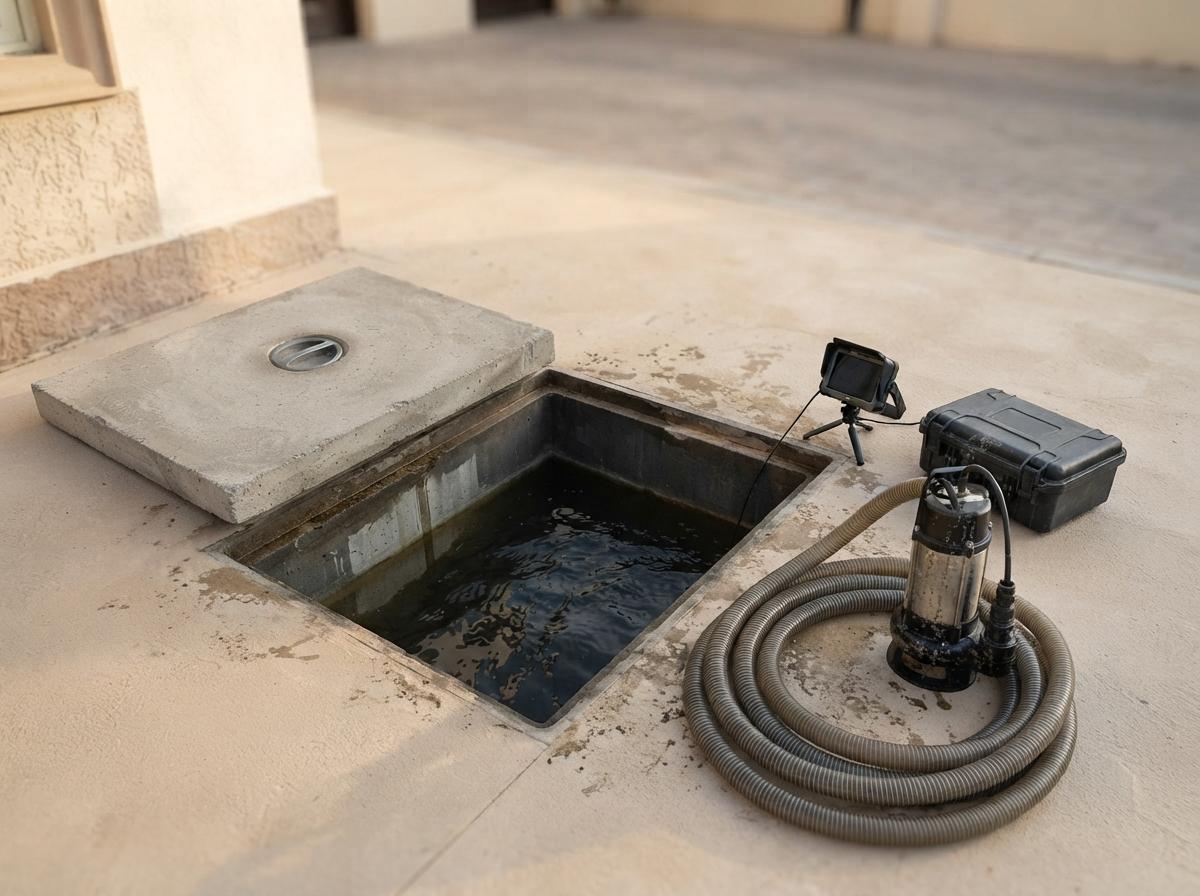
Do You Need a New Tank, or a Repair?
You need a new water tank when the tank body itself has failed: cracked or brittle plastic, corroded steel, or a shell that can no longer hold water safely. You need a repair when the problem sits in a fitting such as the float valve, lid or overflow. A float valve that won’t shut off is the most common tank repair we see, and fittings like it cost AED 80 to 250 to fix.
The table below is the same check we run on a survey. If your symptom points to a repair, our tank cleaning and fitting repair page covers it in detail, and we’ll tell you on the visit if a replacement isn’t needed.
| What you see | Likely cause | What we recommend |
|---|---|---|
| Overflow pipe running, or the tank never stops filling | Float valve worn or jammed | Repair: float valve, AED 100 – 250 |
| Insects, dust or sand inside; lid cracked or warped by sun | Cover no longer seals | Repair: new lid or hatch, AED 80 – 180 |
| Cloudy water, sediment at the tap, slimy walls | Overdue cleaning; the tank itself is usually fine | Clean and disinfect first, then reassess |
| Weeping seam or hairline crack in a one-piece plastic tank | Body failure; patches rarely hold on potable plastic | Replace the tank |
| Chalky, brittle or bulging walls on a rooftop plastic tank | UV and heat damage to the shell | Replace, ideally with an insulated or shaded tank |
| Drip at one joint of a GRP panel tank | Gasket or bolt failure at that joint | Repair: reseal or swap the panel, no full replacement |
| Rust stains or flakes inside a steel or GI tank | Corrosion of the tank shell | Replace the tank; rust means the shell is corroding into your drinking water |
| Tank runs dry every evening or during supply interruptions | Undersized for the household | Upsize, after checking the roof or base can carry it |
Overflow pipe running, or the tank never stops filling
- Likely cause
- Float valve worn or jammed
- What we recommend
- Repair: float valve, AED 100 – 250
Insects, dust or sand inside; lid cracked or warped by sun
- Likely cause
- Cover no longer seals
- What we recommend
- Repair: new lid or hatch, AED 80 – 180
Cloudy water, sediment at the tap, slimy walls
- Likely cause
- Overdue cleaning; the tank itself is usually fine
- What we recommend
- Clean and disinfect first, then reassess
Weeping seam or hairline crack in a one-piece plastic tank
- Likely cause
- Body failure; patches rarely hold on potable plastic
- What we recommend
- Replace the tank
Chalky, brittle or bulging walls on a rooftop plastic tank
- Likely cause
- UV and heat damage to the shell
- What we recommend
- Replace, ideally with an insulated or shaded tank
Drip at one joint of a GRP panel tank
- Likely cause
- Gasket or bolt failure at that joint
- What we recommend
- Repair: reseal or swap the panel, no full replacement
Rust stains or flakes inside a steel or GI tank
- Likely cause
- Corrosion of the tank shell
- What we recommend
- Replace the tank; rust means the shell is corroding into your drinking water
Tank runs dry every evening or during supply interruptions
- Likely cause
- Undersized for the household
- What we recommend
- Upsize, after checking the roof or base can carry it
Age alone isn’t a reason to replace. A ten-year-old GRP tank with sound panels and fresh gaskets can keep going. A five-year-old plastic tank that has sat in full sun without UV protection may already be past saving. Press the wall of a plastic tank near the top: if it flexes more than you’d expect or leaves a chalky residue on your hand, the plastic is breaking down.
One more reason to replace that owners often miss: DEWA lists deterioration of the tank body, poor connections and improper positioning among the usual causes of household leaks. A tank that leaks slowly onto a roof can go unnoticed for months, with the loss showing up only on the bill. If your consumption has climbed and you can’t see why, check the tank and its overflow before anything else.
Choosing a Tank: Plastic, GRP Water Tank, Steel or Concrete
For most Dubai villas the choice is between a multi-layer plastic tank and a GRP water tank. Plastic is cheaper and faster to swap on a small rooftop. GRP (glass reinforced plastic) lasts longer, can be insulated, and is built from panels, so it can go where a one-piece tank can’t be carried. Buildings and commercial sites almost always use GRP.
Access decides more than people expect. A one-piece 1,000-gallon plastic tank is typically around 1.8 m across and almost as tall. If the only way to your roof is a staircase and a hatch, it either goes up by crane or it doesn’t go up at all, and a GRP panel tank carried up in flat sections becomes the practical answer even for a small villa.
| Material | Where it fits in Dubai | Heat and durability | Access and installation |
|---|---|---|---|
| Multi-layer plastic (polyethylene) | Villa and townhouse rooftops, up to about 2,000 imperial gallons (IG) | Lightest option and quickest to swap. Needs UV-stabilised outer layers; a single-layer tank in full sun degrades within a few years | One piece, so it must fit through the access route or be lifted by crane |
| GRP panel (sectional) | Larger villas, buildings, plant rooms, commercial sites | Does not rust; available with PUF insulation for exposed roofs | Carried up in flat panels and bolted together on site, so it suits roofs with stair-only access |
| GRP one-piece (moulded) | Underground villa tanks, smaller buildings | Stable underground; needs correct bedding and backfill | Delivered whole, so the excavation and delivery route must allow it |
| Stainless steel | Kitchens, labs, some commercial specifications | Hygienic and heat-tolerant, but heats up fast if exposed and costs the most | Heavy; mixed-metal connections must be avoided |
| Concrete (built into the structure) | Older villas and buildings, basement tanks | Stays cool underground; cracks let ground moisture in over time | Not replaceable like-for-like; usually relined or bypassed with a new GRP tank |
Multi-layer plastic (polyethylene)
- Where it fits in Dubai
- Villa and townhouse rooftops, up to about 2,000 imperial gallons (IG)
- Heat and durability
- Lightest option and quickest to swap. Needs UV-stabilised outer layers; a single-layer tank in full sun degrades within a few years
- Access and installation
- One piece, so it must fit through the access route or be lifted by crane
GRP panel (sectional)
- Where it fits in Dubai
- Larger villas, buildings, plant rooms, commercial sites
- Heat and durability
- Does not rust; available with PUF insulation for exposed roofs
- Access and installation
- Carried up in flat panels and bolted together on site, so it suits roofs with stair-only access
GRP one-piece (moulded)
- Where it fits in Dubai
- Underground villa tanks, smaller buildings
- Heat and durability
- Stable underground; needs correct bedding and backfill
- Access and installation
- Delivered whole, so the excavation and delivery route must allow it
Stainless steel
- Where it fits in Dubai
- Kitchens, labs, some commercial specifications
- Heat and durability
- Hygienic and heat-tolerant, but heats up fast if exposed and costs the most
- Access and installation
- Heavy; mixed-metal connections must be avoided
Concrete (built into the structure)
- Where it fits in Dubai
- Older villas and buildings, basement tanks
- Heat and durability
- Stays cool underground; cracks let ground moisture in over time
- Access and installation
- Not replaceable like-for-like; usually relined or bypassed with a new GRP tank
On lifespan, be wary of any single number. GRP suppliers in the UAE quote anything from 20 to more than 40 years, and the real figure depends on the panels, the base and how the tank is maintained. A plastic tank’s life depends mostly on sun: the same product lasts far longer under a shade structure than on an open roof. The tanks that fail early tend to be exposed single-layer plastic, or steel that has started to rust.
If you have an old concrete tank below the villa, replacing it like-for-like is rarely sensible. The usual choices are to have it relined, or to decommission it and fit a GRP tank in a position that can be reached for cleaning.
GRP Panel Tanks: What to Specify Before You Buy
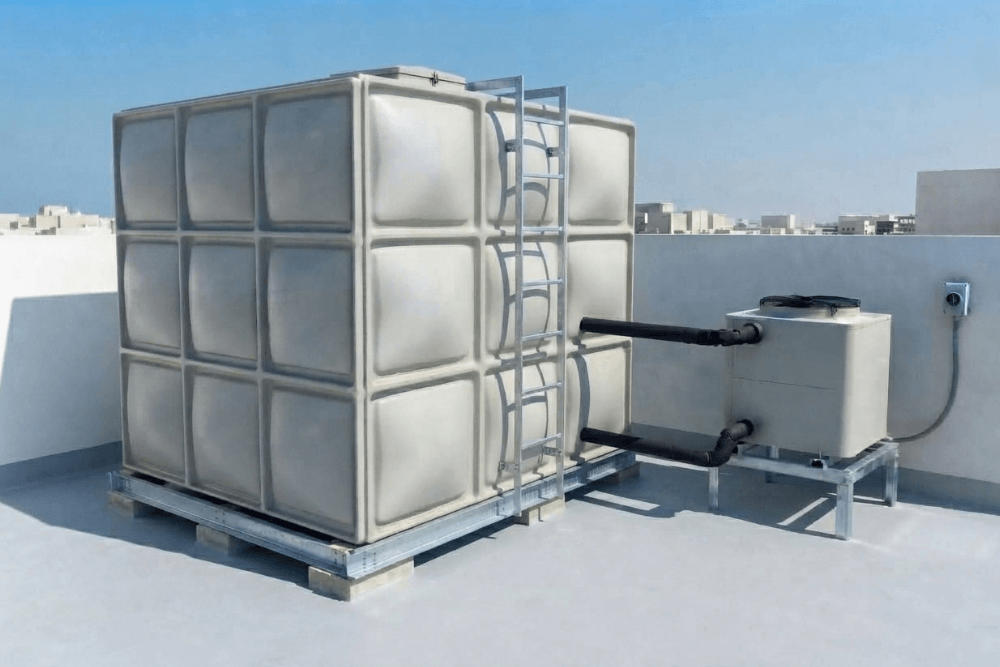
A GRP panel tank is a sectional tank bolted together on site from square glass reinforced plastic panels, sealed with gaskets and braced with stainless steel tie rods. Two quotes for “a 10,000-gallon GRP tank” can describe very different products, so compare the standard, panel type, bracing, insulation and accessories, not only the capacity and the price.
We supply and install GRP panel tanks, and this is the checklist we would use to judge any quote, including ours.
| Item | What to ask for | Why it matters |
|---|---|---|
| Standard | BS EN 13280, the European standard for GRP sectional cold water tanks | Tells you the panels were designed and tested as a system, not moulded to a price |
| Drinking-water approval | WRAS or NSF/ANSI 61 certificates covering panels and gaskets | The gasket touches your water as much as the panel does |
| Panel type | Hot-pressed (SMC) panels, or hand-laid if you accept the trade-off | Pressing gives even wall thickness and a smooth inner surface; hand lay-up varies more |
| Panel module | 1 m or 1.22 m panels, with the exact outside dimensions | Decides whether the tank fits the roof, plant room or door, and how much headroom is left for cleaning |
| Panel thickness by height | Thicker panels in the lower rows | Pressure is highest at the bottom; one thickness for every row is a warning sign |
| Internal and external bracing | Stainless steel (SS304 or SS316) tie rods inside, galvanised steel outside | Plain or painted steel inside a potable tank will corrode |
| Partition | A dividing wall with separate outlets on anything over villa size | One half stays in service while the other is cleaned or repaired |
| Insulation | PUF thickness stated in mm (50, 75 or 100) | “Insulated” with no thickness is not a specification |
| Accessories | Lockable manhole, internal and external ladders, screened vents, overflow with screen, drain at the lowest point, level indicator | These are what make monthly inspection and six-monthly cleaning possible |
| Base | Galvanised steel skid on concrete plinths, levelled before assembly | The panels are only as flat as what they sit on |
Standard
- What to ask for
- BS EN 13280, the European standard for GRP sectional cold water tanks
- Why it matters
- Tells you the panels were designed and tested as a system, not moulded to a price
Drinking-water approval
- What to ask for
- WRAS or NSF/ANSI 61 certificates covering panels and gaskets
- Why it matters
- The gasket touches your water as much as the panel does
Panel type
- What to ask for
- Hot-pressed (SMC) panels, or hand-laid if you accept the trade-off
- Why it matters
- Pressing gives even wall thickness and a smooth inner surface; hand lay-up varies more
Panel module
- What to ask for
- 1 m or 1.22 m panels, with the exact outside dimensions
- Why it matters
- Decides whether the tank fits the roof, plant room or door, and how much headroom is left for cleaning
Panel thickness by height
- What to ask for
- Thicker panels in the lower rows
- Why it matters
- Pressure is highest at the bottom; one thickness for every row is a warning sign
Internal and external bracing
- What to ask for
- Stainless steel (SS304 or SS316) tie rods inside, galvanised steel outside
- Why it matters
- Plain or painted steel inside a potable tank will corrode
Partition
- What to ask for
- A dividing wall with separate outlets on anything over villa size
- Why it matters
- One half stays in service while the other is cleaned or repaired
Insulation
- What to ask for
- PUF thickness stated in mm (50, 75 or 100)
- Why it matters
- “Insulated” with no thickness is not a specification
Accessories
- What to ask for
- Lockable manhole, internal and external ladders, screened vents, overflow with screen, drain at the lowest point, level indicator
- Why it matters
- These are what make monthly inspection and six-monthly cleaning possible
Base
- What to ask for
- Galvanised steel skid on concrete plinths, levelled before assembly
- Why it matters
- The panels are only as flat as what they sit on
Reading a GRP tank quote
Most published GRP prices in the UAE are ex-works: the tank at the supplier’s gate. One UAE supplier, for example, lists a 3,000-gallon panel tank from AED 2,800 and a 15,000-gallon tank at AED 14,000, with delivery and installation quoted separately. Those figures are useful for comparing panels, but they are not what you will pay for a working tank. Delivery, the steel skid and plinths, assembly, pipe connections, testing and disinfection all come on top.
When you compare quotes, line them up on the same basis: capacity in litres, the outside dimensions, the standard and certificates, panel type, insulation thickness, whether a partition is included, and whether the price is ex-works, delivered or installed. A quote that skips any of these is cheaper for a reason you’ll find out later.
Panel tanks are also built in heights from half a metre to about five metres, depending on the system. A taller, narrower tank saves floor area in a plant room but needs thicker lower panels and more bracing. A lower, wider tank is easier to clean and puts less load on each square metre of slab, which matters on a villa roof.
Litres, Imperial Gallons and US Gallons
An imperial gallon holds 4.546 litres; a US gallon holds 3.785 litres. Dubai tank sizes are usually quoted in imperial gallons (DEWA reports its own reservoirs in millions of imperial gallons), but some suppliers and price guides use US gallons. The difference is about 20%, so a “1,000-gallon” tank can hold either 4,546 or 3,785 litres.
Always ask for the capacity in litres. It removes the ambiguity, and it is the unit you need anyway for sizing, for weight on the roof, and for dosing disinfectant.
| Quoted size | Litres | Same tank in the other gallon |
|---|---|---|
| 500 IG | 2,273 L | 600 US gal |
| 1,000 IG | 4,546 L | 1,201 US gal |
| 2,000 IG | 9,092 L | 2,402 US gal |
| 5,000 IG | 22,730 L | 6,005 US gal |
| 10,000 IG | 45,461 L | 12,009 US gal |
| 1,000 US gal | 3,785 L | 833 IG |
500 IG
- Litres
- 2,273 L
- Same tank in the other gallon
- 600 US gal
1,000 IG
- Litres
- 4,546 L
- Same tank in the other gallon
- 1,201 US gal
2,000 IG
- Litres
- 9,092 L
- Same tank in the other gallon
- 2,402 US gal
5,000 IG
- Litres
- 22,730 L
- Same tank in the other gallon
- 6,005 US gal
10,000 IG
- Litres
- 45,461 L
- Same tank in the other gallon
- 12,009 US gal
1,000 US gal
- Litres
- 3,785 L
- Same tank in the other gallon
- 833 IG
For a panel tank, the capacity on paper is length × width × height in metres, times 1,000 litres. A 3 × 2 × 2 m tank is 12,000 litres nominal. The water you can use is less, because the level stops below the overflow and roof panels. Ask for the working capacity as well as the nominal one.
How Big Should Your Water Tank Be?
Size a Dubai water tank to hold at least 24 hours of your household’s use, which is the minimum in Dubai Municipality’s drinking-water guideline, and in most villas no more than about two days. Bigger is not safer: the same guideline lists oversized tanks as a cause of stagnant water, because water that sits for days warms, loses its chlorine and lets bacteria grow.
For apartment buildings the decision isn’t yours to make. DEWA calculates the tank capacity for each building from the number of residents and their daily use, and the Dubai Building Code sets the sizing method. For a villa, you can work it out yourself in two ways.
Method 1: from your DEWA bill
Take the water consumption on your highest summer bill, convert it to litres, and divide by the days in the billing period. That is your real daily use, including everything your household does that no rule of thumb can guess. If your garden irrigation runs on a separate line that bypasses the tank, take its share out.
Method 2: by occupants
Allow about 180 litres per person per day for household use, counting live-in staff, then add garden and pool top-up. Published per-person figures for Dubai vary widely, so treat this as a starting point. Our tank size calculator does the arithmetic for you.
Worked example: sizing from a bill
Highest summer bill: 42 m³ over 30 days = 42,000 L
Daily use: 42,000 ÷ 30 = 1,400 L per day
24-hour minimum: 1,400 L (about 310 IG)
Two days of cover: 2,800 L (about 620 IG)
A 1,000 IG tank (4,546 L) would hold about 3.2 days:
more storage than this household turns over, unless supply interruptions are frequent
The example shows why we don’t default to the biggest tank that fits. A household using 1,400 litres a day is well served by a tank of around 3,000 litres. A 4,546-litre tank would mean some of the water is always more than three days old, sitting in a warm tank. If your area has regular supply interruptions, a larger tank is reasonable, but make that choice on purpose.
Upsizing has one more cost: weight. Every 1,000 litres of water weighs a tonne. Going from a 500 IG tank to a 1,000 IG tank adds about 2.3 tonnes to the same spot on your roof, and that needs a structural check before it goes up.
Rooftop, Ground or Underground: Where the Tank Goes
Most Dubai villas use a rooftop tank that feeds the house by gravity. Ground-level and underground tanks keep water cooler and free up the roof, but they always need a pump to push water back into the house. When replacing a tank, the cheapest option is usually the existing position, as long as the base is sound and the new tank is no heavier than the old one.
| Position | Advantages | What to plan for |
|---|---|---|
| Rooftop | Gravity feeds the house; no pump needed in most villas | Heat in summer; weight on the slab; crane or stair access for delivery |
| Ground level | Easy to reach for cleaning and repair | Needs a pump to supply the house; takes garden or yard space |
| Underground | Coolest water, out of sight | Pump always needed; the manhole must be raised above surface water; excavation cost |
Rooftop
- Advantages
- Gravity feeds the house; no pump needed in most villas
- What to plan for
- Heat in summer; weight on the slab; crane or stair access for delivery
Ground level
- Advantages
- Easy to reach for cleaning and repair
- What to plan for
- Needs a pump to supply the house; takes garden or yard space
Underground
- Advantages
- Coolest water, out of sight
- What to plan for
- Pump always needed; the manhole must be raised above surface water; excavation cost
The weight on a roof
A full 1,000 IG tank carries about 4.5 tonnes of water. On a footprint of three square metres, that is around 1.5 tonnes on every square metre, several times the load an ordinary roof slab is designed to carry. Tanks therefore sit on plinths or steel beams placed over the building’s beams and columns, in the position the structural engineer allowed for. Moving a tank to a new spot, or putting a bigger one in the old spot, means checking that the structure beneath it can take the load.
A level base
GRP panel tanks need a flat, rigid base. UK manufacturer Balmoral, for example, specifies a foundation that varies by no more than 2 mm per metre, or 6 mm over 6 metres. A tank assembled on an uneven base pulls its joints apart as it fills, and the leak often doesn’t show until weeks later. We level the steel skid on its plinths before the first panel goes on.
Underground tanks
An underground tank needs three things a rooftop tank doesn’t. First, a manhole raised above the surrounding ground, so rain and wash-down water can’t run in. Second, correct bedding and backfill, and in coastal areas where groundwater sits close to the surface, anchoring so an empty tank can’t float. Third, a pump to supply the house, which is where transfer and booster pumps come in. If the water reaches your taps weakly after a tank change, see our low water pressure guide.
Access for cleaning
Dubai Municipality expects tanks to be inspected inside every month and emptied, cleaned and disinfected at least twice a year. Wherever the tank goes, leave room to open the manhole fully and to climb in with a pump and a hose. A tank squeezed under a pergola or against a parapet wall will be cleaned less often, and it shows in the water.
Keeping Rooftop Water Cool in a Dubai Summer
An exposed rooftop tank can’t keep cold water cold through a Dubai summer. Dubai Municipality’s guideline says cold water should be stored and distributed at 20°C or below, and a tank in full sun from June to September runs well above that. Insulated GRP, a shade structure, and insulated rooftop pipes are the three changes that make a measurable difference.
No Dubai regulation requires a fix. When Khaleej Times asked, a Dubai Municipality official said hot water from rooftop tanks isn’t covered by a specific regulation, and pointed to shading tanks and insulating exposed pipes as the practical answers. So it comes down to what you specify when the tank is replaced.
| Situation | What to fit | Notes |
|---|---|---|
| Shaded villa roof | 50 mm PUF, or a quality multi-layer plastic tank under a shade | Adequate for most villas |
| Exposed villa or building roof | 75 mm PUF insulated GRP | The usual specification for exposed commercial roofs |
| Hospitals and other sensitive sites | 100 mm PUF | Where water must be held cool through the whole summer |
Shaded villa roof
- What to fit
- 50 mm PUF, or a quality multi-layer plastic tank under a shade
- Notes
- Adequate for most villas
Exposed villa or building roof
- What to fit
- 75 mm PUF insulated GRP
- Notes
- The usual specification for exposed commercial roofs
Hospitals and other sensitive sites
- What to fit
- 100 mm PUF
- Notes
- Where water must be held cool through the whole summer
Insulation guidance as published by one UAE GRP supplier; insulated tanks from the same supplier cost about 25–35% more than standard ones.
Insulating the tank does little if the pipe from the tank to the house runs across an open roof. That pipe can hold enough water for the start of every shower, and in August it will be hot. Insulating it, or rerouting it through shade, is a small job that people notice every day.
Keep the tank sized to your use, too. A tank that turns over its water every day or two stays cooler than one where water sits for most of a week under the sun. If you want the cold tap to run cold in August, the tank alone won’t get you there; that takes a water tank chiller, and insulating the tank first lets a smaller one do the job.
How We Install or Replace a Water Tank
A water tank installation takes one to two days on site for most villas, plus a 24-hour fill test before handover. The steps below are the same for plastic and GRP tanks; only the base and assembly differ. The two that most often get skipped elsewhere are the level base and the 24-hour test, and they are the two that decide whether the tank leaks.
- 1
Survey and sizing
We measure the existing tank and its position, check the access route to the roof or plant room, look at the base and the structure under it, and work out the size from your bill or occupancy. You get a written quote with the capacity in litres.
- 2
Plan the changeover
Where there is room, we build the new tank beside the old one so the house stays supplied until the switch. Where there isn't, we agree a shutdown window in advance and tell you how long the taps will be off.
- 3
Prepare the base
Plinths and a galvanised steel skid for panel tanks, or a flat, continuous platform for plastic tanks, levelled before anything is placed on it. Underground tanks get their excavation, bedding and anchoring at this stage.
- 4
Remove the old tank
The old tank is drained, disconnected and taken away. Removal, disposal and any crane lift are quoted separately, because they depend on the tank's size and how it has to come down.
- 5
Set or assemble the new tank
One-piece tanks are positioned and secured. Panel tanks are built up row by row with gaskets, stainless steel bolts and internal tie rods, then the partition, roof panels, manhole and screened vents go on.
- 6
Connect and valve
Inlet with a new float valve, isolation valves on every connection, outlet, overflow and drain, with the overflow discharging where a fault will be seen. We avoid mixing metals at the joints and insulate exposed rooftop pipework.
- 7
Hold it full for 24 hours
The tank is filled and left for 24 hours while we check every joint, connection and the base. Anything that weeps is fixed and the test is repeated.
- 8
Disinfect and flush
The tank is disinfected with chlorine at the strength Dubai Municipality sets for tank disinfection, 50 mg/L, then drained, rinsed and refilled so no disinfectant reaches your taps.
- 9
Test and hand over
A laboratory water test is available and recommended, since Dubai Municipality calls for sampling after major changes to a water system. You receive the capacity in litres, the product details, the test record and the date the first cleaning is due.
Three details that prevent most tank problems
Keep it full. Panel tanks are braced for a full load. At least one manufacturer’s installation guide asks for the water level to stay above the tie rods, ideally over 85% of the tank’s height. A float valve set low to “save water” works against the design.
Feed the house from the tank. DEWA advises that internal pipes should be connected to the water tank rather than directly to the main supply line. Cross-connections added over the years, such as a garden tap teed off the main, are worth removing when the tank is replaced.
Let the overflow be seen. An overflow that discharges out of sight hides a failing float valve until the bill arrives. We route it where someone will notice water running.
Water Tank Installation Cost in Dubai
Water tank installation in Dubai costs AED 1,500 to 3,000 to replace a small rooftop plastic tank, AED 3,500 to 8,000 for a villa plastic tank of 1,000 to 2,000 imperial gallons, and AED 6,000 to 14,000 for a villa-scale GRP panel tank. These prices include the tank, base preparation, connections, the 24-hour fill test and disinfection.
| Work | Typical price (supplied and installed) |
|---|---|
| Plastic tank replacement, rooftop, up to 500 IG | AED 1,500 – 3,000 |
| Plastic villa tank, 1,000 – 2,000 IG, supplied and installed | AED 3,500 – 8,000 |
| GRP panel tank, villa scale (2,000 – 5,000 IG), supplied and installed | AED 6,000 – 14,000 |
| Insulated GRP (50 – 75 mm PUF) | Add 25 – 35% to the GRP price |
| Commercial GRP tanks, 10,000 IG and above | Quoted after survey |
| Underground or ground-level tank with transfer pump | Quoted after survey (pump alone AED 900 – 2,200) |
| Removal and disposal of the old tank; crane lift | Quoted separately |
| Laboratory water test after installation | AED 150 – 350 |
Plastic tank replacement, rooftop, up to 500 IG
- Typical price (supplied and installed)
- AED 1,500 – 3,000
Plastic villa tank, 1,000 – 2,000 IG, supplied and installed
- Typical price (supplied and installed)
- AED 3,500 – 8,000
GRP panel tank, villa scale (2,000 – 5,000 IG), supplied and installed
- Typical price (supplied and installed)
- AED 6,000 – 14,000
Insulated GRP (50 – 75 mm PUF)
- Typical price (supplied and installed)
- Add 25 – 35% to the GRP price
Commercial GRP tanks, 10,000 IG and above
- Typical price (supplied and installed)
- Quoted after survey
Underground or ground-level tank with transfer pump
- Typical price (supplied and installed)
- Quoted after survey (pump alone AED 900 – 2,200)
Removal and disposal of the old tank; crane lift
- Typical price (supplied and installed)
- Quoted separately
Laboratory water test after installation
- Typical price (supplied and installed)
- AED 150 – 350
Where a job falls in each range depends on four things: the capacity, the material and insulation, how the tank reaches its position (stairs, hatch or crane), and how much new pipework the connection needs. A like-for-like swap on a roof with good access sits at the bottom of the range. A tank that has to be relocated, with new valves and a rerouted overflow, sits at the top.
Old-tank removal and crane lifts are priced separately because they vary more than anything else on the job. A small plastic tank can be cut up and carried down the stairs. A large tank on a villa with no crane access from the street is a different exercise, and we would rather price it after seeing it than pad every quote.
For comparison with supplier price lists, remember that those are usually ex-works tank prices, without delivery, base, assembly or connections. For commercial tanks of 10,000 imperial gallons and above, we quote after a site survey, because the plant room, partitioning and changeover plan drive the cost more than the tank does.
Villas, Buildings and Commercial Sites
Who arranges a tank replacement depends on who owns the tank. In a villa it is the owner, and in a rented villa normally the landlord. In an apartment building it is the building owner or management company. Dubai Municipality’s guideline makes the owner of a building, or the owner’s representative, responsible for the safety of its water systems.
Villas and townhouses
Most villa jobs are like-for-like rooftop swaps or upgrades from plastic to insulated GRP. If you rent, send the landlord or agent the survey report and quote; a failed tank is a building fault, not a tenant repair, unless your contract says otherwise.
Apartment buildings
Replacing a building’s tanks is mostly a changeover problem. Partitioned GRP tanks help here: one half stays in service while the other is rebuilt, and residents keep their supply. For single-compartment tanks we plan the work in phases and agree shutdown times with building management. Buildings also keep records of tank work and water tests for inspection, so we hand over documents in a form that can be filed.
Commercial and healthcare sites
Restaurants, offices and warehouses usually need larger GRP tanks and work outside trading hours; see our commercial plumbing page for how we schedule around a business. Healthcare facilities follow the stricter DHA design guidelines, which require storage tanks to be divided into two equal compartments and treated water to be held in insulated GRP tanks. Fire water tanks are outside our scope and need a Civil Defence-approved contractor.
Water Tank Installation FAQ
How much does water tank installation cost in Dubai?
What size water tank does a villa in Dubai need?
Is a GRP tank better than a plastic tank?
How long does it take to replace a water tank?
What is the difference between an imperial gallon and a US gallon?
Will we be without water while the tank is replaced?
Do I need permission to replace or move a water tank?
Who pays for a new water tank in a rented villa?
How can I stop the water from my rooftop tank getting hot in summer?
Do you install fire-fighting water tanks?
What warranty comes with a tank installation?
Does a new tank need to be cleaned and tested?
Get the Size, the Base and the Test Right
Send us a photo of your current tank, its label if it has one, and your latest DEWA bill. We’ll tell you whether it needs a repair or a replacement, what size to fit, and what it will cost installed.
Tank installation across Dubai, including: