Residential Water Leak Detection Dubai
A water leak inside a Dubai home rarely announces itself cleanly. A burst pipe shooting water across the room happens, but it's the exception. Far more common is the quiet kind: a small fracture behind the kitchen tiles, a failing joint beneath the bathroom slab, a concealed cistern seal weeping for months.
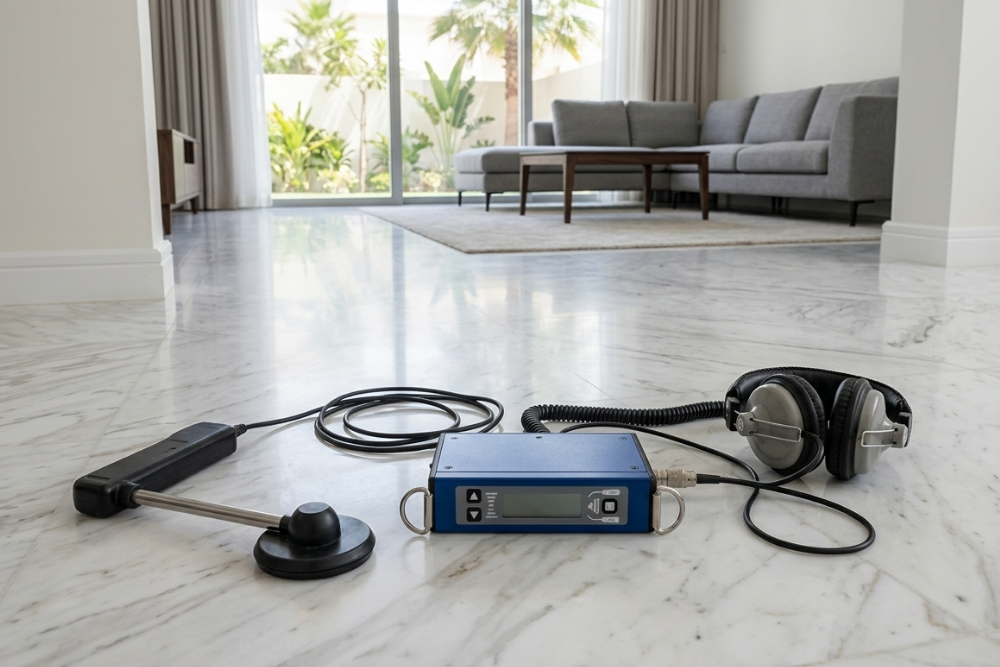
We combine acoustic listening equipment, electronic sensors, and thermal imaging to locate leaks accurately inside homes, without breaking tiles, opening walls, or drilling into floors unnecessarily. Once found, we handle the repair too.
AED 350+
Detection survey
1-3hr
Typical survey time
1
Company, detection to repair
Why Residential Water Leaks in Dubai Are So Common
Dubai's residential properties face a specific combination of conditions that accelerates pipe and joint deterioration faster than most other climates. The temperature swing between a January night and a July afternoon puts continuous stress on pipework through thermal expansion and contraction. Over several years, joints fatigue, seals degrade, and fittings that were installed perfectly begin to work loose.
Hard water compounds the problem. The UAE's water supply carries a high mineral content that gradually deposits scale inside pipes, around valve seats, and on fitting surfaces. This scale buildup interferes with seals and can cause fittings to crack or fail earlier than they otherwise would. Water heaters and mixing valves are particularly vulnerable.
Many residential leaks in Dubai also originate at concealed connections: supply lines behind tiled walls, flexible hoses under kitchen units, underground connections between the building's main supply and individual villa units. These locations get no visual inspection during routine maintenance, so a developing fault has months or years to worsen before any symptom appears.
A DEWA water bill rising month after month with no change in usage
The water meter moving when all taps and appliances are off
Damp or discoloured patches on walls, ceilings, or floors
Tiles lifting off the floor in bathrooms, kitchens, or living areas
A persistent musty or damp smell in one specific room
Warm patches on a tiled floor over hot water supply lines
Paint bubbling or peeling without an obvious water source
Reduced water pressure at taps or showers
Common Leak Locations in Dubai Homes
Below-Slab Supply Lines
Many Dubai villas and ground-floor apartments have water supply pipes running through or beneath the concrete slab. These pipes are completely inaccessible for routine inspection. When a joint or pipe section develops a fault, the only indication is usually an unexplained change in water consumption or a warm damp feeling on the floor surface above the pipe run. Acoustic detection is the most reliable method for locating slab pipe leaks precisely before any concrete work is needed.
Behind Bathroom and Kitchen Tiles
Concealed supply connections, shower valve bodies, and mixer tap inlets that sit behind tiled walls represent one of the most common residential leak sources in the UAE. The waterproof layer behind bathroom tiles is typically the first line of defence, but once a joint or fitting begins to fail, water migrates through the tile adhesive layer and begins saturating the wall structure behind. Thermal imaging makes these hidden moisture zones visible without tile removal.
Flexible Hose Connections
Under kitchen sinks, behind bathroom vanity units, and at dishwasher and washing machine connections, flexible braided hoses connect rigid supply lines to appliances. These hoses have a limited service life, typically five to ten years in UAE conditions, after which the inner liner begins to crack. A failing flexible hose can drip slowly for months inside a cabinet before the water works its way out to a visible location.
Concealed Cisterns
Concealed cisterns, the flush systems built into wall cavities behind back-to-wall toilets, are one of the more deceptive residential leak sources. A faulty fill valve or worn flush seal allows water to continuously trickle from the cistern into the pan, or in some cases directly into the wall structure. The toilet appears to be functioning normally, but the cistern is constantly losing small amounts of water. A pressure test of the cistern circuit quickly identifies this type of fault.
Underground Supply Connections
In villa developments with individual supply connections running underground from the main to each unit, pipe joint failures underground are reasonably common. These leaks are invisible at the surface, often running for extended periods before the accumulation of water consumption on the DEWA bill prompts an investigation. We use acoustic ground microphones to survey these connections without excavation.
Is It a Plumbing Leak, or AC Condensate?
A genuinely common source of confusion in Dubai homes: what looks and behaves like a water leak is sometimes the property's air conditioning system, not the plumbing at all.
Air conditioning units generate significant condensate, especially given how hard Dubai's systems run for most of the year, and that water has to drain somewhere. When the condensate drain line blocks, disconnects, or wasn't installed with adequate fall, the overflow shows up as water damage that looks identical to a plumbing leak: ceiling stains, damp patches near where an indoor unit is mounted, water pooling below a balcony AC condenser.
The distinguishing pattern is usually location and timing. Condensate issues track closely with AC usage, worse in peak summer, less noticeable when the system runs less, and the damage typically originates near where indoor units or ductwork are mounted rather than following a supply pipe route. A plumbing leak doesn't follow that seasonal pattern in the same way.
This isn't always obvious without inspection, and it's exactly the kind of distinction we confirm as part of a proper survey rather than something to self-diagnose with certainty. But if your symptom appeared or worsened during a hot spell and sits near an AC unit, mentioning that when you message us helps direct the diagnosis correctly from the start.
What You Can Check Yourself First
A few quick checks, all safe and free, help confirm whether you actually have a leak and give a technician a head start on where to look.
The meter test
Turn off every tap, appliance, and irrigation zone in the property. Note the water meter reading, wait 30 minutes without using any water, then check it again. If the reading has moved, there's an active leak somewhere in the supply system.
Check under sinks and behind appliances
Flexible hose connections at kitchen sinks, bathroom vanities, and washing machine or dishwasher connections are common failure points. A quick visual check for dampness or corrosion at these connections takes minutes.
Feel the floor near suspect areas
A warm patch on a tiled floor over a hot water line, or a persistently cool damp patch elsewhere, are both worth noting and mentioning when you message us, since they help narrow down the likely location before a technician arrives.
Review your last two DEWA bills
A gradual or sudden increase with no corresponding change in household usage is one of the clearest indicators of a leak running somewhere in the property, even before any visible sign appears.
How Residential Leak Detection Works
A methodical, non-invasive by default process, designed to produce a confirmed result on the same visit.
Initial walkthrough
We start with a full walkthrough of the property, checking meter readings, reviewing visible symptoms, and identifying the most likely areas of concern. This narrows the survey zone before any equipment is deployed.
Meter test
The water supply is checked at the meter to confirm active leakage before any detection equipment is deployed, ruling out normal consumption and confirming water is escaping somewhere in the supply system.
Acoustic survey
For pressurized supply line leaks, the most common type in residential properties, acoustic detection equipment is applied to floor surfaces, walls, and accessible pipe runs, triangulating the source to within centimetres.
Thermal imaging scan
Where a leak is suspected inside a wall cavity or above a ceiling, thermal imaging detects the temperature differential between dry and moisture-saturated building materials, making invisible water pathways visible.
Electronic detection
For bathroom and flat roof situations where moisture has penetrated a waterproof layer, electronic detection traces the conductivity path of water and confirms exactly where the waterproof layer has failed.
Location mark & report
Once confirmed, the exact spot is marked. You receive a written report covering what was found, the detection method used, the confirmed location, and the recommended repair approach. The repair usually begins immediately.
Residential Leak Detection & Repair Cost
Prices are indicative ranges. A written quotation is provided before any work begins.
| Service | Typical Dubai Price Range |
|---|---|
| Residential leak detection survey | AED 350 - 700 |
| Acoustic + thermal survey (combined) | AED 500 - 900 |
| Concealed pipe repair (wall/floor) | AED 400 - 1,200 |
| Slab pipe repair (targeted opening) | AED 800 - 2,500 |
| Flexible hose replacement | AED 150 - 350 |
| Concealed cistern repair | AED 200 - 500 |
Residential leak detection survey
- Typical Dubai Price Range
- AED 350 - 700
Acoustic + thermal survey (combined)
- Typical Dubai Price Range
- AED 500 - 900
Concealed pipe repair (wall/floor)
- Typical Dubai Price Range
- AED 400 - 1,200
Slab pipe repair (targeted opening)
- Typical Dubai Price Range
- AED 800 - 2,500
Flexible hose replacement
- Typical Dubai Price Range
- AED 150 - 350
Concealed cistern repair
- Typical Dubai Price Range
- AED 200 - 500
Benefits of Professional Residential Leak Detection
Exact location before opening
The fault is confirmed before any wall, tile, or floor surface is opened, no guesswork, no unnecessary demolition.
Minimum household disruption
A non-invasive approach keeps disruption to the household to an absolute minimum. Repair access is limited to the single confirmed fault point.
Lower repair costs
Because the opening needed is limited to the confirmed fault point only, total repair costs are significantly lower than exploratory approaches.
DEWA bill normalises
The water bill returns to expected levels immediately after a confirmed leak is properly repaired, no more unexplained consumption.
Prevents secondary damage
Catching a leak early stops the cascade, mould growth, structural weakening, corrosion, from progressing any further.
Survey report provided
A written survey report usable for insurance claims, landlord-tenant documentation, or facilities management records.
Why Choose Quick Fix Dubai for Residential Leak Detection
Non-invasive first, always
Nothing gets opened until the leak is confirmed and located. The survey produces the exact fault position before any structural access begins.
Detection and repair, one company
The same team that detects the leak carries out the repair. No coordination between separate contractors. One call, one job, one invoice.
Same-day service
In most residential cases, detection and repair are completed on the same visit. Emergency response available around the clock.
Certified specialists
All our technicians are trained on acoustic, electronic, and thermal detection methods and on UAE plumbing repair standards.
Written survey report
Every job produces a written report suitable for insurance claims, landlord-tenant disputes, or property management records.
All Dubai property types
Villas, apartments, townhouses, penthouses, and ground-floor commercial units, across all Dubai communities.
Residential Leak Detection Across Dubai
Villas, apartments, townhouses, and penthouses across every Dubai community, with acoustic, thermal, and electronic detection equipment on every van.
Residential Leak Detection FAQ
My DEWA bill has gone up but I can't see any leak. What should I do?
How do you find a water leak behind tiles without removing them?
Can a water leak damage my villa's structure?
I'm a tenant. Do I need the landlord's permission before calling for leak detection?
How long does a residential leak detection inspection take?
Do you work in apartments as well as villas?
Will the leak detection survey itself damage my flooring or walls?
How do I do the meter test to check for a leak myself?
Should I check anything before calling, or just book a survey directly?
Can a slow leak affect my DEWA bill even before any visible damage appears?
How do I know if a damp patch is from a plumbing leak or my AC condensate line?
If it turns out to be an AC condensate issue and not a plumbing leak, can you still help?
Do I need to call a plumber for water leak detection, or an electrician if it's near a wall outlet?
Find Your Residential Water Leak Today
A water leak caught early is a straightforward repair. The same leak left running for three months is a structural problem. We locate the fault accurately, carry out the repair, and confirm it's holding before leaving, one company, start to finish.
Licensed & insured. All areas of Dubai.