Sewer Line Repair and Replacement in Dubai: Camera First, Then the Right Fix
Sewer line repair in Dubai starts with a camera survey. It shows whether the pipe needs a single spot repair, a new lining inside the old pipe, or full replacement by pipe bursting or excavation. Under Dubai Municipality's Local Order No. 8 of 2002, the owner is responsible for the private drainage network up to the connection with the public sewer.
We repair and replace drainage in villas, apartments and commercial properties, using patch liners, full relining, pipe bursting and open excavation. We pick the method from the survey footage, not the other way round. If your line is blocked rather than broken, start with our sewer line cleaning service instead.
4
Repair methods, chosen on camera
AED 300+
Camera survey of the main line
CCTV
Before and after every repair
Signs Your Sewer Line Is Damaged, Not Just Blocked
A sewer line is probably damaged rather than blocked when the same blockage returns soon after cleaning, when several fixtures slow down together, or when there's a sewage smell, damp ground or sand in the chamber outside. Cleaning clears a blockage. It can't fix the crack, dip or displaced joint that keeps creating one.
The same blockage keeps coming back
A line that blocks again within weeks of a proper clean usually has a defect that catches waste: a displaced joint, a crack with roots in it, or a dip that holds water and sediment.
Several fixtures slow down together
One slow basin is a local blockage. Toilets, showers and floor drains all slowing at once point to the main line.
Sewage smell outside the house
A smell along the route of the line, around a chamber, or through garden paving suggests effluent is escaping underground.
Damp, sinking or unusually green patches
Leaking effluent softens the ground and feeds plants. A patch that stays wet, a paving slab that drops, or a strip of grass greener than the rest can all mark the line.
Sand or soil in the inspection chamber
Ground material in a chamber or the pipe means the line is open to the soil somewhere upstream: a crack, a broken joint or a damaged chamber wall.
Pests around the chamber
Cockroaches and rodents use cracked lines and damaged chamber covers as a route. An infestation that keeps returning near the drainage is worth a camera look.
If the problem is a smell inside the house with no drainage symptoms, the cause is often a dry trap or a venting fault rather than the main line. Our guide to sewage smells in Dubai homes covers those checks.
Who Owns Which Pipe: Local Order No. 8 of 2002
Dubai Municipality's Local Order No. 8 of 2002 makes a building's owner responsible for the operation and maintenance of its private sewerage network, including any blockage, overflow or leak in it. Where a private network becomes a public health risk, the Municipality can put it right and charge the owner. For a villa, the private network runs from the house to the inspection chamber at the plot boundary, where it meets the public sewer.
The Municipality's sewerage design guidelines set the pattern: each plot drains separately to an inspection chamber outside its boundary. Everything on your side of that connection is your system to maintain and repair. The same Local Order also prohibits covering, burying or building over the public network's manholes and inspection chambers, or planting trees where they could affect it.
| Property | Owner's responsibility | Not the owner's |
|---|---|---|
| Villa or townhouse | The private line from the house to the inspection chamber at the plot boundary | The public sewer beyond the connection, run by Dubai Municipality |
| Apartment | Branch pipes, traps and WC connectors inside your unit | Shared soil stacks, risers and building drainage, handled by building management |
| Commercial unit | The unit's internal drainage, plus any grease trap serving it | Shared building drainage beyond the unit's connection |
Villa or townhouse
- Owner's responsibility
- The private line from the house to the inspection chamber at the plot boundary
- Not the owner's
- The public sewer beyond the connection, run by Dubai Municipality
Apartment
- Owner's responsibility
- Branch pipes, traps and WC connectors inside your unit
- Not the owner's
- Shared soil stacks, risers and building drainage, handled by building management
Commercial unit
- Owner's responsibility
- The unit's internal drainage, plus any grease trap serving it
- Not the owner's
- Shared building drainage beyond the unit's connection
In apartment towers, the split matters for who pays. A blocked or cracked shared stack is a building matter, even when the symptom appears in your bathroom. A failed WC connector or a cracked branch under your shower is inside your unit. Our camera survey shows which side of that line the defect sits on, and the footage gives you something concrete to send to building management.
Between landlord and tenant, repair of the drainage system normally falls to the landlord unless the tenancy contract says otherwise. A blockage caused by what went down the drain is a different conversation. Our landlord plumbing maintenance guide sets out the usual split.
Why Sewer Lines Fail in Dubai
Most private sewer lines in Dubai fail for one of four reasons: the ground settles under them, nearby digging damages them, roots get in at the joints, or sand gets in through cracks and loose covers. The cause matters because it decides whether the fix will last. Relining a pipe that's still sinking only moves the problem.
Ground settlement
Plots built on filled or reclaimed ground can settle after construction. A rigid pipe that was laid straight ends up with a dip or a pulled joint, and the dip collects sediment.
Construction and landscaping damage
Extensions, pools, new paving and fence posts are dug near drainage lines all the time. A pipe cracked by an excavator often keeps working for months before the defect shows.
Roots at joints
Palms and irrigated shrubs send roots toward the moisture at pipe joints. Once inside, roots widen the gap every year they're cut back and regrow.
Sand
Sand washed into lines and chambers through cracks or loose covers settles at low points and speeds up wear. Our sewer cleaning page covers sand ingress in detail.
Heavy rain in Dubai often exposes lines that were already weak. Water and sand get into cracked pipes and poorly sealed chambers, and a line that coped in dry weather starts backing up through floor drains. If your problems started after a storm, the storm probably found the defect rather than caused it. For the cleaning side of sand and roots, see our sewer line cleaning page.
Camera First: What the Survey Decides
A camera survey decides three things before any repair is priced: what the defect is, exactly where it is including its depth, and whether the rest of the line is sound enough to keep. Without it, a contractor is guessing, and the guess usually becomes either a trench longer than needed or a repair in the wrong place.
The camera head carries a small transmitter. From above ground, we can trace its position and depth to mark the defect on your paving or lawn to within a short distance. That's what makes a targeted opening or a short patch repair possible instead of opening the whole route. The survey also records the pipe's material, diameter and joint condition, which decides which trenchless methods are available.
Before any camera goes in, the line is cleaned. Otherwise the footage shows debris, not defects. The survey process and reporting are the same as our standalone drain line camera inspection. Every repair ends with a second camera run, so you have before and after footage of the same section.
Repair, Reline or Replace: Decided by the Defect
The defect on the camera footage decides the method. A single cracked or displaced joint gets a patch liner or a short spot repair. A cracked pipe that still holds its shape gets relined. A collapsed or deformed pipe, a dip that holds water, or a pipe laid at the wrong fall gets replaced by pipe bursting or excavation. Choosing the method first and fitting the pipe to it is how people end up paying twice.
| What the camera shows | Usually | Why |
|---|---|---|
| Roots at a few joints, pipe otherwise sound | Clear the roots, then patch or reline those joints | Seals the entry points so the roots can't return |
| One cracked or displaced joint | Patch liner, or a short spot excavation | The rest of the line doesn't need touching |
| Cracks along a pipe that still holds its shape | Full-section relining | A new jointless pipe forms inside the old one |
| Pipe deformed or partly collapsed | Pipe bursting or excavation | A liner needs a sound host pipe to cure against |
| Section fully collapsed | Excavate and replace | There's no open pipe left to line through |
| A dip (belly) that holds water | Excavate and re-lay to a proper fall | A liner follows the dip, so the dip stays |
| Undersized pipe or wrong fall from the original build | Replace by excavation, or by bursting to upsize | Lining can't change the size or the gradient |
| Line under a building slab or finished floor | Reline where possible | Avoids breaking the floor to reach the pipe |
Roots at a few joints, pipe otherwise sound
- Usually
- Clear the roots, then patch or reline those joints
- Why
- Seals the entry points so the roots can't return
One cracked or displaced joint
- Usually
- Patch liner, or a short spot excavation
- Why
- The rest of the line doesn't need touching
Cracks along a pipe that still holds its shape
- Usually
- Full-section relining
- Why
- A new jointless pipe forms inside the old one
Pipe deformed or partly collapsed
- Usually
- Pipe bursting or excavation
- Why
- A liner needs a sound host pipe to cure against
Section fully collapsed
- Usually
- Excavate and replace
- Why
- There's no open pipe left to line through
A dip (belly) that holds water
- Usually
- Excavate and re-lay to a proper fall
- Why
- A liner follows the dip, so the dip stays
Undersized pipe or wrong fall from the original build
- Usually
- Replace by excavation, or by bursting to upsize
- Why
- Lining can't change the size or the gradient
Line under a building slab or finished floor
- Usually
- Reline where possible
- Why
- Avoids breaking the floor to reach the pipe
Patch liners
A short resin sleeve cured at one defect, such as a displaced joint or a single crack, while the rest of the line stays as it is. It suits a line that the survey shows is sound everywhere else.
Pipe bursting
A bursting head is pulled through the old pipe, splitting it outward, while a new pipe follows behind in the same path. It needs a pit at each end, works best on straight runs, and can fit a slightly larger pipe than the one it replaces.
Relining vs. pipe bursting vs. excavation
Relining disturbs the least but needs a sound pipe and keeps the old route and fall. Bursting replaces a failed pipe along the same path from two pits. Excavation disturbs the most but is the only method that can fix a dip, change the fall or move the route.
| Relining | Pipe bursting | Excavation | |
|---|---|---|---|
| Digging | None, or one small opening | A pit at each end | Along the defect or the whole route |
| Needs a sound host pipe | Yes | No | No |
| Fixes a dip or wrong fall | No | Partly, follows the old path | Yes |
| Can increase pipe size | No, slightly reduces the bore | Yes, a step up | Yes |
| Under paving, pools or slabs | Best suited | Suited if pits can be placed | Paving lifted and relaid |
| Typical time on site | About a day per section | One to two days | Several days plus reinstatement |
Digging
- Relining
- None, or one small opening
- Pipe bursting
- A pit at each end
- Excavation
- Along the defect or the whole route
Needs a sound host pipe
- Relining
- Yes
- Pipe bursting
- No
- Excavation
- No
Fixes a dip or wrong fall
- Relining
- No
- Pipe bursting
- Partly, follows the old path
- Excavation
- Yes
Can increase pipe size
- Relining
- No, slightly reduces the bore
- Pipe bursting
- Yes, a step up
- Excavation
- Yes
Under paving, pools or slabs
- Relining
- Best suited
- Pipe bursting
- Suited if pits can be placed
- Excavation
- Paving lifted and relaid
Typical time on site
- Relining
- About a day per section
- Pipe bursting
- One to two days
- Excavation
- Several days plus reinstatement
Sewer Pipe Relining, Explained
Relining, also called cured-in-place pipe or CIPP, repairs a sewer line from the inside without digging along its route. A resin-soaked liner is fed into the cleaned pipe and cured in place, forming a new jointless pipe inside the old one. It seals cracks and the joints roots get through. Access is through an existing chamber or a single small opening.
- 1
Confirm the pipe can be lined
The camera survey confirms the pipe still holds its shape. Relining strengthens and seals a sound host pipe; it can't rebuild one that has collapsed or badly deformed.
- 2
Clean the pipe back to its wall
The line is jetted clear of roots, scale and debris, because the liner has to sit tight against the existing pipe wall to seal it.
- 3
Insert and cure the liner
A resin-saturated liner is pulled or inverted into the pipe, then cured in place with hot water, steam or UV light, depending on the resin system.
- 4
Reopen any branch connections
Where side branches join the lined section, their openings are cut back from inside the pipe with a remote cutter.
- 5
Camera the finished lining
A final survey confirms the liner has cured evenly and sealed the old cracks and joints, and gives you before and after footage.
Where relining is the right call: a line with a history of root intrusion, joints that have opened, or cracks along its length, especially where the route runs under a driveway, pool deck, mature planting or the house itself. The treated section has no joints left, so the gaps roots used are gone, rather than cut back and waiting to regrow.
Where it isn't:
- A collapsed or badly deformed pipe, because the liner needs a host to cure against.
- A dip that holds water, because the liner follows the dip.
- A pipe that's too small, because lining slightly reduces the bore.
In those cases we'll recommend bursting or excavation instead, and show you the footage that led to that recommendation.
Excavation Replacement and Under-Slab Drains
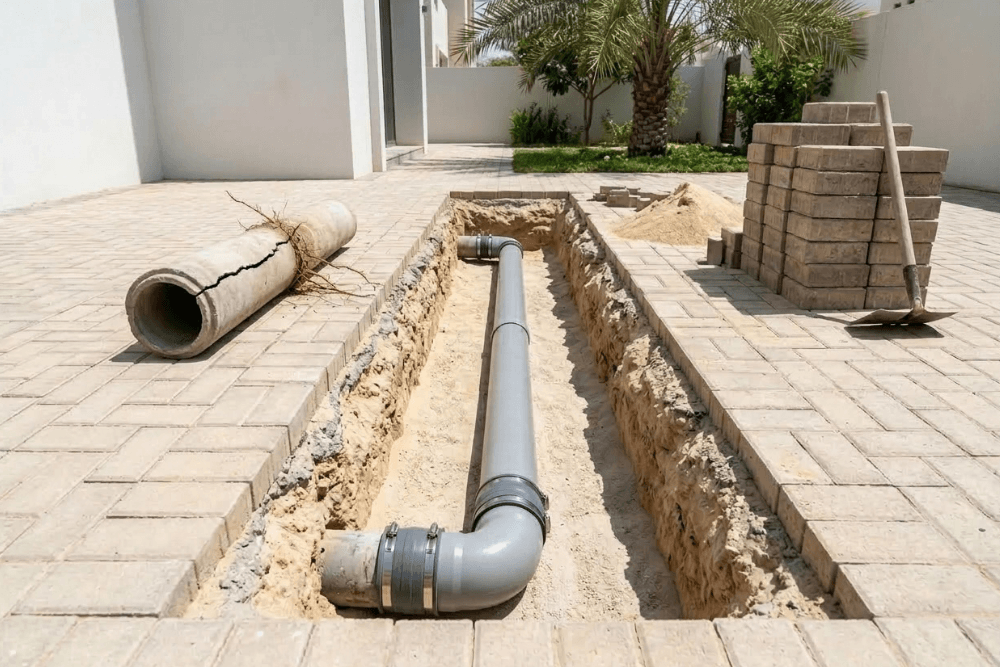
Excavation is still the right repair for a collapsed pipe, a line with a dip, or a pipe laid at the wrong fall. It's also the only way to change the route. With the camera marking the defect from above, the opening is kept as short as the problem allows. We don't trench the full route unless the whole route needs replacing.
The new pipe is bedded on a stable base and laid to a steady fall, so the flow keeps the pipe clean. Each joint is checked before backfilling. Paving and interlock are lifted and set aside so they can be relaid, not broken and replaced. Where the route passes a shared boundary or a community area, digging may need a permit, so we build that into the schedule.
Villa ground floors often carry drainage under the slab. A leaking or broken drain under a finished floor is first surveyed and located by camera. Where the pipe still holds its shape, relining from the nearest access point avoids breaking the floor at all. Where it doesn't, a targeted opening over the located defect limits the damage to one area of tiles.
For leaks in the water supply under a slab rather than the drainage, see our slab leak detection page. Supply and drainage problems under a floor can look similar from above, but they're found and fixed differently.
Inspection Chambers, Soil Stacks and Septic Lines
Sewer repair isn't only about the buried pipe. Three other points fail often enough that we check them on every survey: villa inspection chambers, whose walls, benching and covers let in sand and water; soil and waste pipes inside buildings, where connections crack behind walls and ceilings; and the inlet line to a septic tank, where the pipe meets the tank.
Inspection chambers
The channel at the bottom of a chamber, called the benching, should guide flow straight through. Cracked walls, broken benching and loose covers let sand and water in and let waste settle. We repair walls, re-form the benching and refit covers, and keep every chamber accessible rather than paved over.
Soil and waste pipes
Inside apartments and villas, a cracked WC connector, a failed joint on a shower waste or a split branch in a ceiling void causes stains and smells well before anything backs up. We replace the failed section through the nearest access panel or a planned opening, and camera the branch to confirm the rest is sound.
Septic inlet lines
Where a property still runs to a septic tank, the inlet pipe is where settlement between the tank and the house shows up first. A separated inlet lets effluent into the ground around the tank. We replace the inlet section, and our septic tank services cover the tank itself.
On new builds, drains that are already damaged or full of grout and cement at handover are the developer's to fix during the liability period. Our plumbing snagging inspection includes a camera run on the main lines for exactly that reason.
How a Sewer Line Repair Runs
Every sewer line repair follows the same order: clean and survey, a written recommendation with a fixed price, approvals and access, the repair, a test and a second camera run, then reinstatement. Nothing is dug or lined before you've seen the footage and agreed the method, and you finish with before and after footage of the same stretch of pipe.
- 1
Clean and survey
The line is cleaned so the camera sees the pipe wall, then surveyed from the house to the boundary chamber, with each defect recorded and located from above.
- 2
Written recommendation
You receive the footage, the defects with their positions and depths, the method we recommend for each and why, and a fixed price.
- 3
Approvals and access
Where digging affects shared areas or a community requires it, the permit or NOC is arranged. Paving over the work area is lifted and set aside.
- 4
Repair
The chosen method is carried out: a patch liner, full relining, pipe bursting or excavation and re-laying, keeping the property's drainage usable for as much of the work as possible.
- 5
Test and camera again
The repaired section is flow-tested and surveyed again, so you have before and after footage of the same stretch of pipe.
- 6
Reinstate
Openings are backfilled and compacted, paving is relaid, and chambers are left accessible with sound covers.
Sewer Line Repair and Replacement Cost in Dubai
Sewer line repair in Dubai costs from AED 1,500 for a single spot repair and AED 2,000 for a no-dig patch liner, up to AED 6,000 to 22,000 to replace a full villa line to the boundary chamber. The camera survey that decides the method costs AED 300 to 800. Depth, access, pipe length and what sits above the route move a job within each range.
| Work | Typical price |
|---|---|
| Camera survey of the main line | AED 300 - 800 |
| Spot repair by excavation (single crack or joint) | AED 1,500 - 4,000 |
| Patch liner, no-dig (single defect) | AED 2,000 - 5,000 |
| Relining, per section | AED 3,000 - 8,000+ |
| Full villa line to boundary chamber, open trench | AED 6,000 - 18,000 |
| Full villa line to boundary chamber, no-dig | AED 8,000 - 22,000 |
| Inspection chamber rebuild or re-benching | AED 1,200 - 3,500 |
| Soil or waste pipe section inside an apartment | AED 1,200 - 4,000 |
| Under-slab drain, targeted opening | AED 2,500 - 7,000 |
Camera survey of the main line
- Typical price
- AED 300 - 800
Spot repair by excavation (single crack or joint)
- Typical price
- AED 1,500 - 4,000
Patch liner, no-dig (single defect)
- Typical price
- AED 2,000 - 5,000
Relining, per section
- Typical price
- AED 3,000 - 8,000+
Full villa line to boundary chamber, open trench
- Typical price
- AED 6,000 - 18,000
Full villa line to boundary chamber, no-dig
- Typical price
- AED 8,000 - 22,000
Inspection chamber rebuild or re-benching
- Typical price
- AED 1,200 - 3,500
Soil or waste pipe section inside an apartment
- Typical price
- AED 1,200 - 4,000
Under-slab drain, targeted opening
- Typical price
- AED 2,500 - 7,000
Included
Cleaning before the survey, the survey and written recommendation, the repair, flow testing, the post-repair survey with footage, backfilling and relaying lifted paving.
Not included
New paving or tiles where the originals can't be reused, landscaping replacement, and any fees charged by your community or building for permits.
What sewer line replacement costs, and why the range is wide
Replacing a full villa sewer line to the boundary chamber costs AED 6,000 to 18,000 by open trench and AED 8,000 to 22,000 by no-dig methods. Repairing one defect costs a fraction of that, which is why the camera survey comes first: most lines that look like they need replacing have one or two failed joints or a single cracked section.
Repair or replace. A single crack, root entry or displaced joint is a spot repair or a patch liner, AED 1,500 to 5,000. Replacement becomes the cheaper choice when the survey shows defects along most of the line, a sagging section that holds standing water, or a collapse that has flattened the pipe.
No-dig or excavation. Trenchless work costs more per metre of pipe, but it avoids lifting and relaying paving, driveways and landscaping. On an open garden run, digging is usually cheaper. Under a driveway, a pool deck or interlock paving, the reinstatement cost of digging often makes the no-dig price the lower total.
Collapsed pipes. A collapsed section can’t be relined, because the liner needs an intact host pipe to form inside. The collapsed length is replaced by pipe bursting or by excavation, and the rest of the line is lined or left in place depending on what the camera shows.
Under the slab. Drains under a villa’s floor slab are reached by a targeted opening at the defect, AED 2,500 to 7,000, rather than by breaking out the whole floor. The camera survey locates the defect to within a tile or two before any floor is opened.
Chambers are priced separately from pipes. If the problem is a broken cover, a loose frame or a cracked inspection chamber rather than the pipe itself, see manhole and inspection chamber repair.
Four questions to ask any sewer repair quote
- Will I see the camera footage before I agree the method?
- Is the line cleaned before it's surveyed?
- Does the price include a camera run after the repair?
- If the plan is to dig, why can't the section be lined, and if it's to line, why is the host pipe suitable?
A contractor who can answer all four from footage of your pipe has diagnosed the problem. One who can't is selling a method.
Sewer Repair for Restaurants, Shops and Buildings
Commercial sewer repair uses the same methods, planned around a business that usually can't close. Relining and patch liners suit commercial premises well, because they work through existing access points and often fit into a night or a weekend. That avoids breaking a kitchen floor or a shopfront's paving during trading hours.
Restaurant lines carry grease, and grease that gets past a failing or undersized grease trap coats the pipe wall and builds up at every defect. Before relining a kitchen line, we check that the trap and its connections are doing their job, so the new lining isn't coated the same way within a year. Our grease trap cleaning service covers the trap itself, and our commercial plumbing page covers scheduled maintenance for businesses.
Keeping a Repaired Sewer Line Healthy
A repaired sewer line stays healthy when only waste and toilet paper go down it, chambers stay uncovered and sealed, trees and heavy planting stay off the route, and older lines get a camera check every few years. Most repeat failures after a good repair come from what's put into the line or planted over it.
What goes down the line
Wet wipes, even those sold as flushable, cooking fat and kitchen scraps are the most common reasons a sound line blocks again. Fat sets in the pipe as it cools and catches everything behind it.
Chambers and covers
Keep inspection chambers visible and their covers sealed. A chamber paved over during landscaping can't be used to clean or survey the line, and a loose cover lets sand and water in.
Planting near the route
Palms and irrigated shrubs planted on top of a drainage line will look for its joints. Plant clear of the route, and keep the route photos from the repair so future landscaping knows where it runs.
A camera check every few years
For older lines, and for the unlined sections either side of a repair, a survey every few years catches a new defect while it's still a patch job. Our sewer line cleaning page covers maintenance cleaning.
Where We Repair Sewer Lines in Dubai
We repair and replace sewer lines across Dubai. Most villa line work comes from the established communities, where drainage has had years of settlement, landscaping and root growth above it. Older buildings in Deira, Bur Dubai and Al Qusais bring stack and branch repairs. These area pages carry local plumbing notes:
Sewer Line Repair FAQ
How much does sewer line repair cost in Dubai?
How much does it cost to replace a sewer line in Dubai?
Is trenchless sewer replacement more expensive than digging?
How much does it cost to repair a collapsed drain pipe?
Can you replace old cast iron drain pipes in an apartment?
Who is responsible for the sewer line of my property in Dubai?
How do I know if my sewer line is broken or just blocked?
Can every sewer pipe be relined?
How long does a relined sewer pipe last?
Will you need to dig up my garden or driveway?
How long does a sewer line repair take?
Do I need a permit to repair my sewer line?
Is sewer line cleaning enough, or do I need a repair?
Who pays for sewer repairs in a rented property?
See the Pipe Before You Pay for the Fix
Tell us the property type and what's happening: repeat blockages, smells, damp ground or sand in the chamber. We'll clean and survey the line, show you the footage, and quote the method that fits the defect.