Water Tank Cleaning Dubai
Your water tank is the source of every drop your household uses, drinking, cooking, bathing, and it's also the part of a property nobody actually looks at. Cleaning and sterilisation for rooftop and underground tanks, villas, apartments, and commercial buildings, to real Dubai Municipality standards, not a vague compliance claim.
Optional lab testing for Legionella and total bacteria count, full float and foot valve inspection, and compliant disposal documentation for the drained water, not just a rinse and refill.
AED 250+
Standard apartment tank
Every 6mo
DM recommended cycle
Free
Initial inspection
Why Tanks Get Contaminated in Dubai Specifically
Dubai Municipality's own guidance identifies specific, concrete triggers, not a vague 'it's good practice' recommendation. Understanding which one applies to your tank explains what an inspection is actually looking for.
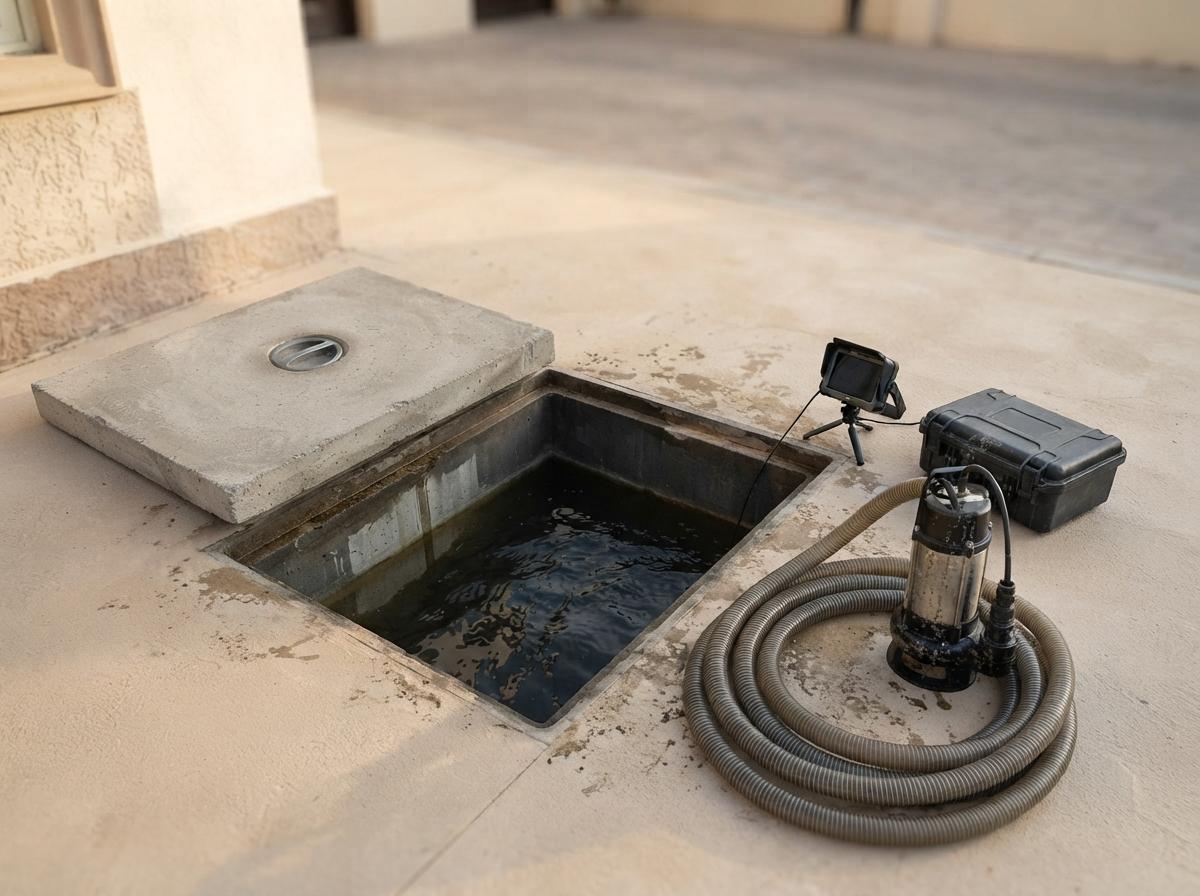
Insects and debris through an unsealed cover
The cover is the single most common failure point, and it's rarely dramatic. A cover that's cracked, warped from sun exposure, or just not seated flush leaves a gap small enough to miss on a casual glance but large enough for insects, dust, and windblown debris to enter continuously rather than in one obvious event. Dubai Municipality's own inspection guidance treats cover condition as the first thing to check, precisely because it's the entry point behind most contamination that otherwise looks unexplained.
Rainwater seepage through wall cracks
More relevant to underground tanks than rooftop ones. Concrete and older tank walls develop hairline cracks over years, and surrounding ground moisture, worse during Dubai's rare but intense rain events, finds its way in through those cracks rather than through the cover. This is why an underground tank inspection has to cover exterior wall condition, not just what's visible from inside, a crack that looks minor from inside can be a much larger problem from the soil side.
Algae and bacterial growth accelerated by heat
A rooftop tank under direct Dubai sun for most of the day sits at a water temperature considerably warmer than the same tank would reach in a milder climate, and warmth is the single biggest accelerant for both algae growth and bacterial multiplication. A translucent or poorly sealed cover makes this worse by letting light reach the water directly, algae needs light as much as it needs warmth, so a fully opaque, properly sealed cover does real, measurable work here, not just a cosmetic difference.
Mineral sediment from hard water settling out
Dubai's water carries a measurable mineral load, and over months that settles as sediment at the tank base regardless of whether any biological contamination is present at all. This is a separate problem from algae or bacteria, a tank can fail a clarity or taste check purely from sediment while still being biologically clean, which is part of why cleaning and sterilisation are genuinely two different steps rather than one combined action.
These four causes rarely act alone. A rooftop tank with a slightly warped cover is dealing with heat, light, and a debris entry point simultaneously, which is why a proper inspection checks all of them rather than assuming the obvious cause is the only one present.
Rooftop vs. Underground, and Who's Actually Responsible
Rooftop vs. Underground Tanks: Genuinely Different Risks
| Tank type | Primary risk | What inspection focuses on |
|---|---|---|
| Rooftop tank | Algae growth from direct sun and light exposure | Cover condition first, then interior wall growth |
| Underground tank | Rainwater and ground moisture seeping through wall cracks | Interior and exterior wall condition, not just what's visible from inside |
Rooftop tank
- Primary risk
- Algae growth from direct sun and light exposure
- What inspection focuses on
- Cover condition first, then interior wall growth
Underground tank
- Primary risk
- Rainwater and ground moisture seeping through wall cracks
- What inspection focuses on
- Interior and exterior wall condition, not just what's visible from inside
Villas vs. Apartments: Who's Actually Responsible?
| Property type | Who's responsible | Note |
|---|---|---|
| Villa | The tank is private property, maintenance is a direct owner or resident responsibility | No building management involved, it's on you |
| Apartment, private unit tank | Same as a villa, it's the unit owner or tenant's responsibility | Confirm with the landlord if renting |
| Apartment, shared central tank | Building administration or the owners' association | Common in newer developments, ask building management before booking privately |
Villa
- Who's responsible
- The tank is private property, maintenance is a direct owner or resident responsibility
- Note
- No building management involved, it's on you
Apartment, private unit tank
- Who's responsible
- Same as a villa, it's the unit owner or tenant's responsibility
- Note
- Confirm with the landlord if renting
Apartment, shared central tank
- Who's responsible
- Building administration or the owners' association
- Note
- Common in newer developments, ask building management before booking privately
If you're noticing a change in water quality in an apartment, the first question worth answering is whether your unit has its own tank or shares a central one, since that determines who should actually be covering the cost before you book anything privately.
Signs Your Tank Needs Cleaning Now
Dubai Municipality recommends cleaning every 6 months as routine maintenance, regardless of symptoms. These signs mean don't wait for that schedule.
- !A change in water taste or smell, even subtle
- !Visible cloudiness when filling a clear glass
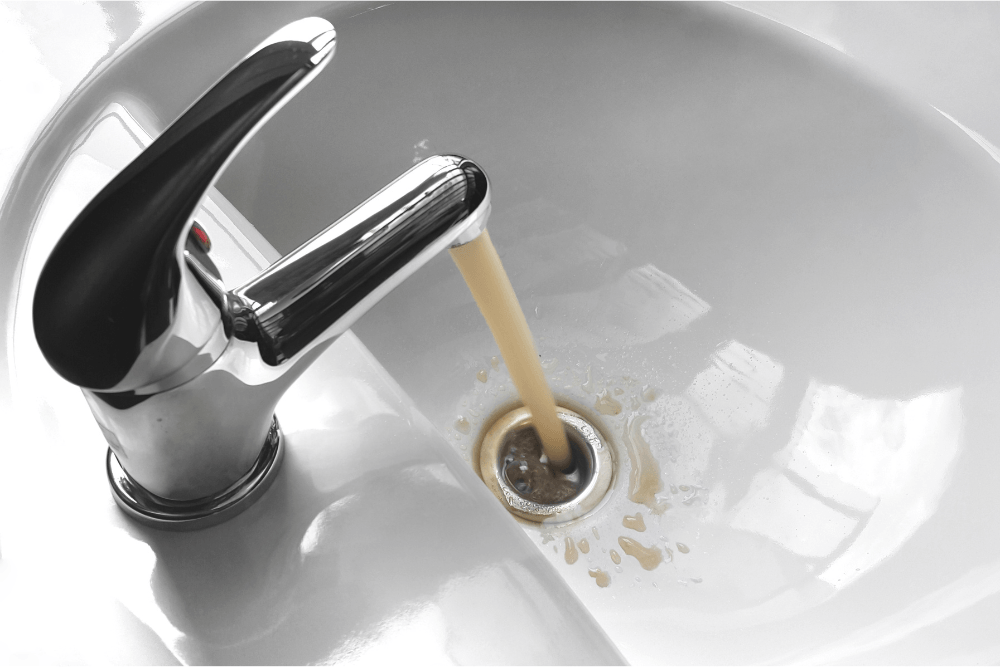
- !Visible sediment when a tap is opened after standing unused
- !A sudden drop in water pressure, which can indicate partial blockage at the tank outlet from sediment
- !Any construction or excavation work near an underground tank
A Real Health Consideration Worth Understanding
This is well-established public health information, not specific to Dubai, but genuinely more relevant here because of the climate. Stagnant water in the roughly 25-42°C range creates ideal conditions for certain bacteria, including Legionella, associated with a serious respiratory illness when contaminated water droplets are inhaled. That temperature range maps directly onto a rooftop tank exposed to a Dubai summer. This doesn't mean every neglected tank carries this risk, but it explains why regular cleaning and sterilisation is a genuine preventive step grounded in established science, not just a cosmetic maintenance task.
Cleaning vs. Sterilisation, and Our Full Process
Cleaning
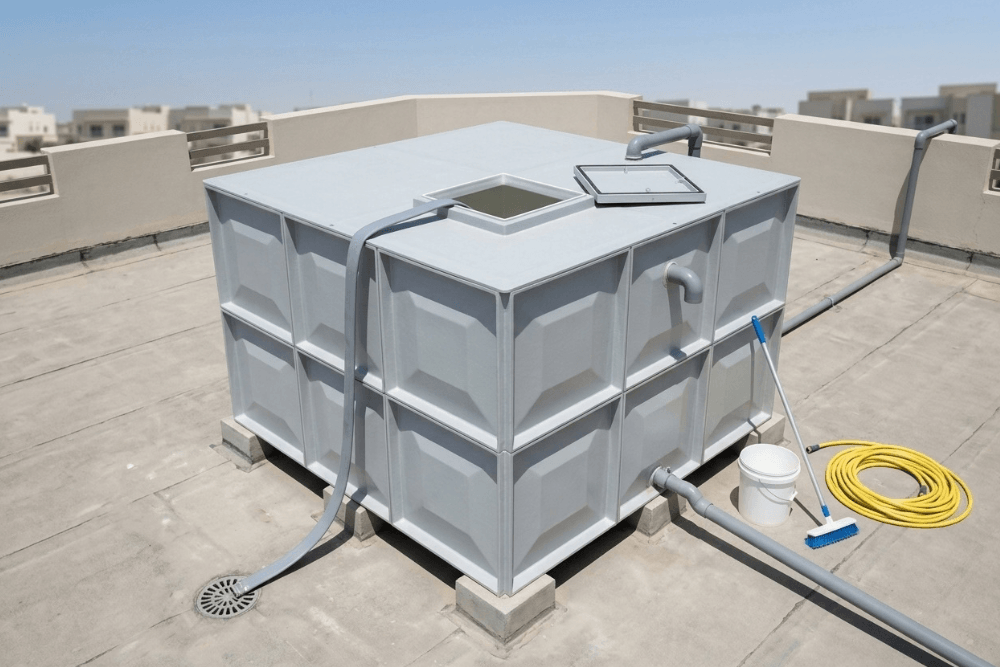
The physical removal of visible sediment and algae from walls and the base, removing what you can see.
Sterilisation
A safe chemical treatment that eliminates bacteria invisible to the eye. Any genuine service includes both steps, not just a surface rinse.
Assessment
We evaluate tank type, material, and condition before starting, including the cover seal and visible exterior walls. This is also when we confirm whether float valve, foot valve, or suction pipe issues exist separately from contamination, a tank can be perfectly clean and still have a failing float valve causing pressure or overflow problems.
Drain and clean
Remaining water is drained via submersible pump, then sediment and algae are physically removed from walls and base using tools that won't scratch the interior surface. This is the cleaning step: physical removal of what's visible.
Sterilise
A safe, Dubai Municipality-approved chemical treatment designed specifically for drinking water systems eliminates bacteria invisible to the eye. This is a genuinely separate step from cleaning, a tank that's been cleaned but not sterilised can look completely clear while still carrying biological contamination you can't see.
Optional lab testing
For properties wanting confirmation beyond visual inspection, Legionella and total bacteria count (TBC) testing is available as an add-on. Genuinely useful for commercial properties, buildings with a history of water quality complaints, or anyone who wants a documented result rather than taking cleanliness on faith.
Full rinse
The tank is rinsed thoroughly to confirm no trace of sterilising agent remains before refilling, checked rather than assumed.
Compliant disposal
Drained water and sediment are disposed of through proper waste channels, not into a storm drain or the nearest patch of ground. For commercial and larger residential jobs, documentation is available confirming compliant disposal, useful for property managers who need it on file.
Final check
We confirm the cover seals properly, the single most common cause of contamination according to Dubai Municipality's own guidance, and provide before-and-after documentation of the completed work.
Water Tank Cleaning Cost in Dubai
Priced by tank size and property type, confirmed after inspection, not a phone guess.
| Service | Typical Cost (AED) |
|---|---|
| Initial inspection | Free |
| Standard apartment tank, clean & sterilise | AED 250 - 500 |
| Villa tank (rooftop or underground) | AED 500 - 1,200 |
| Large or commercial tanks | AED 1,200 - 2,000 |
| Legionella / TBC lab testing (add-on) | AED 150 - 350 |
| Float, foot valve, or suction pipe repair | Quoted after inspection |
| Compliant disposal documentation (commercial) | Included on request |
Initial inspection
- Typical Cost (AED)
- Free
Standard apartment tank, clean & sterilise
- Typical Cost (AED)
- AED 250 - 500
Villa tank (rooftop or underground)
- Typical Cost (AED)
- AED 500 - 1,200
Large or commercial tanks
- Typical Cost (AED)
- AED 1,200 - 2,000
Legionella / TBC lab testing (add-on)
- Typical Cost (AED)
- AED 150 - 350
Float, foot valve, or suction pipe repair
- Typical Cost (AED)
- Quoted after inspection
Compliant disposal documentation (commercial)
- Typical Cost (AED)
- Included on request
Final price depends on actual tank size and condition after inspection, not a phone guess.
Managing a building, hotel or staff accommodation? Our Legionella risk assessment and water testing service covers the whole water system, not only the tank.
Water Tank Repair: Fittings & Components
A tank inspection during cleaning often turns up a fitting that's failing, not just dirt. These are quoted and fixed on the same visit if you'd like, or noted in the report for later.
| Component | Typical Cost |
|---|---|
| Float valve (ballcock) stuck or not shutting off | AED 100 - 250 |
| Foot valve replacement | AED 120 - 280 |
| Suction pipe repair or replacement | Quoted after inspection |
| Overflow pipe repair or resealing | AED 100 - 200 |
| Access hatch / lid replacement | AED 80 - 180 |
Float valve (ballcock) stuck or not shutting off
- Typical Cost
- AED 100 - 250
Foot valve replacement
- Typical Cost
- AED 120 - 280
Suction pipe repair or replacement
- Typical Cost
- Quoted after inspection
Overflow pipe repair or resealing
- Typical Cost
- AED 100 - 200
Access hatch / lid replacement
- Typical Cost
- AED 80 - 180
A float valve that won't shut off is the single most common water tank repair we see, it wastes water continuously and, left long enough, can overflow the tank entirely. It's also one of the cheapest fixes on this page, which is why we check it on every cleaning visit rather than only when it's already failed.
If the tank body itself has cracked, gone brittle in the sun or started to rust, a fitting won't fix it. See water tank replacement and installation for GRP and plastic tanks, sizing and installed prices.
What You're Actually Getting
Real inspection, not a phone guess
Tank type, material, and condition assessed before we name a price, including cover seal and exterior wall condition on underground tanks.
Optional lab-verified results
Legionella and TBC testing available for anyone who wants documented confirmation, not just a visual clean.
Float, foot valve & suction pipe check
We check the mechanical components connected to your tank, not just the tank shell itself.
Compliant disposal, documented
Drained water and sediment handled through proper waste channels, with documentation available for commercial properties.
Before-and-after documentation
Photo evidence of the completed work, useful for your own records or for a landlord and property manager.
Licensed and insured
The same standard on a standard apartment tank as on a large commercial job.
Serving All of Dubai
From villa rooftop tanks to shared central tanks in older apartment buildings, our technicians carry the equipment for every tank type and size.
Water Tank Cleaning FAQ
How often should I clean my water tank in Dubai?
Can I clean my villa's tank myself?
How long does a full tank cleaning take?
Could tank contamination be connected to a bigger plumbing issue?
What's the difference between cleaning and sterilising a tank?
Do you offer lab testing to confirm the water is actually safe?
What happens to the water and sediment once the tank is drained?
Is my apartment's tank my responsibility, or the building's?
Do you check the float valve and other tank components, or just clean the tank itself?
Why does my rooftop tank seem to need cleaning more often than an underground one?
Is a dirty water tank actually a health risk, or just an inconvenience?
Overdue for a Tank Clean? Book a Free Inspection
Every drop your household uses starts in that tank, and it's the one part of a property nobody actually checks. Dubai Municipality recommends cleaning every 6 months, regardless of whether any sign of contamination has appeared yet.
Full cleaning and sterilisation, optional lab-verified testing, compliant disposal, fixed price after inspection, not a phone guess.
Licensed & insured. All areas of Dubai.