Underground Water Leak Detection Dubai
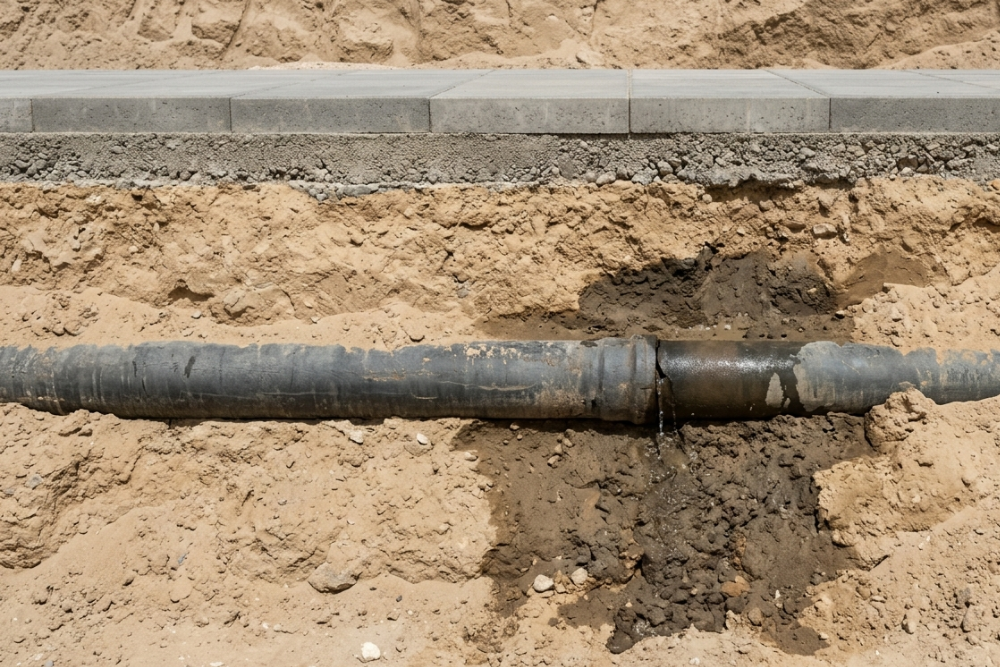
An underground water leak is one of the more difficult problems a property faces, precisely because there's nothing to see. The leak forms below the surface, water migrates through the surrounding soil, and weeks or months can pass before any surface indication appears.
We use acoustic ground microphones and tracer gas methods to locate buried pipe leaks precisely before any excavation begins. The difference between a confirmed location and an approximate one is the difference between a small targeted repair trench and a large-scale groundworks project.
0.5-1m
Typical acoustic accuracy
6m+
Tracer gas effective depth
0
Digging to detect
What Causes Underground Water Leaks in Dubai?
Underground supply pipes in Dubai face a combination of stresses that accelerates their deterioration. The significant temperature range between winter nights and summer days causes thermal expansion and contraction in the pipe material and at joints, a continuous mechanical stress that eventually fatigues fittings, particularly at elbow joints, T-junctions, and connection points where different pipe materials meet.
Ground movement is another factor. Dubai's soils, a mix of sand, compacted fill, and in some areas reclaimed ground, aren't uniformly stable. Settlement of fill material under paving and foundations can place bending stress on buried pipes that were installed without adequate compaction around them.
Corrosion affects older metallic pipework, particularly galvanized steel and uncoated copper. The combination of groundwater mineral content, soil chemistry, and the electrochemical environment around reinforced concrete structures creates conditions where external pipe corrosion accelerates.
An unexplained and consistent rise in DEWA water consumption
Soft, waterlogged, or unusually green patches of ground
Paving or hardstanding that's begun to subside, crack, or move
Mud or wet soil around the base of a garden wall or foundation
Reduced water pressure at points of use inside the building
The water meter moving when all supply points are confirmed closed
Damp patches at the base of external walls without recent rainfall
Reading Your DEWA Smart Meter Data
Many Dubai properties now have smart meters that log consumption hour by hour, not just a monthly total. That detail is genuinely useful for narrowing down whether an underground leak is likely before a survey even begins.
A monthly total tells you consumption went up. Hourly data tells you when. If your property shows steady water use during the overnight hours, when every tap is off, nobody's showering, and the irrigation system isn't running, that's a strong indicator of a leak somewhere in the system rather than normal household usage that happens to be elevated.
The DEWA smart meter portal or app, where available for your property, lets you check this yourself before calling anyone. A flat, consistent overnight consumption line is different from the near-zero reading you'd expect from a property with no active leak, and it's exactly the kind of detail worth mentioning when you call, since it helps us prioritize which system to check first.
This isn't a replacement for a proper survey, a pattern in the data tells you something is likely wrong, not where. But it's a genuinely useful first step that costs nothing and takes a few minutes to check.
Underground Leak Detection Methods
Acoustic Ground Microphone Survey
This is the primary method for locating pressurized pipe leaks underground. Specialist ground microphones are placed on the surface at intervals along the route of the suspected buried pipe. The equipment amplifies the low-frequency sound of water escaping under pressure through a pipe fracture or failed joint, a sound that propagates through the surrounding soil and the pipe material itself. Signal strength at each microphone position is compared and the leak source triangulated to a precise point, typically to within half a metre to one metre depending on pipe depth, soil type, and background noise conditions.
Tracer Gas Detection
For situations where acoustic detection can't achieve a reliable result, deep installations, very high background noise, or complex multi-pipe environments, tracer gas detection provides higher accuracy. A non-toxic, non-damaging inert gas mixture is introduced into the affected pipe section under low pressure. The gas migrates through the leak point and through the overlying soil toward the surface. A highly sensitive gas detector walked along the surface above the pipe route detects the gas escaping, pinpointing the leak location even at significant depth.
Pressure Testing
Before a survey begins, pressure testing of the suspected pipe section confirms whether active leakage is present and quantifies the rate of pressure loss. This information guides the detection approach and establishes a baseline against which repair effectiveness can be confirmed.
How Dubai's Soil Conditions Affect Detection
Acoustic signal transmission through soil isn't uniform, and knowing what's actually beneath the surface helps us choose the right combination of methods before the survey begins.
Natural Sand
Dubai's native sandy soil transmits acoustic signals reasonably well when compacted, though loose or recently disturbed sand can dampen the signal and require closer sensor spacing to compensate.
Compacted Fill
Common beneath paved areas, driveways, and building foundations. Well-compacted fill actually transmits acoustic signal more predictably than loose sand, making detection more straightforward in these zones.
Reclaimed or Made Ground
Some newer developments sit on reclaimed ground with mixed fill material. This can produce inconsistent acoustic behavior across a short distance, which is exactly the kind of condition where tracer gas cross-checking earns its place in the survey.
In practice, most Dubai properties involve a mix of these conditions across a single survey area, which is exactly why we don't commit to acoustic detection alone on every job. Where soil conditions make a clean acoustic read difficult, tracer gas provides an independent method that isn't affected by soil transmission characteristics in the same way.
Underground Leaks by Property Type
Villas
The main risk area is the run between the water meter and the property, and any irrigation supply lines feeding garden zones. These are typically shallower than main municipal lines and more exposed to root intrusion from established landscaping, ground settlement near boundary walls, and thermal cycling in sections that run close to the surface.
Apartments & shared buildings
Underground supply typically serves the building as a whole before internal distribution takes over, meaning a leak in this section can affect water pressure or consumption across multiple units rather than a single household. Coordination with building management is often necessary to access and isolate the relevant section.
Commercial & industrial sites
Larger-diameter supply and often more extensive underground networks serving multiple buildings or zones on a single site. Detection surveys here are typically scoped as multi-point projects rather than a single pipe run, and access planning around ongoing site operations is a real factor in scheduling.
Underground Leak Detection Process
Route identification
We establish the route of the buried pipe to be surveyed, reviewing drawings, using pipe-locating equipment, or working from known connection points at each end of the run.
Pressure test
The pipe section is isolated and pressure tested to confirm active leakage and quantify the loss rate. This also helps identify whether there's one leak or multiple failure points.
Acoustic survey
Ground microphones are applied at intervals along the identified pipe route. The technician listens for the leak sound signature and records signal strength at each position; the strongest signal corresponds to the leak location.
Tracer gas cross-check
Where acoustic results indicate a specific area but precise location confirmation is required, tracer gas is introduced into the pipe. A surface sensor survey confirms the gas escape point independently.
Location mark & report
The confirmed leak location is marked on the surface. A written report documents the detection methods used, the confirmed position, depth estimate, and recommended excavation scope.
Excavation & repair
We carry out the targeted excavation and pipe repair at the confirmed location. After repair, pressure testing confirms system integrity before backfill and surface reinstatement.
Underground Leak Detection & Repair Cost
Repair costs depend heavily on depth, pipe material, and surface reinstatement requirements. A written quotation is provided once the leak location is confirmed.
| Service | Typical Dubai Price Range |
|---|---|
| Acoustic underground pipe survey | AED 500 - 1,200 |
| Tracer gas detection survey | AED 700 - 1,500 |
| Combined acoustic + tracer gas | AED 900 - 2,000 |
| Underground pipe excavation and repair | AED 1,500 - 5,000 |
| Pressure test (before and after repair) | Included |
Acoustic underground pipe survey
- Typical Dubai Price Range
- AED 500 - 1,200
Tracer gas detection survey
- Typical Dubai Price Range
- AED 700 - 1,500
Combined acoustic + tracer gas
- Typical Dubai Price Range
- AED 900 - 2,000
Underground pipe excavation and repair
- Typical Dubai Price Range
- AED 1,500 - 5,000
Pressure test (before and after repair)
- Typical Dubai Price Range
- Included
Benefits of Professional Underground Leak Detection
No guesswork excavation
The exact fault location is confirmed before any ground is opened. Excavation is targeted at one small area rather than a full trench along the pipe route.
Acoustic + gas combined
Using both methods on complex jobs produces a result we can stand behind, double confirmation before any ground opens.
Protects foundations
Finding and fixing an underground leak early stops soil erosion and foundation undermining that accumulates silently over months.
Reduces excavation cost
A targeted repair trench over a confirmed location costs a fraction of exploratory excavation along a full pipe route.
DEWA bill normalised
Once the underground leak is repaired and confirmed by pressure test, water consumption returns to the expected baseline immediately.
Fully documented
Written survey report including confirmed fault position, detection method, and depth estimate, suitable for contractor briefings and insurance records.
Why Choose Quick Fix Dubai for Underground Leak Detection
Underground pipe surveys across Dubai residential communities, commercial sites, and industrial facilities, in every soil and access condition Dubai has to offer.
Acoustic specialists
Our team is trained specifically on acoustic ground microphone technique, the primary tool for underground pipe detection in the UAE.
Tracer gas capability
Full tracer gas detection capability for deep installations, plastic pipe surveys, and situations where acoustic methods alone don't produce a reliable result.
Minimal surface disruption
Nothing is excavated until the fault is confirmed. The entire detection process is carried out from the surface without any digging.
Detection and repair combined
We handle the full job: detection, excavation at the confirmed location, pipe repair, pressure testing, and surface reinstatement.
Experience with Dubai's soils
Sand, fill, compacted gravel, reclaimed ground. We understand how different Dubai soil types affect acoustic survey results and adjust the approach accordingly.
24/7 emergency response
Active underground leaks causing visible surface damage or foundation risk are treated as emergencies. Call any time.
Underground Detection Across Dubai
From villa communities with mature landscaping to commercial sites with extensive underground networks, our acoustic and tracer gas equipment covers every soil and access condition in Dubai.
Underground Leak Detection FAQ
How deep can you detect underground leaks?
Do you need to dig to find the leak?
How accurate is underground leak detection?
What if there are multiple pipes buried in the same area?
Can you detect leaks in underground irrigation systems?
Will an underground leak survey damage my garden or landscaping?
How does an underground leak affect my DEWA bill before it's found?
Does Dubai's sandy soil make underground leak detection harder?
How do you handle underground leaks affecting a shared apartment building supply?
Can underground leak detection be scheduled for a large commercial site with multiple buildings?
Can I use my DEWA smart meter data to check for a leak before calling?
Does one garden patch being greener than the rest mean I have an underground leak?
Find Your Underground Leak Before It Causes Structural Damage
Every day an underground leak runs undetected, it's eroding soil, elevating consumption, and working toward the surface. We locate it accurately from above, no guesswork, no unnecessary excavation.
Licensed & insured. All areas of Dubai.