Pressure Reducing Valve (PRV) Replacement and Adjustment in Dubai
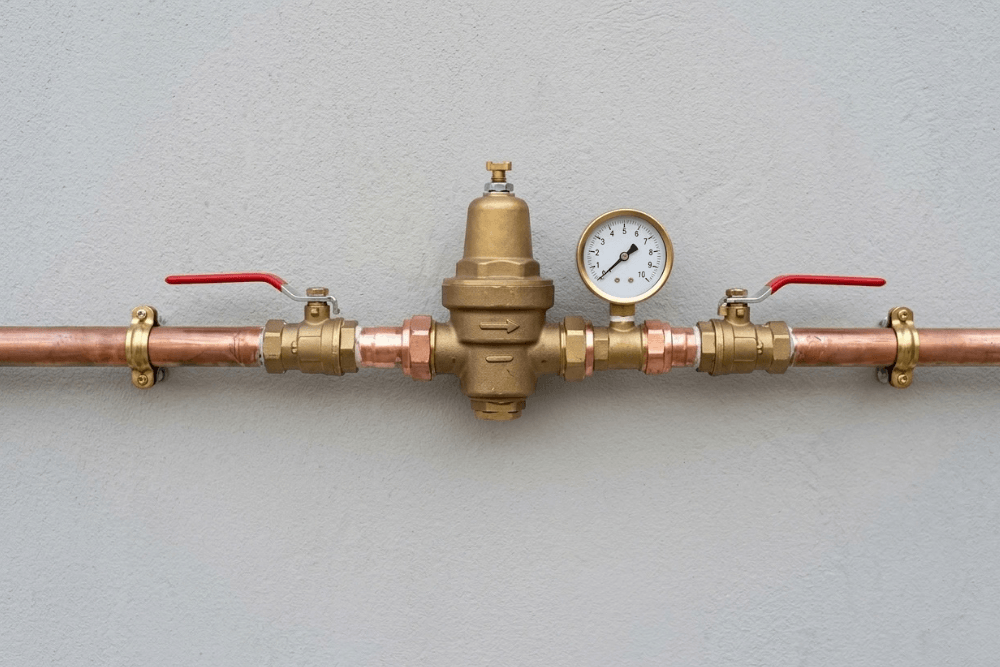
A pressure reducing valve (PRV) lowers the water pressure coming into your home to a steady, safe level, usually 3 to 4 bar. When it fails or is set wrong, you get banging pipes, dripping taps, burst shattaf and flexi hoses, and a water heater relief valve that keeps discharging. We test the pressure first, then adjust, clean or replace the valve.
High pressure is a tower problem more than a villa one. The lower floors of each pressure zone always run hottest, so two identical apartments a few floors apart can behave completely differently. If your problem is weak flow rather than too much pressure, start with our low water pressure page instead.
3–4 bar
Typical home setting
≈0.3 bar
Added per floor lower in a zone
AED 450+
Apartment PRV replaced, valve included
What a PRV Does, and When a Dubai Home Needs One
A pressure reducing valve is a spring-loaded valve on the incoming water supply that holds the pressure downstream at a fixed setting, however high the pressure upstream climbs. A Dubai home needs one when the supply reaching it is higher than its taps, hoses, heater and appliances are built to take, which is common on the lower floors of towers and on villas with powerful booster pumps.
Inside the valve, a diaphragm balances the outlet pressure against an adjustable spring. When you open a tap, outlet pressure falls, the spring pushes the valve open, and water flows. When the taps close, outlet pressure rises back to the setting and the valve closes. A correctly working PRV does this thousands of times a day without you noticing, and most domestic models have a small strainer on the inlet that stops sand and scale from reaching the seat.
Not every home needs one. A villa fed from a roof tank by gravity rarely has enough pressure to cause trouble, and many upper-floor apartments sit at the low end of their zone. The ones that need a PRV are the ones where the incoming pressure has been measured and found too high, not the ones where a plumber assumes it.
Why Lower Floors Run High Pressure: The Maths
Water pressure rises by about 1 bar for every 10.2 metres of height below the point where it is set. With typical floor-to-floor heights of 3.2 to 3.5 metres, each floor lower in a pressure zone adds roughly 0.3 bar. That is why two identical apartments a few floors apart in the same tower can behave completely differently.
Tall buildings are split into pressure zones, each fed through its own PRV station, so that no floor sees the full pressure of the column above it. Valve manufacturer Bermad, for example, describes zones of up to ten floors, calibrated so that every level in the zone receives between 2.5 and 5 bar. The zone PRV is set for the top floor of the zone. Every floor below it gets that setting plus the height difference.
Worked example: a ten-floor zone
Zone PRV set to give the top floor of the zone: 2.5 bar
Floor-to-floor height: 3.3 m
Bottom floor of the zone is 9 floors lower: 9 × 3.3 = 29.7 m
Extra pressure: 29.7 ÷ 10.2 = about 2.9 bar
Bottom floor of the zone: 2.5 + 2.9 = about 5.4 bar
At 5.4 bar the bottom floor is still inside what the building was designed for, but it sits well above the 3 to 4 bar most home fittings run most comfortably at. Add a zone PRV that has drifted upward over the years, and the lowest floors of each zone are where shattaf hoses split, mixer cartridges wear out early and pipes bang.
Villas get there a different way. A villa booster pump sized generously, or with its pressure switch set high, can push the whole house above 5 bar every time it runs. A PRV after the pump, set to 3 to 4 bar, protects everything downstream without changing how the pump itself works.
Signs Your Pressure Is Too High, or Your PRV Has Failed
Too much pressure shows up as banging pipes, dripping taps, a water heater relief valve that discharges, and flexi or shattaf hoses that split. A PRV can fail in two opposite directions: failing open lets full supply pressure through, while failing closed, often from a blocked strainer, starves every outlet at once. The pattern tells you which.
| What you notice | Likely cause | What to do |
|---|---|---|
| Banging or knocking when a tap or appliance valve shuts | Pressure too high: PRV missing, set too high or failing open | Test static pressure; adjust or replace the PRV |
| Shattaf hoses, flexi hoses or mixer cartridges failing repeatedly | Sustained high pressure on every fitting in the unit | Test pressure; fit or reset the PRV, then replace weakened hoses |
| Water heater relief valve dripping after each heating cycle | Heater expansion with nowhere to go (closed loop), or pressure above the relief setting | Overnight gauge test; add an expansion vessel or lower the PRV setting |
| Taps and cisterns that drip or refill on their own | Seals pushed past their rating by high pressure | Bring pressure down before replacing washers or fill valves |
| Pressure reading creeps up when nothing is running | PRV seat not sealing (failing open slowly) | Clean or replace the cartridge, or replace the valve |
| Weak flow at every outlet at once, including cold | PRV failing closed, or its built-in strainer blocked with sand or scale | Clean the strainer; replace the cartridge or valve if it doesn't recover |
| Weak flow at one outlet only | Not the PRV: a local valve, cartridge or pipe restriction | Local diagnosis (see our low water pressure page) |
Banging or knocking when a tap or appliance valve shuts
- Likely cause
- Pressure too high: PRV missing, set too high or failing open
- What to do
- Test static pressure; adjust or replace the PRV
Shattaf hoses, flexi hoses or mixer cartridges failing repeatedly
- Likely cause
- Sustained high pressure on every fitting in the unit
- What to do
- Test pressure; fit or reset the PRV, then replace weakened hoses
Water heater relief valve dripping after each heating cycle
- Likely cause
- Heater expansion with nowhere to go (closed loop), or pressure above the relief setting
- What to do
- Overnight gauge test; add an expansion vessel or lower the PRV setting
Taps and cisterns that drip or refill on their own
- Likely cause
- Seals pushed past their rating by high pressure
- What to do
- Bring pressure down before replacing washers or fill valves
Pressure reading creeps up when nothing is running
- Likely cause
- PRV seat not sealing (failing open slowly)
- What to do
- Clean or replace the cartridge, or replace the valve
Weak flow at every outlet at once, including cold
- Likely cause
- PRV failing closed, or its built-in strainer blocked with sand or scale
- What to do
- Clean the strainer; replace the cartridge or valve if it doesn't recover
Weak flow at one outlet only
- Likely cause
- Not the PRV: a local valve, cartridge or pipe restriction
- What to do
- Local diagnosis (see our low water pressure page)
The creeping gauge is the most useful clue. A healthy PRV holds a steady reading with everything closed. If the reading climbs slowly overnight, either the valve seat is letting water past or a water heater is expanding into a closed system. The next section shows how to tell the two apart.
For the banging itself, our guide to water hammer and banging pipes covers the causes that have nothing to do with pressure, such as loose pipe clips and booster pumps short-cycling.
Check Your Own Water Pressure in Five Minutes
You can measure your home's water pressure with a screw-on gauge from any hardware store, fitted to the washing machine valve or a garden tap. Read it with every tap closed for the static pressure, then with one tap running for the working pressure. Anything steadily above 5 bar is worth fixing; 3 to 4 bar is where most homes should sit.
- 1
Get the right gauge
A water pressure gauge reading to at least 10 bar, with a ¾-inch BSP female thread. That fits most washing machine valves and garden taps in Dubai.
- 2
Close everything
Turn off every tap, make sure no toilet is refilling, and pause the washing machine and dishwasher.
- 3
Fit and open
Screw the gauge onto the valve by hand and open the valve fully. The needle settles within a few seconds.
- 4
Read the static pressure
That is the pressure with no flow. Above 5 bar is high, and above 6 bar hoses, cartridges and seals wear noticeably faster.
- 5
Open a tap elsewhere
Run a basin tap and watch the needle. A drop of about a bar is normal. A collapse to near zero points to a PRV failing closed or a blocked strainer.
- 6
Leave it overnight (optional)
Note the reading at bedtime and again in the morning with nothing used. A higher morning reading means the PRV is creeping or the heater is expanding into a closed loop.
To separate a creeping PRV from heater expansion, switch the water heater off for a night and repeat the overnight test. If the reading still climbs, the PRV seat is leaking. If it stays flat with the heater off, expansion is the cause, and the fix is an expansion vessel rather than a new PRV.
Who Owns the PRV: Your Building or Your Unit?
In a Dubai tower, the zone PRVs in riser and pump rooms belong to the building and are maintained by its facilities team, while a PRV installed inside your apartment belongs to the unit. Villa PRVs belong to the villa owner. Knowing which one is at fault decides who you call and who pays.
| Where the PRV is | Who is responsible | What to do |
|---|---|---|
| Zone PRV station in a riser or pump room | The building, through its owners association or facilities manager | Report it to building management with your pressure readings |
| PRV inside your apartment (usually near the meter or heater) | The unit owner; in a rental, normally the landlord | Book a test and repair for the unit |
| PRV on a villa's incoming main or after the booster pump | The villa owner | Book a test and repair |
| Point-of-use PRV on a heater, washing machine or RO unit | Whoever owns the appliance or unit | Repair or replace with the appliance |
Zone PRV station in a riser or pump room
- Who is responsible
- The building, through its owners association or facilities manager
- What to do
- Report it to building management with your pressure readings
PRV inside your apartment (usually near the meter or heater)
- Who is responsible
- The unit owner; in a rental, normally the landlord
- What to do
- Book a test and repair for the unit
PRV on a villa's incoming main or after the booster pump
- Who is responsible
- The villa owner
- What to do
- Book a test and repair
Point-of-use PRV on a heater, washing machine or RO unit
- Who is responsible
- Whoever owns the appliance or unit
- What to do
- Repair or replace with the appliance
The same symptom can come from either side. If several apartments on the lower floors of a zone all report burst hoses and banging, the zone PRV has most likely drifted or failed, and it's a building matter. If only your unit has the problem, the cause is probably inside it. Your gauge readings, taken at a known time, are the evidence building management needs to act on a zone valve.
In rented homes, repairing the plumbing system normally falls to the landlord unless the tenancy contract says otherwise. Our landlord plumbing maintenance guide sets out the usual split between landlord and tenant.
Pressure Reducing Valve vs. Pressure Relief Valve
A pressure reducing valve controls pressure all the time, lowering the incoming supply to a steady setting. A pressure relief valve does nothing until pressure passes a limit, then opens to dump water. Both get called “PRV”, which is why people ask for the wrong one. A dripping valve on your water heater is the relief valve, and it is usually reacting to a problem, not causing it.
| Pressure reducing valve | Pressure relief valve | |
|---|---|---|
| Job | Holds downstream pressure at a set level, continuously | Opens only when pressure passes a limit, to dump water and protect a tank or heater |
| Normally | Partly open whenever water is flowing | Fully closed |
| Where you find it | Incoming supply, after a booster pump, before sensitive appliances | On the water heater (often combined with a temperature element as a T&P valve) |
| Sign of trouble | Pressure too high, too low, or creeping | Dripping or discharging water |
| Can it replace the other? | No | No |
Job
- Pressure reducing valve
- Holds downstream pressure at a set level, continuously
- Pressure relief valve
- Opens only when pressure passes a limit, to dump water and protect a tank or heater
Normally
- Pressure reducing valve
- Partly open whenever water is flowing
- Pressure relief valve
- Fully closed
Where you find it
- Pressure reducing valve
- Incoming supply, after a booster pump, before sensitive appliances
- Pressure relief valve
- On the water heater (often combined with a temperature element as a T&P valve)
Sign of trouble
- Pressure reducing valve
- Pressure too high, too low, or creeping
- Pressure relief valve
- Dripping or discharging water
Can it replace the other?
- Pressure reducing valve
- No
- Pressure relief valve
- No
When a relief valve drips, it is doing its job. Replacing it without finding out why the pressure is reaching its setting only buys a few weeks. The usual reasons are high incoming pressure, which the reducing valve should be handling, or heater expansion in a closed system, covered next. The relief valve itself is part of the heater installation, which our water heater installation page covers.
The Closed-Loop Problem: Water Heaters and Expansion Vessels
Water expands as it heats. Without a PRV, that extra volume pushes back into the mains. Many PRVs, especially models with a built-in check valve, block that route and create a closed system, so every heating cycle raises the pressure until the heater's relief valve opens. The fix is a small expansion vessel on the cold feed to the heater.
This is the most common complaint after a PRV is fitted: “the pressure is fixed, but now the heater drips.” The PRV is doing its job. What the installation is missing is somewhere for the expanding water to go. An expansion vessel is a small tank with a rubber membrane and a cushion of air behind it. As the heated water expands, it pushes into the vessel instead of lifting the system pressure.
The vessel only works if three things are right:
- It is sized for the heater's capacity and the PRV setting.
- Its air pre-charge is set to match the PRV's outlet pressure. A vessel left at the factory setting can sit full of water and do nothing.
- It sits on the cold feed between the PRV and the heater, with no valve between the vessel and the heater that could isolate it.
If you already have a vessel and the relief valve still drips, the membrane may have failed. Tap the top of the vessel: a solid, heavy sound where it should sound hollow usually means it is waterlogged. The overnight gauge test with the heater switched off, described above, confirms whether expansion is the cause before anything is replaced.
PRV Sizes and Set Pressures for Dubai Homes
Most Dubai apartments need a ½-inch or ¾-inch PRV set to about 3 to 3.5 bar, and most villas a 1-inch or 1¼-inch valve set to 3 to 4 bar. Size the valve to the pipe and the flow the home needs, not to the pipe alone. An undersized PRV is a common cause of weak showers when two bathrooms run at once.
| Where | Typical size | Typical setting | Position |
|---|---|---|---|
| Apartment incoming supply | ½" to ¾" (15–22 mm) | 3 to 3.5 bar | Near the unit meter or the heater cupboard |
| Villa incoming main | 1" to 1¼" (25–32 mm) | 3 to 4 bar | After the meter, or after the booster pump on tank-fed villas |
| Water heater cold feed | ½" to ¾" (15–22 mm) | Below the heater's relief setting, with margin | On the cold inlet, before the expansion vessel |
| Washing machine, dishwasher, RO unit | ½" or ¾" point-of-use | Per the appliance manual | Directly before the appliance |
| Building zone station | 1½" and larger (40 mm+) | Set for the top floor of the zone | Riser or pump room, usually as duty and standby pair |
Apartment incoming supply
- Typical size
- ½" to ¾" (15–22 mm)
- Typical setting
- 3 to 3.5 bar
- Position
- Near the unit meter or the heater cupboard
Villa incoming main
- Typical size
- 1" to 1¼" (25–32 mm)
- Typical setting
- 3 to 4 bar
- Position
- After the meter, or after the booster pump on tank-fed villas
Water heater cold feed
- Typical size
- ½" to ¾" (15–22 mm)
- Typical setting
- Below the heater's relief setting, with margin
- Position
- On the cold inlet, before the expansion vessel
Washing machine, dishwasher, RO unit
- Typical size
- ½" or ¾" point-of-use
- Typical setting
- Per the appliance manual
- Position
- Directly before the appliance
Building zone station
- Typical size
- 1½" and larger (40 mm+)
- Typical setting
- Set for the top floor of the zone
- Position
- Riser or pump room, usually as duty and standby pair
Domestic PRVs are usually adjustable across a range such as 1.5 to 5 or 1.5 to 6 bar, and leave the factory preset at about 3 bar. What we look for when choosing one:
- A built-in strainer. Dubai water carries sand and scale, and a strainer that can be removed and cleaned without taking the valve out saves a replacement later.
- A gauge port or fitted gauge, so the setting can be checked in seconds on any future visit.
- A replaceable cartridge. On quality valves, the diaphragm, seat and spring come out as one unit, so a worn valve can often be restored rather than cut out.
- Brass or bronze body, rated for potable water, in a model and brand with spares available in the UAE.
Installation matters as much as the valve. It goes in the direction of the arrow on the body, with an isolation valve on each side so it can be serviced without draining the system, and somewhere it can be reached. A PRV sealed behind tiles is a PRV nobody will ever adjust.
Protecting Appliances: RO Units, Heaters, Washing Machines and Shattafs
When the whole home can't be brought down to a safe pressure, or one appliance needs less than the rest, a small point-of-use PRV protects just that item. It is the usual answer for reverse osmosis purifiers, water heaters and shattaf hoses on high-pressure floors. Always check the appliance manual for its maximum inlet pressure first.
RO drinking water units
Under-sink reverse osmosis systems list a maximum inlet pressure in their manuals, often well below what a lower-floor apartment receives. Above it, housings and fittings leak under the sink. A point-of-use PRV on the RO feed solves it. Our water filtration page covers the units themselves.
Water heaters
The heater's relief valve setting is printed on its label. The PRV on the cold feed must hold the working pressure comfortably below it, leaving room for expansion, otherwise the relief valve becomes a permanent drip.
Washing machines and dishwashers
Their inlet valves tolerate high pressure better than most fittings, but the hose between the tap and the machine does not. A burst inlet hose behind a washing machine floods a room in minutes.
Shattafs
The shattaf hose sits under full pressure all day, held back only by the trigger. On high-pressure floors it is often the first thing to split. Fixing the pressure properly beats replacing the hose every few months. Our shattaf repair guide covers the hose, trigger and valve themselves.
Building PRV Stations: Large-Bore Service for Towers and Commercial Sites
Tower zone PRVs are usually larger, pilot-operated valves installed in duty and standby pairs, with strainers, gauges and a bypass so one valve can be serviced while the other carries the zone. We service these stations for building managers, owners associations and commercial sites, alongside unit and villa PRVs.
A station service covers:
- Floor-by-floor pressure survey of each zone, so the setting is judged by what the top and bottom floors receive, not by one gauge in the plant room.
- Strainer cleaning. A blocked strainer upstream of a zone valve is a frequent cause of weak pressure across a whole group of floors.
- Pilot and diaphragm inspection, with replacement of worn diaphragms, seals and pilot parts.
- Setpoint correction and duty/standby changeover testing, so the standby valve works when it's needed.
- A written report with readings before and after, for the facilities file.
Large pressure drops across a single valve cause noise and wear. Bermad advises keeping the ratio of inlet to outlet pressure at no more than 2.5 to avoid cavitation, the bubble formation that makes zone valves roar and erodes their internals. Where a station exceeds that, two-stage reduction with valves in series is the usual correction.
Fire-system pressure regulating valves are a separate discipline. They are installed, tested and certified by Civil Defence-approved fire contractors, and are not part of this service.
Replace, Adjust or Clean? How We Handle a PRV Job
We measure first, then try the cheapest fix that lasts. Many PRVs that seem dead are only clogged, and recover once the strainer is cleaned and the setting is reset. A valve that still creeps or won't hold a setting after cleaning gets replaced, and every job ends with recorded readings and a labelled valve.
- 1
Measure before touching anything
Static pressure with everything closed, working pressure with outlets running, and where needed an overnight reading to catch creep or heater expansion.
- 2
Find the valve responsible
Identify whether the problem sits with a building zone PRV, the unit or villa PRV, or a point-of-use valve, so the right party fixes it.
- 3
Clean and try to recover the valve
Isolate the PRV, clean its strainer, inspect the cartridge, and test whether it will hold a setting again. Many valves recover at this step.
- 4
Replace if it won't hold
Fit a correctly sized potable-water PRV in the flow direction, with isolation valves either side and a gauge or gauge port, somewhere it can be reached.
- 5
Set under real conditions
Set the pressure with water flowing, then confirm the static reading, and check the water heater relief valve and expansion vessel against the new setting.
- 6
Record and label
Record the before and after readings, and label the valve with its setting and the service date for the next visit.
Keeping a PRV working between visits
A PRV is a moving part in hard, sandy water, so it rewards a little attention. Once a year, read the gauge with everything closed and compare it with the setting on the label; a reading that has crept up by more than half a bar is the early sign of a seat or strainer problem. Clean the strainer at the same time on valves where it unscrews from the body without cutting the pipe.
If your building's water is interrupted for maintenance, check again afterwards. Air and sediment pushed through when supply returns are a common reason a PRV starts misbehaving in the weeks after a shutdown. And if you replace a water heater, recheck the expansion vessel's pre-charge against the PRV setting, because a new heater of a different size changes what the vessel has to absorb.
After the pressure comes down, weakened parts don't repair themselves. A hose that spent years at 6 bar is still a weakened hose. We check the flexi and shattaf hoses on the same visit and tell you which ones to replace. If a pipe has already failed, see our burst pipe repair page.
PRV Replacement Cost in Dubai
PRV replacement in Dubai costs AED 450 to 950 for an apartment valve and AED 750 to 1,600 for a villa main, with the valve included. A pressure test and diagnosis costs AED 150 to 250. Where cleaning or adjusting recovers the existing valve, the job costs AED 150 to 350 instead.
| Work | Typical price |
|---|---|
| Pressure test and diagnosis | AED 150 - 250 |
| PRV adjustment, or strainer/cartridge cleaning | AED 150 - 350 |
| PRV replacement, apartment (½" to ¾"), valve included | AED 450 - 950 |
| PRV replacement, villa main (1" to 1¼"), valve included | AED 750 - 1,600 |
| Point-of-use PRV (heater, washing machine, RO, shattaf) | AED 250 - 500 |
| Expansion vessel for a water heater, fitted and pre-charged | AED 450 - 900 |
| Building PRV station survey and service (large bore) | Quoted after survey |
Pressure test and diagnosis
- Typical price
- AED 150 - 250
PRV adjustment, or strainer/cartridge cleaning
- Typical price
- AED 150 - 350
PRV replacement, apartment (½" to ¾"), valve included
- Typical price
- AED 450 - 950
PRV replacement, villa main (1" to 1¼"), valve included
- Typical price
- AED 750 - 1,600
Point-of-use PRV (heater, washing machine, RO, shattaf)
- Typical price
- AED 250 - 500
Expansion vessel for a water heater, fitted and pre-charged
- Typical price
- AED 450 - 900
Building PRV station survey and service (large bore)
- Typical price
- Quoted after survey
Where your job falls in each range depends on the valve brand and size, access, and whether isolation valves already exist on either side. If they don't, adding them is part of the job, because a PRV that can't be isolated can't be serviced.
Pressure Reducing Valve FAQ
How much does PRV replacement cost in Dubai?
What water pressure should a Dubai apartment have?
How do I know if my pressure reducing valve is bad?
Can I adjust my PRV myself?
How long does a pressure reducing valve last?
Why does my water heater drip after a PRV was installed?
Is a pressure reducing valve the same as a pressure relief valve?
Who pays if the building's PRV fails?
Does a villa need a pressure reducing valve?
Do you service building PRV stations?
Measure It Before You Replace Anything
Tell us your building and floor, or your villa's pump setup, and what you're seeing. We'll test the pressure, find the valve responsible, and fix it at the level it belongs: your unit, your villa or your building.