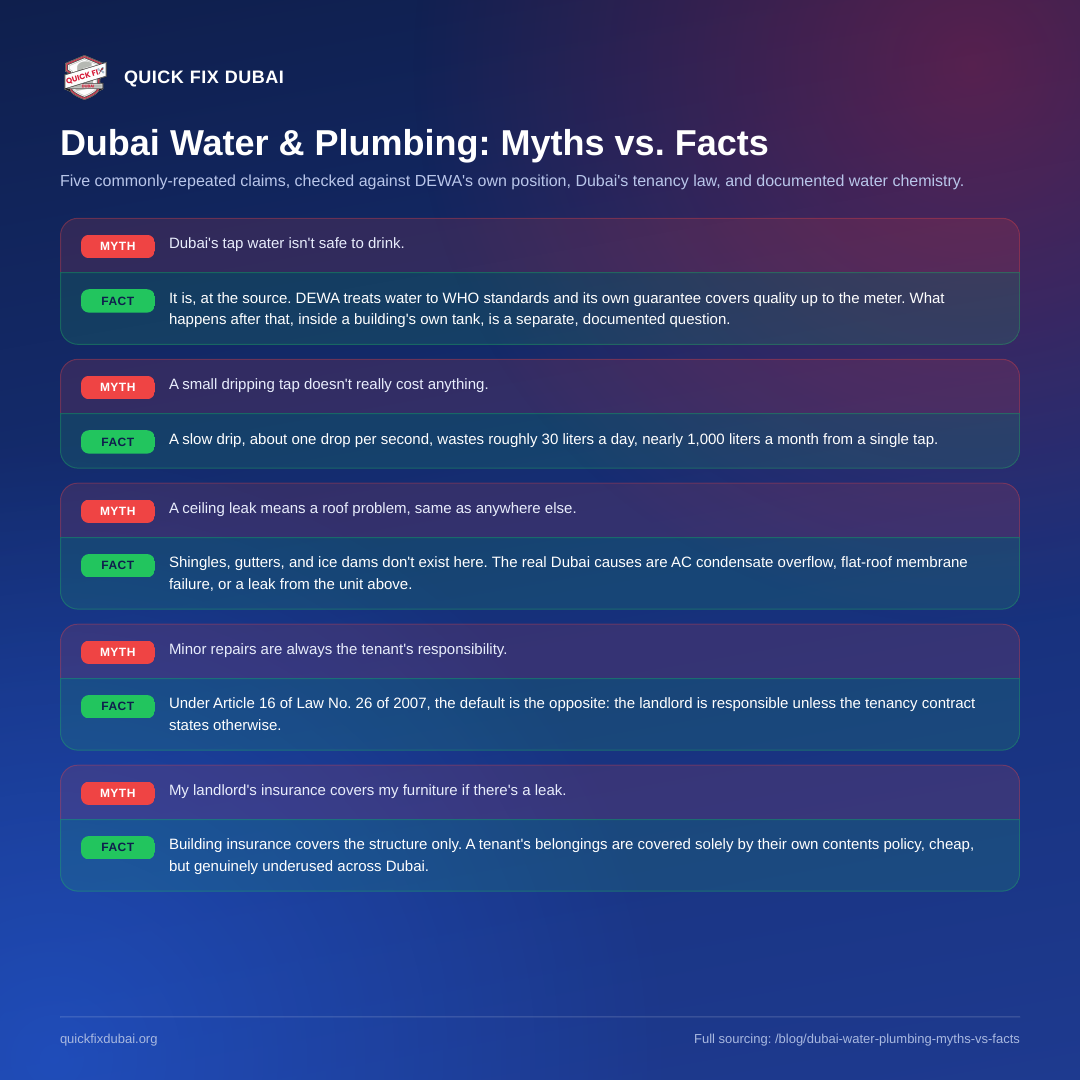
Some of what gets repeated about Dubai water and plumbing is accurate. Some of it is a half-truth that skips the part that actually matters. Here are ten specific claims, checked against DEWA's own published position, Dubai's actual tenancy law, and documented water chemistry, not general assumption.
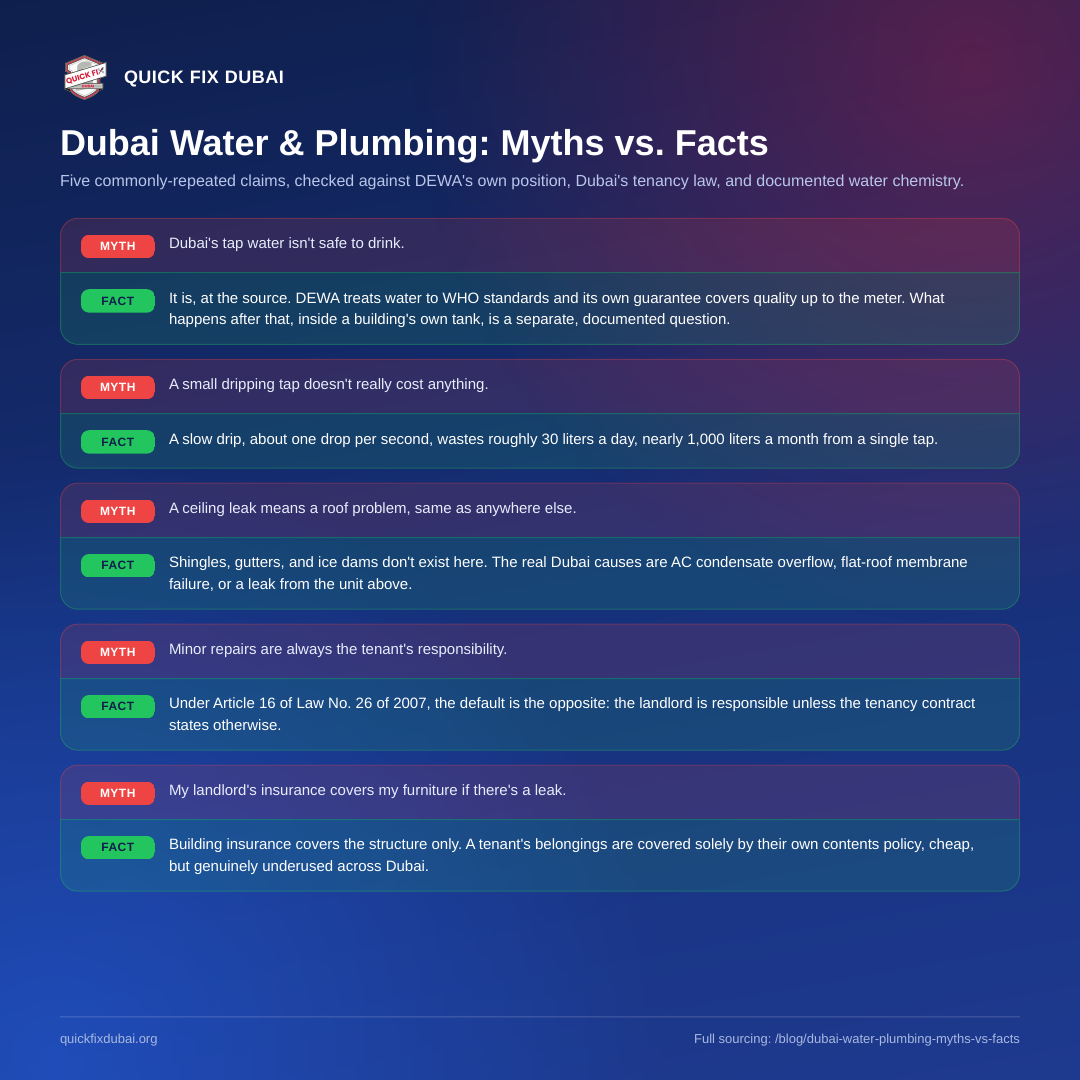
Myth 1: "Dubai's tap water isn't safe to drink."
Fact: it is, at the point DEWA delivers it. Dubai's supply is desalinated and treated to WHO drinking water standards, and DEWA has been explicit that its responsibility covers water quality up to the meter. What changes after that point, inside a building's storage tank and internal pipework, is a separate question with a real, documented mechanism behind it, not a reason to doubt the source itself.
Myth 2: "A small dripping tap doesn't really cost anything."
Fact: a slow drip, roughly one drop per second, wastes around 30 liters a day, close to a thousand liters a month from a single tap. A running or continuously refilling toilet is a bigger problem, commonly estimated at around 750 liters a day. Neither looks dramatic in the moment, which is exactly why both get ignored.
Myth 3: "If my tank is fed by DEWA's supply, it doesn't need cleaning."
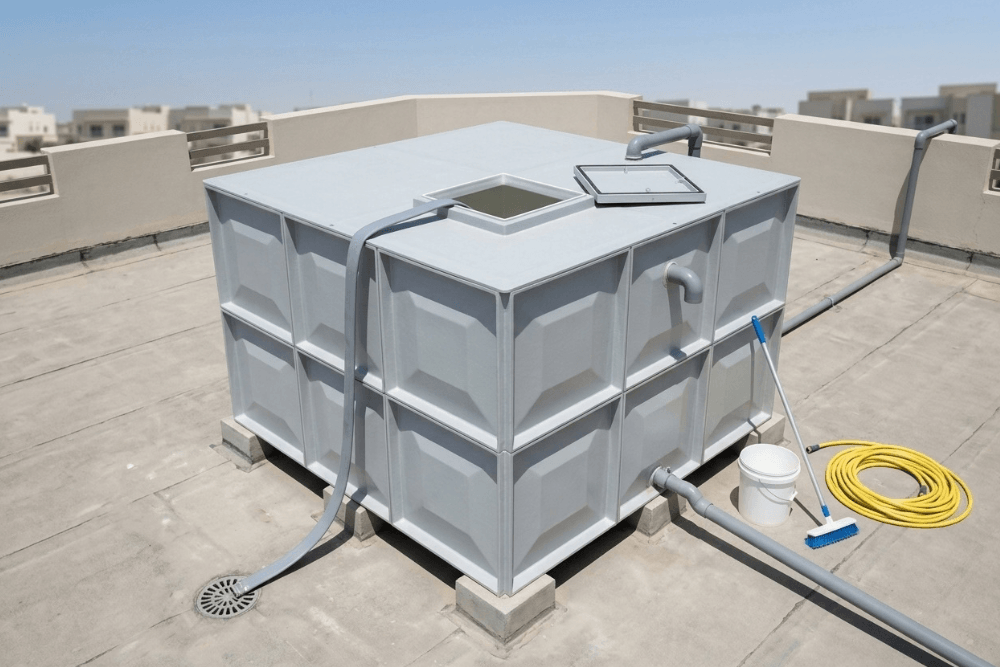
Fact: Dubai Municipality recommends cleaning every 6 months regardless of the source, because the contamination risk happens inside the tank itself. Heat and light accelerate algae growth, insects and debris enter through a compromised cover, and sediment settles from the water's mineral content, none of which has anything to do with what DEWA delivered to the meter.
Myth 4: "A ceiling leak means a roof problem, same as anywhere else."
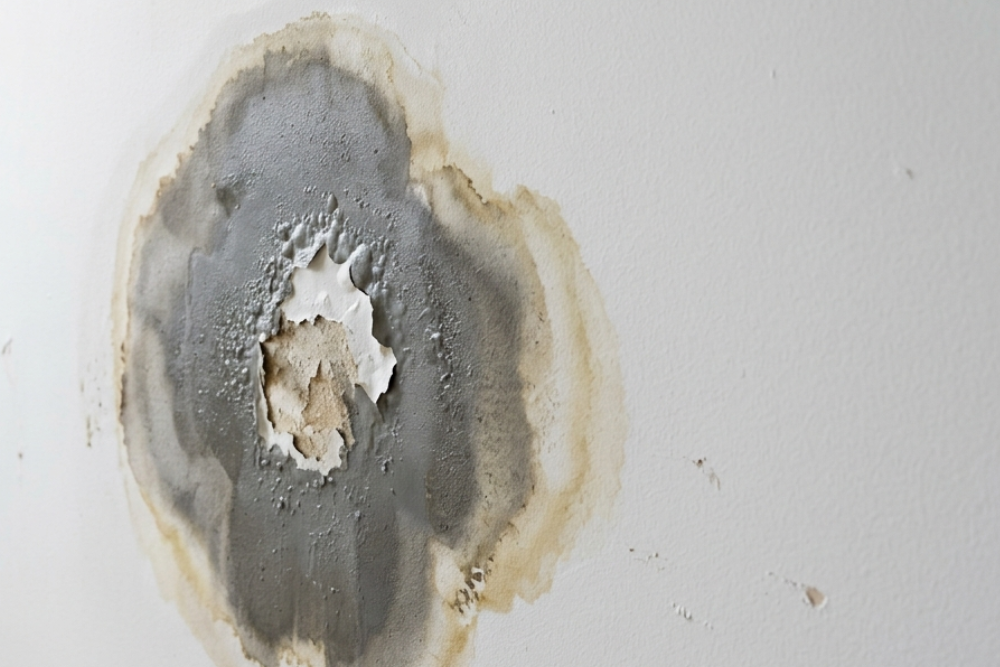
Fact: the standard Western explanations, damaged shingles, blocked gutters, ice dams, don't apply to a Dubai property at all. The real, climate-specific causes are AC condensate drain overflow, flat-roof waterproofing membrane failure, or a leak from the unit above in an apartment building, an entirely different diagnostic starting point.
Myth 5: "Minor repairs are always the tenant's responsibility."
Fact: under Article 16 of Dubai's Law No. 26 of 2007, the default position is the opposite, the landlord is responsible for maintenance and repair unless the tenancy contract specifically states otherwise. In practice, many contracts do set a cost threshold splitting responsibility, but that threshold comes from the individual contract, not a general rule that repairs default to the tenant.
Myth 6: "My landlord's building insurance covers my furniture if there's a leak."
Fact: building insurance covers the structure, walls, fixtures, common areas, never a tenant's personal belongings. Those are only covered if the tenant holds their own contents insurance, which is inexpensive but genuinely underused across Dubai's rental market.
Myth 7: "Hard water is just a taste issue, not a real problem."
Fact: Dubai's hard water measurably shortens the working life of anything that touches water in a home, taps, water heaters, booster pumps, by accelerating scale buildup and increasing component wear. It doesn't cause one dramatic failure, it just quietly compounds across every fixture at once.
Myth 8: "If pressure is still weak after installing a new booster pump, the pump itself is faulty."
Fact: the single most common reason a "new" booster pump still doesn't fix weak pressure is that it was undersized for the property from the start, not a manufacturing fault. Repairing or replacing an undersized pump just restores it to being correctly-functioning and still undersized, sizing has to account for head height and realistic simultaneous demand, not just floors.
Myth 9: "A running toilet isn't really wasting water, it's just going back into the system."
Fact: it's metered and billed exactly like any other water use. Worse, DEWA's tariff is progressive, so a leak large enough to push total household usage into a higher pricing slab increases the cost of every unit consumed that month, not just the leak's own share.
Myth 10: "Septic tank size can be roughly guessed from the size of the property."
Fact: the standard sizing method used by installers is based on bedroom count, not square footage or current occupancy. Bedrooms are a stable proxy for a property's realistic maximum load, since current household size changes as families grow or a property changes hands, while bedroom count doesn't.
What Happens to DEWA Water Between the Meter and Your Tap
The full chemistry and mechanism behind Myth 1.
Water Leak Cost Calculator
See what your own leak is actually costing, in AED.
Plumbing Maintenance Responsibilities in Dubai
The full breakdown behind Myth 5, with real legal citations.
Water Damage Insurance in Dubai
The building-versus-contents split behind Myth 6, explained fully.
Related Service
Water Tank Cleaning
Dealing with this issue right now? See real pricing and how we handle it.
View Water Tank Cleaning