Ask whether Dubai's tap water is safe and you'll get the same answer everywhere, from DEWA itself and from every article on the subject: yes, at the source, tested and treated to WHO standards. That answer is accurate and it's also where almost every explanation stops. DEWA has been explicit about the actual boundary of that guarantee. Following a 2016 water-quality scare at a school, DEWA's official statement put it plainly: the utility's responsibility is to provide safe water up to the meter, and the water supply inside the compound after that point is the customer's or building owner's responsibility. That's not a technicality, it's the entire explanation for why two people drinking from the same DEWA network can have genuinely different water reaching their tap.
What's Actually in the Water at the Meter
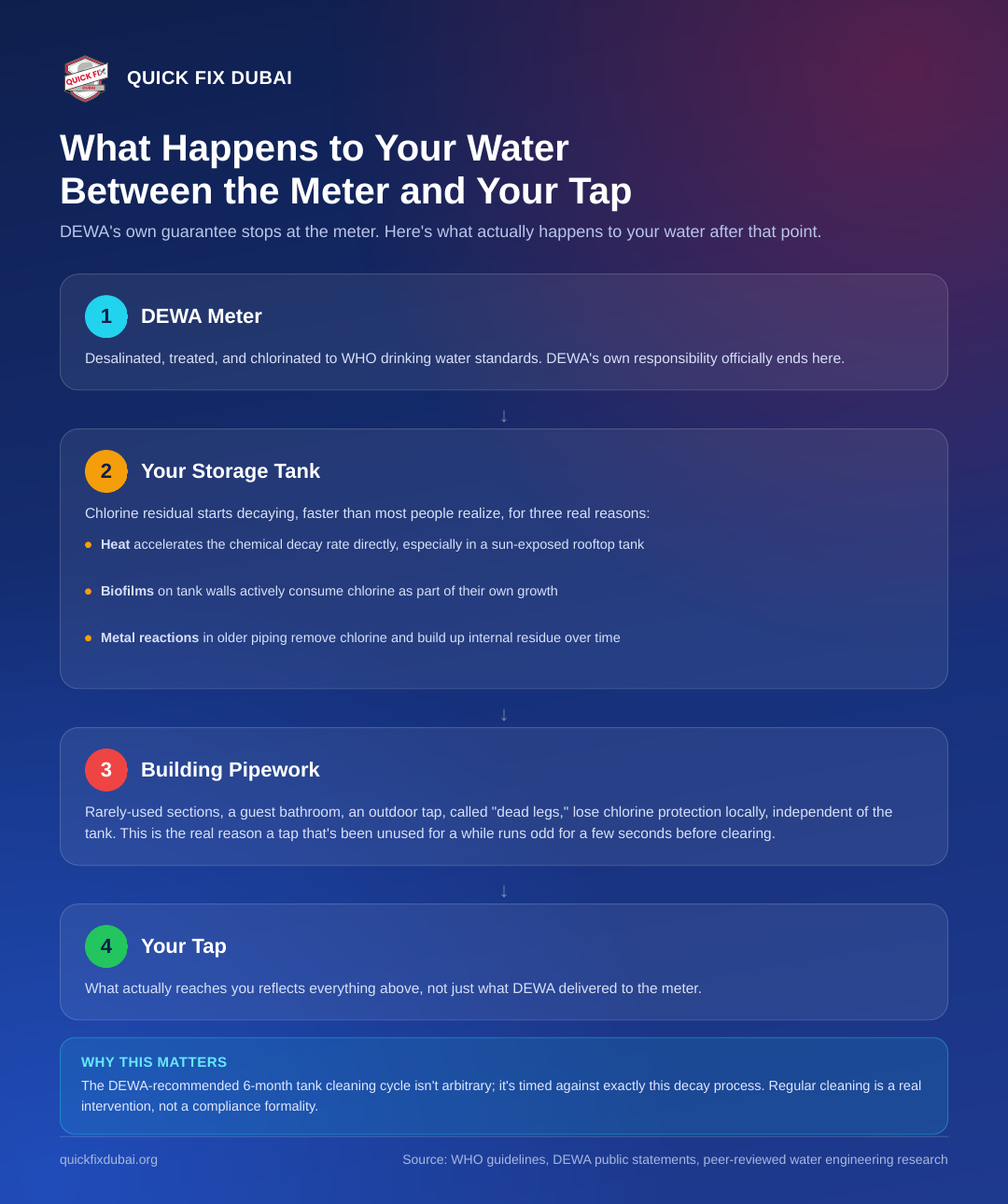
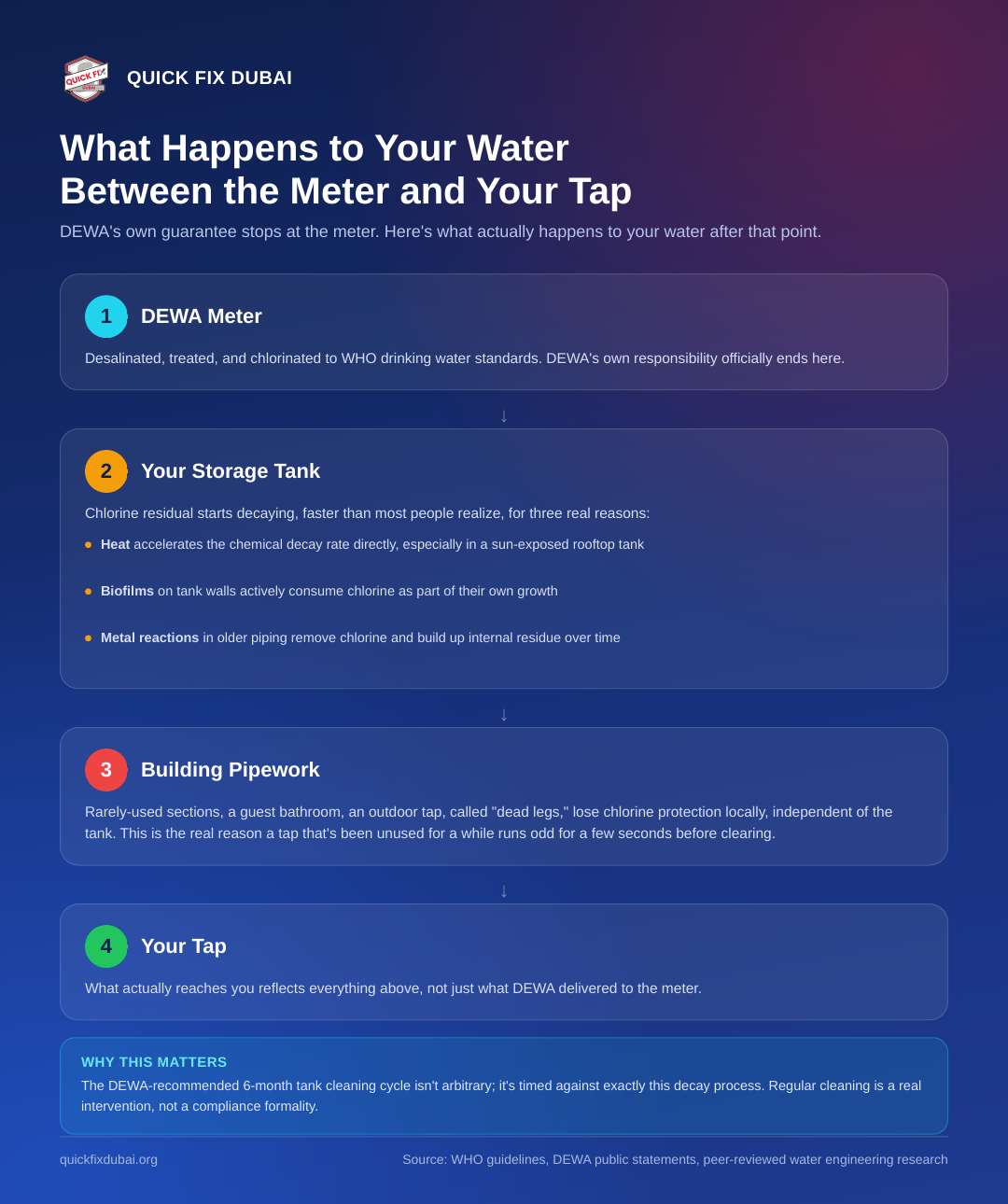
Dubai's supply is almost entirely desalinated seawater, treated through multi-stage processes and disinfected before distribution. Part of that disinfection is a chlorine residual, a small, deliberately maintained amount of chlorine left in the water specifically so it keeps protecting against bacterial regrowth as it travels through the network, not just at the treatment plant. The World Health Organization recommends a minimum residual of around 0.2 mg/L for this exact purpose, enough to keep working after the water leaves treatment, not just at the moment it's tested.
That residual is not a fixed, permanent property of the water. It's an active chemical that gets consumed, and understanding what consumes it is most of what explains the difference between water at the meter and water at your tap.
Why Chlorine Residual Actually Decays
Three mechanisms drive this, and all three are more active in a Dubai property than in a cooler climate. Heat accelerates the chemical reaction rate of chlorine decay directly, water sitting in a rooftop tank under direct sun for hours a day loses its residual measurably faster than the same water would in a shaded, cool reservoir. Biofilms, the thin layer of microorganisms that forms on any tank or pipe wall that holds water for any length of time, actively consume chlorine as part of their own biological processes, and they're notoriously difficult to fully eliminate once established. And in metal tanks and pipework specifically, chlorine reacts directly with the metal, in older galvanized steel piping in particular, forming oxides that both remove chlorine from the water and contribute to the internal buildup that narrows pipe diameter over years.
!This isn't a Dubai-specific quirk
It's basic water chemistry that happens to be significantly accelerated here. A 2025 peer-reviewed hydraulic modelling study specifically analysed chlorine decay in private storage tanks, including a real-world case from Dubai, and found that tank design (specifically inlet and outlet configuration) measurably affects how quickly stored water loses its chlorine protection.
Why Storage Tanks Are Where This Actually Plays Out
Most Dubai properties don't receive water on continuous mains pressure the way many other cities do. Water arrives, fills a rooftop or underground storage tank, and is then pumped from that tank to fixtures as needed. That storage step is exactly where chlorine residual has time to decay, and how much it decays depends heavily on how the tank is designed and used, not just how long the water sits.
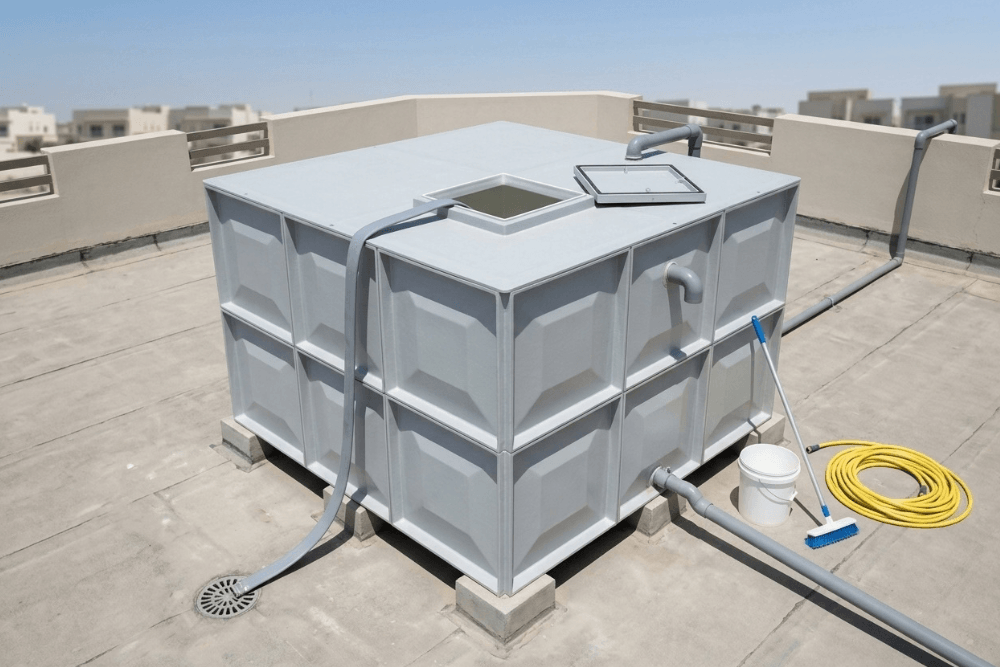
A tank that isn't actively mixed develops temperature stratification in warm weather, cooler incoming water settles toward the bottom while older, warmer water rises and stays near the top, exactly the water most likely to actually reach a fixture next since it's often drawn from higher in the tank. That warm upper layer is where stagnation and chlorine loss are most advanced, creating the conditions bacterial growth actually needs. This is also the direct mechanical link to something covered elsewhere on this site: water sitting in the 25 to 42°C range for extended periods is the exact window where organisms like Legionella can establish, and a rooftop tank under a Dubai sun spends a great deal of its life in that range.
Dead Legs: The Part of the System Nobody Thinks About
Every building's internal pipework has sections that see far less flow than others, a bathroom in a guest suite used once a month, an outdoor tap that's rarely opened, a section of pipe serving a room that's been closed off. Plumbing engineers call these dead legs, and they're a genuine water-quality problem independent of the tank itself. Water sitting in a dead leg isn't being replaced by fresh, chlorinated supply, so it loses its residual through exactly the same decay mechanisms, just locally, in a section of pipe that might be metres away from where the bulk of the building's water is flowing normally.
This is the actual, specific reason a tap that hasn't been used in a while sometimes runs slightly discoloured or smells different for the first few seconds. That's not typically evidence the whole property's water is unsafe, it's stagnant water that's been sitting in a dead leg finally being pushed through, and it usually clears within moments as fresh supply reaches the fixture.
What This Actually Means, Practically
- Running a tap briefly after returning from travel, or in a rarely-used bathroom, clears stagnant water from a dead leg before you fill a glass or a kettle
- A tank that's regularly cleaned and, ideally, actively used rather than left nearly full and stagnant, holds its water quality far better than one that sits mostly undisturbed
- Newer buildings with PPR or copper pipework generally hold chlorine residual and resist internal buildup better than older galvanized steel systems, which is a genuine, if unglamorous, reason two buildings on the same street can have noticeably different water
- The DEWA-recommended 6-month tank cleaning cycle isn't an arbitrary compliance box, it's timed against exactly the kind of sediment, biofilm, and stagnation buildup this mechanism actually produces
The Honest Summary
DEWA's water at the meter is genuinely safe, tested, and treated to a real international standard, that part isn't in dispute anywhere, including in this article. What changes it is entirely physical and chemical, not a failure of the network: heat accelerating chlorine decay, storage time in a tank that may or may not be well-designed for mixing, and pipework that either holds up well or doesn't. None of this is reason for alarm. It's reason to take the maintenance side, tank cleaning specifically, seriously as a real intervention in a real process, rather than a box-ticking exercise.
Related Service
Water Tank Cleaning
Dealing with this issue right now? See real pricing and how we handle it.
View Water Tank Cleaning