Limescale gets treated as a cosmetic problem, the white crust on a showerhead, the cloudy residue on a glass shower door, easy to wipe away and forget about. Inside your pipes, where you can't see it, the same mineral is doing something considerably more serious, and how much damage it causes depends heavily on what your pipes are actually made of.
!Quick answer
Galvanized steel is damaged fastest and worst, scale hides active corrosion developing underneath it. Copper resists better along straight runs but leaks specifically at joints and elbow fittings, where scale concentrates. Plastic pipe (PPR, PVC, CPVC, HDPE) doesn't corrode but can still narrow with scale over years. A whole-property water softener is the only fix that addresses the mineral content itself rather than treating each symptom separately.
What Limescale Actually Is
Dubai's water supply carries a meaningfully higher mineral content, primarily calcium and magnesium, than what's generally considered soft water. As that water flows through pipework, particularly as it heats up, some of those dissolved minerals precipitate out and attach to the interior pipe surface as calcium carbonate, the same chalky substance that makes up limestone. Layer by layer, that deposit builds up, and the effect is genuinely comparable to how plaque narrows an artery: the usable diameter of the pipe shrinks progressively, restricting flow and increasing the pressure the whole system has to work against to deliver the same amount of water.
Galvanized Steel: The Most Vulnerable Material
If your property has original galvanized steel pipework, common in older Dubai buildings, this is the material hard water damages fastest and most seriously. Galvanized pipe has a rougher interior surface than copper or plastic, which gives mineral particles more to grip onto, and scale accumulates here faster than on smoother materials as a direct result.
The genuinely damaging part isn't the scale itself, it's what happens underneath it. Once a layer of scale forms, it creates a barrier that traps moisture and chemistry against the metal, and rust begins developing beneath that layer, invisible from inside the pipe until it's advanced enough to cause a leak or, in a worse case, a pinhole failure. The scale that looks like it might be protecting the pipe is actually hiding active corrosion happening right beneath it. Galvanized pipe in a hard water environment can fail meaningfully earlier than its general expected service life as a result.
Copper: More Resistant, But Not Immune
Copper handles hard water considerably better than galvanized steel overall, its smoother interior surface gives mineral particles less to cling to along most of a straight pipe run. But copper's vulnerability isn't spread evenly, it concentrates specifically at joints, elbow fittings, and bends, exactly the points where water changes direction and slows down. Scale forms preferentially at these slower-flow points, and underneath that localised buildup, the same trapped-moisture corrosion mechanism that affects galvanized steel can develop, just concentrated at specific fitting points rather than along the whole pipe.
This is directly why copper pipe leaks in Dubai properties tend to appear as pinhole failures at specific joints and elbow fittings rather than as generalised wear along a straight run, our copper pipe leak repair page covers the repair side of this in more depth. Understanding that the fittings are the genuine weak point, not the pipe material generally, is useful context for anyone trying to understand why a copper system develops leaks in some spots and not others.
Plastic Pipe: Genuinely More Resistant, Not Scale-Proof
PPR, PVC, CPVC, and HDPE, increasingly common in newer Dubai construction, don't corrode the way metal pipes do, since there's no metal for rust to develop in. This is a genuine, meaningful advantage over galvanized steel and copper for long-term durability against hard water specifically. It's not complete immunity, though, mineral scale can still deposit on plastic pipe interior surfaces and narrow the usable diameter over enough years, the same flow-restriction effect as metal pipe, just without the corrosion-driven failure risk layered on top of it.
What This Actually Costs You Over Time
- Reduced water pressure, particularly noticeable at fixtures furthest from the main supply or on upper floors, as the effective pipe diameter narrows
- Higher water heating costs, since scale-narrowed pipes and a scaled heating element both make the whole system work harder to deliver the same result
- Earlier pipe failure than the material's general expected service life, particularly for galvanized steel and at copper joints
- Accelerated wear on every appliance the water passes through afterward, washing machines, dishwashers, and the water heater itself, all affected by the same mineral content
What Actually Prevents This
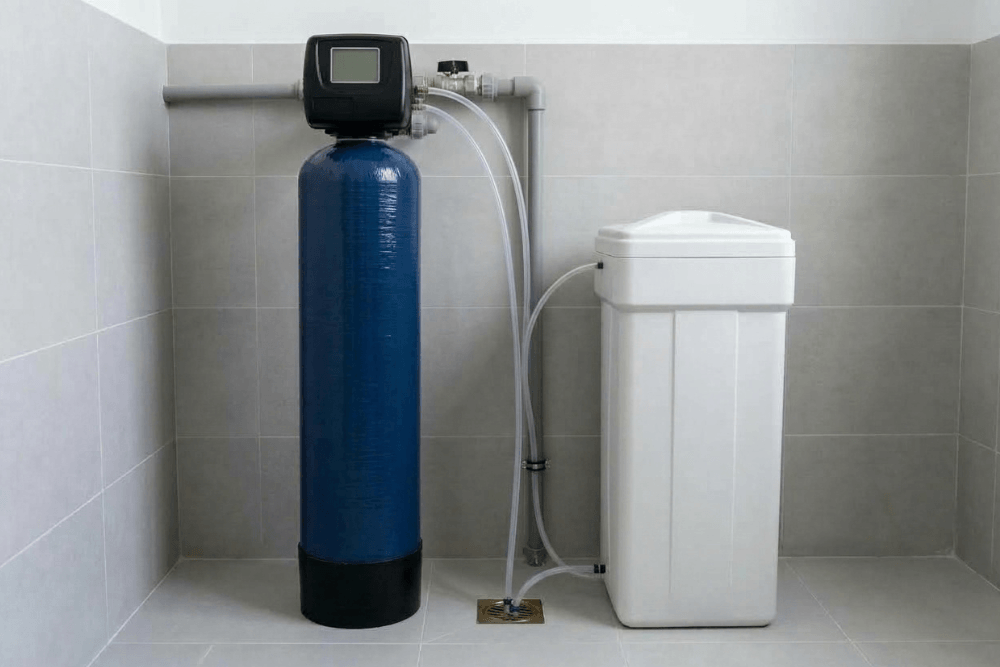
Individual fixes, descaling a showerhead, flushing a water heater tank, address the symptom at that specific point but don't touch the mineral content flowing through the rest of the property's pipework. A whole-property water softener is the only approach that addresses the actual cause rather than treating each downstream symptom separately, removing the calcium and magnesium from the water before it ever reaches your pipes, fittings, or appliances.
Short of a whole-property softener, a few things genuinely help without that level of investment. Regular water heater flushing prevents the single most expensive downstream consequence. Periodic inspection of exposed pipe joints and fittings, the copper vulnerability points described above, catches developing corrosion before it becomes an active leak. And for a property with confirmed galvanized steel pipework showing any sign of reduced pressure or discoloured water, a professional assessment of the pipe's actual condition is worth doing proactively rather than waiting for a failure to force the issue.
!Green or orange staining on visible pipework
If you can see exposed pipe, in a plant room, under a sink, or in a service void, green staining on copper indicates oxidation already underway. Orange or brown staining on steel indicates active rust. Neither means immediate failure, but both are worth noting and monitoring rather than ignoring, since they're visible evidence of exactly the process described above already in progress.
Limescale on a showerhead is an inconvenience. The same mineral content working on the inside of your pipework, invisibly, for years, is a genuine driver of premature pipe failure, and which material you have determines both how much risk that represents and where the actual weak points are likely to show up first.
Which pipe material is most vulnerable to hard water damage?
Why do copper pipes in Dubai tend to leak at joints and fittings rather than along the straight pipe?
Are plastic pipes (PPR, PVC, CPVC, HDPE) immune to hard water damage?
What does hard water actually cost me over time, beyond the visible limescale?
Does a water softener actually fix hard water pipe damage, or just the symptoms?
What does green or orange staining on visible pipework mean?
What can I do short of installing a whole-property water softener?
Related Service
Water Softener & Filtration
Dealing with this issue right now? See real pricing and how we handle it.
View Water Softener & Filtration