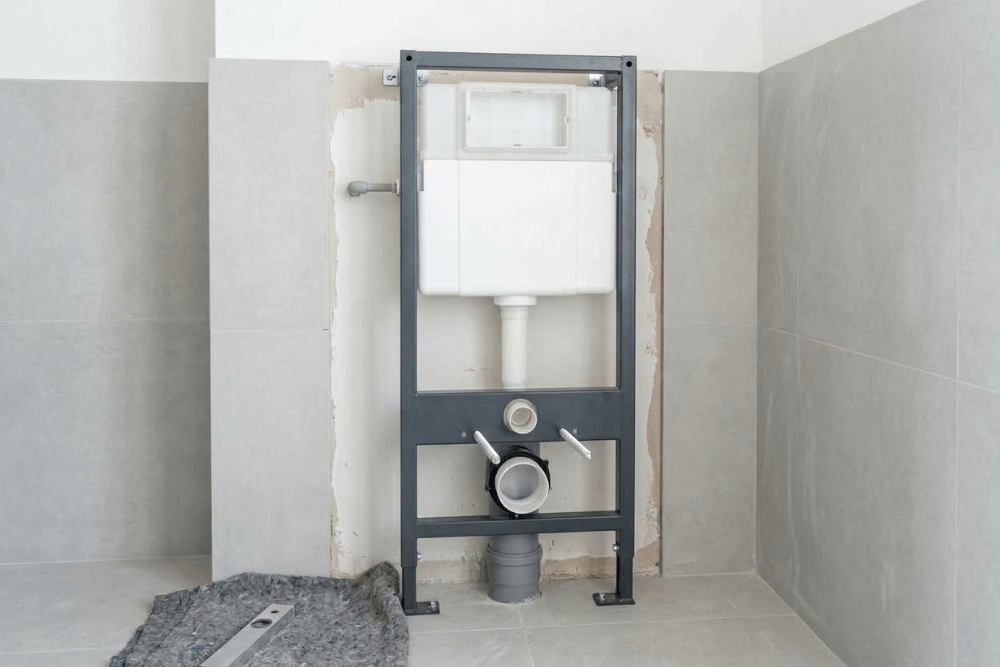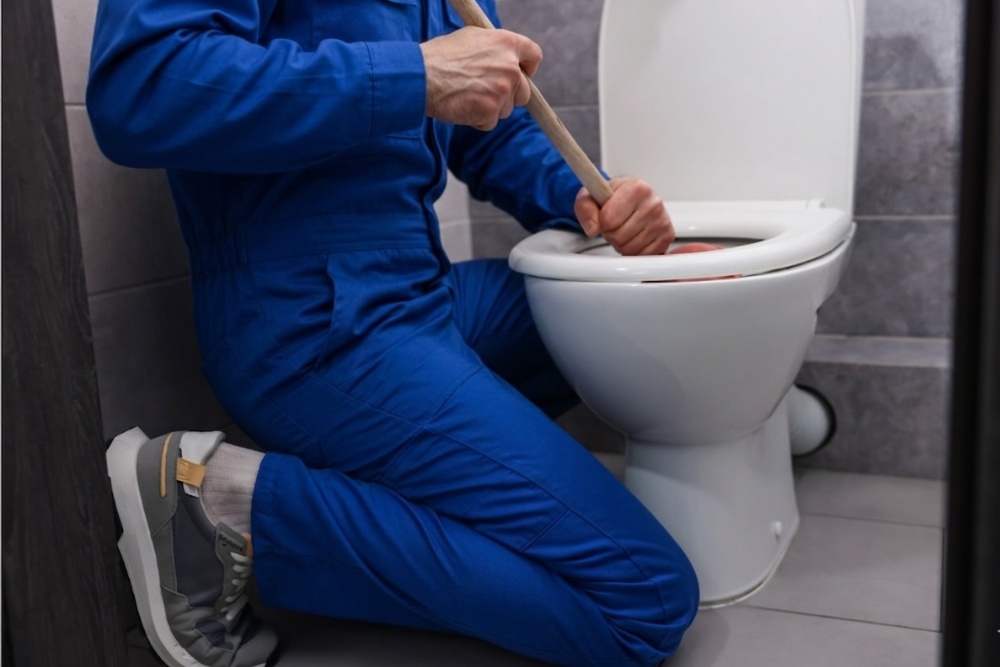
A clogged toilet has a way of feeling like an emergency even when it isn't one. The water's rising, you're not sure whether to flush again, and the nearest plunger might be at a neighbour's place or buried in a storage cupboard you haven't opened in months. The good news: most toilet clogs in Dubai homes are soft blockages, toilet paper, waste, or a combination of the two, and they clear with basic household methods well before you'd ever need to call anyone.
This guide walks through every safe method in the order worth trying them, what's actually happening inside the toilet when it clogs, why Dubai properties see certain causes more than most other cities, and the specific signs that mean it's time to stop troubleshooting and pick up the phone.
!Quick answer
Try in order: a flanged toilet plunger (8-10 firm strokes), then hot water with dish soap left to sit 15-20 minutes, then baking soda and vinegar for a slower soak, then a toilet auger for anything lodged too firmly for the rest. Skip chemical drain cleaners, boiling water, and wire coat hangers, all can make things worse. Call a plumber if none of these clear it, the clog keeps returning, or multiple fixtures are affected at once.
Before You Touch Anything: Stop the Overflow Risk First
If the bowl is filling toward the rim after a flush, your first move isn't to grab a plunger, it's to stop more water from entering the bowl. Take the lid off the tank and look inside. You'll see a flapper valve at the bottom of the tank, connected by a chain to the flush handle. Reach in and hold the flapper down, or press it closed by hand. This stops the tank from continuing to feed water into an already-full bowl while you sort out the actual clog.
If you don't want to reach into the tank, or the water is already at the rim, the shut-off valve behind the toilet, usually a small oval or round handle low on the wall or floor near the base, does the same job from outside. Turn it clockwise until it stops. Don't force it if it's stiff from age; a valve that's seized can snap, and a snapped valve is a genuinely bigger problem than a clogged toilet.
!Don't flush again to test it
The instinct to flush a second time to see if the clog has cleared is exactly what turns a contained clog into water on the bathroom floor. Wait, check the water level, and only flush again once you're confident the blockage has actually moved.
Method 1: The Plunger, Done Properly
A plunger clears the large majority of toilet clogs when it's used correctly, and most people don't use it correctly. The tool matters first: a standard flat-cupped sink plunger doesn't form a proper seal against a toilet's curved bowl outlet. A flanged toilet plunger, the kind with an extra fold of rubber extending from the bottom of the cup, is built specifically for this shape and makes a real difference.
- Make sure there's enough water in the bowl to fully submerge the plunger cup. If the bowl is nearly empty from a failed flush, add water from a bucket first, plunging into air does nothing
- Position the plunger so the flange sits inside the drain opening and the cup forms a complete seal against the porcelain, with no gap for air to escape
- Push down slowly for the first stroke, this pushes air out rather than compressing it, which is what you want
- Once sealed, plunge with firm, steady strokes, pulling up sharply is often what actually dislodges the clog, not the downward push
- Give it eight to ten strokes before stopping to check whether the water is draining
If the water starts draining, even slowly, that's usually the clog breaking apart rather than fully clearing. Keep going with the same steady rhythm rather than switching methods immediately. If there's been no change at all after a genuine attempt, it's worth trying a different approach before spending another ten minutes on the same one.
Method 2: Hot Water and Dish Soap
This works well on soft clogs, paper and waste, and it's genuinely useful when you don't have a plunger at all. Squeeze a generous amount of dish soap into the bowl, roughly half a cup if you're measuring, more if you're just pouring. The soap acts as a lubricant and helps break down the mass of the clog.
Follow it with hot water from the tap, poured from waist height so it has some force behind it. The water needs to be hot, not boiling. Boiling water poured directly into a porcelain bowl can cause thermal shock and crack it, particularly on an older toilet where the porcelain has had years to develop microscopic stress points. Water that's hot to the touch but not steaming is the right temperature.
Let it sit for fifteen to twenty minutes. The combination of heat and soap softens the clog from the outside in. After the wait, try flushing, or if you're cautious about another flush attempt, pour in a bucket of room-temperature water from about waist height instead; the added volume and force often finishes the job without needing the tank to refill and flush.
Method 3: Baking Soda and Vinegar
This is a slower method, and it works best as a follow-up if soap and hot water haven't fully cleared things, or as a first try if you'd rather avoid dish soap for some reason. Pour a cup of baking soda into the bowl, then follow with two cups of vinegar. The reaction fizzes actively for a minute or two, this is normal and is part of what helps loosen debris from the sides of the trap.
Let it sit for a minimum of thirty minutes, longer if you can leave it undisturbed for an hour. Follow with hot water, the same temperature guidance as above, not boiling. This method is genuinely slower than plunging or soap and hot water, so it's not the first choice if the bowl is close to overflowing, but it's a reasonable option for a slow-draining toilet that isn't at immediate risk of overflow.
Method 4: A Toilet Auger (Closet Auger)
If plunging and the soap or baking soda methods haven't worked, the clog is probably lodged more firmly than those methods can reach, or it's caught on something a plunger can't dislodge by pressure alone. A toilet auger, also called a closet auger, is a flexible cable with a corkscrew tip on a hand crank, built specifically to navigate the curved shape of a toilet trap without scratching the porcelain the way a straight metal snake or wire hanger would.
- Insert the auger's rubber-sleeved end into the drain opening at the bottom of the bowl
- Crank the handle clockwise slowly, feeding the cable further in as you turn
- You'll feel resistance when the tip reaches the clog, keep cranking gently rather than forcing it
- Once you feel the resistance give way, or the cable moves freely, crank in the opposite direction to retract it slowly
- Test with a flush before assuming it's fully clear
An auger is worth owning if you're dealing with recurring clogs, since it reaches further into the trap than a plunger can affect. If you don't own one and the clog hasn't cleared with the methods above, this is usually the point where calling for help makes more practical sense than buying a tool for a single use.
What Not to Do
!Skip the chemical drain cleaner, specifically for toilets
Chemical drain cleaners are formulated for sink and shower drains, not toilets, and they're a genuinely poor choice here. A solid clog, paper, waste, a foreign object, doesn't dissolve the way a chemical cleaner is designed to work on grease and hair. What you're left with is a bowl of caustic standing water that's now hazardous to handle, splash-prone, and actively unsafe for a plumber to work on afterward if the clog still hasn't cleared. If plunging and mechanical methods haven't worked, the next step is an auger or a call, not a bottle from the shop.
- Don't use boiling water; it can crack porcelain, particularly on an older toilet
- Don't keep flushing repeatedly hoping the clog will clear on its own; this is how a contained clog becomes water on the floor
- Don't force a stiff shut-off valve; a snapped valve is worse than the clog you started with
- Don't use a straight metal snake or a wire coat hanger inside the bowl itself; both can scratch porcelain, and a scratch becomes a place where future clogs catch more easily
Why Toilets Clog More Often in Dubai Specifically
Toilet clogs happen everywhere, but a few factors make them a genuinely more common call in Dubai than in many other markets, and understanding them helps explain why the same clog sometimes keeps coming back.
"Flushable" wipes are the single most common preventable cause we see, and the labelling is genuinely misleading. Unlike toilet paper, which is engineered to break apart in water within seconds, wipes are built to hold together when wet, that's the entire point of a wipe. They don't dissolve, they snag on the trap or further down the line, and they catch subsequent paper and waste behind them. The same applies to cotton pads, sanitary products, and kitchen roll used as an emergency substitute for toilet paper.
Dubai's hard water plays a smaller but real role too. Mineral deposits, calcium and magnesium carried in the water supply, gradually build up inside the trap and the jet holes under the rim that direct water into the bowl during a flush. A toilet with reduced jet flow from years of mineral buildup flushes with less force, meaning waste and paper that would clear easily on a fresh toilet has a harder time making it all the way through.
Low-flow and water-saving toilet models, increasingly common as water efficiency has become a bigger consideration in UAE construction, are a genuine trade-off. They use less water per flush, which is good for consumption, but that same reduced water volume means less force behind each flush. A well-maintained low-flow toilet performs fine. One with any degree of mineral buildup or a slightly worn flush valve can start clogging more than a standard-volume toilet would under the same use.
| Cause | How It Shows Up | Prevention |
|---|---|---|
| "Flushable" wipes and wet wipes | Sudden, hard clog, plunger resistance is unusually firm | Bin, not bowl, no exceptions |
| Excess toilet paper at once | Slow clearing, clog softens with hot water and soap | Flush in smaller amounts if using a lot at once |
| Hard water mineral buildup in jets | Weak flush over time, more frequent minor clogs | Periodic descaling; have jets checked if flush force has visibly declined |
| Low-flow toilet with reduced force | Occasional clogs on normal paper volume | Confirm the flush valve and jets are functioning at full strength |
| Root intrusion in villa external lines | Recurring clogs at the same toilet despite clearing, sometimes multiple fixtures affected | CCTV drain survey rather than repeated clearing |
Apartments: When It Might Not Be Your Toilet
In a shared building, a toilet that won't clear no matter what you try, or one that clears and then backs up again within days, is sometimes not a fault in your unit at all. Apartment buildings typically share a main drainage line serving multiple units on the same stack. If that shared line has a partial blockage, root intrusion, scale buildup, or a structural issue further down, every toilet connected to it can show symptoms, even though each individual unit's own plumbing is fine.
The way to tell the difference: if your toilet is the only fixture affected and a private clog responds even partially to plunging, it's very likely local to your unit. If multiple fixtures in your apartment are slow at the same time, or if a neighbour on the same stack has mentioned a similar issue recently, that's worth raising with building management alongside calling a plumber, since a shared-line problem needs to be diagnosed and fixed at the building level, not repeatedly treated as an individual unit issue.
Signs It's Time to Stop and Call a Professional
- Plunging, an auger, and both the soap and baking soda methods have all been tried without any real improvement
- The clog clears but comes back within days or weeks, a sign of a recurring cause rather than a one-off blockage
- Multiple fixtures in the property are affected at the same time, not just the one toilet
- Water is backing up from a different drain, a floor drain or another toilet, when this one is flushed
- You can hear gurgling from other fixtures when this toilet is used, a sign of a shared line issue rather than a local clog
None of these mean something has gone badly wrong, they just mean the clog is beyond what household methods are built to handle, and a plumber with camera equipment and proper augering tools can actually see and clear what's causing it rather than repeating the same limited methods with diminishing returns.
What Happens When We Come Out for a Toilet Clog
For a straightforward clog that's resisted DIY methods, the first step is usually a proper mechanical auger pass, professional-grade tools reach further and apply more consistent force than a household version. If that clears it, we test with several flushes before considering the job done, not just one.
For a clog that keeps recurring at the same toilet, or where the symptoms suggest a shared or main-line issue rather than a local one, a camera inspection is the right next step before more clearing attempts. Seeing the actual condition of the line, root intrusion, a structural fault, a section of scale buildup, tells us whether the fix is another clearing pass or something that needs a different repair entirely. Our toilet repair page covers cistern-specific faults and installation in more depth if the underlying issue turns out to be mechanical rather than a blockage.
A Few Specific Situations Worth Addressing
Not every clog fits neatly into the standard soft-blockage category. A few scenarios come up often enough to deserve a direct answer.
A toy or other foreign object flushed by a child is genuinely different from a paper or waste clog, and none of the dissolving methods, soap, hot water, baking soda, will do anything for a solid plastic object. Plunging can sometimes work if the object is small enough to be pushed through, but there's a real risk of pushing it further down where it's harder to reach rather than clearing it. If you know or strongly suspect a specific object caused the blockage rather than paper or waste, an auger attempt is reasonable, but if that doesn't retrieve or clear it, this is a case where calling for help sooner rather than later genuinely saves cost, since a lodged object further down the line is a bigger job than one still accessible near the trap.
Dual-flush toilets, common across newer Dubai apartments, have two buttons for a reason, and using the smaller half-flush out of habit for a fuller-than-usual bowl is a common self-inflicted cause of clogs. If your toilet has a dual-flush mechanism and you're dealing with more waste or paper than usual, use the full flush deliberately rather than the default half-flush; the extra water volume and force is there specifically for this situation.
A guest bathroom clogging during a gathering, when several people have used it in succession with more paper than a typical single-person flush, is usually just a volume problem rather than anything structural. Hot water and dish soap is the fastest non-disruptive fix here since it doesn't require pulling a plunger out in front of guests, and it works well specifically for this kind of paper-volume clog.
- Keep a small bin in every bathroom for wipes, cotton pads, and sanitary products; none of these belong in the bowl regardless of what the packaging claims
- Flush toilet paper in reasonable amounts rather than a full roll's worth at once
- If your property's toilets have felt like they're flushing with less force than they used to, that's worth having checked before it becomes a recurring clog rather than an occasional one
- For villas with a history of recurring clogs at the same fixture, ask about a CCTV line survey rather than continuing to clear the same spot repeatedly
Most toilet clogs are a five-minute fix with the right method and a bit of patience. The few that aren't are usually telling you something, a mineral-scaled flush valve, a shared line issue, root intrusion, that repeated plunging won't solve on its own. Knowing which situation you're in is most of the battle.
What's the best way to unclog a toilet without a plunger?
Why do 'flushable' wipes clog toilets when toilet paper doesn't?
Is it safe to pour boiling water into a clogged toilet?
Can I use a chemical drain cleaner on a clogged toilet?
Why do toilets clog more often in Dubai specifically?
How do I know if a recurring clog is my toilet or a shared building line?
What should I do if a child flushed a toy or object down the toilet?
Should I use the half-flush or full-flush on a dual-flush toilet if it's clogging?
When should I stop trying DIY methods and call a plumber?
Related Service
Toilet Repair & Installation
Dealing with this issue right now? See real pricing and how we handle it.
View Toilet Repair & Installation