"Water heater not working" covers several genuinely different problems, no hot water at all, water that's warm but not hot, hot water that runs out fast, strange smells, unusual noises, or visible leaking, and each points toward a different cause. This guide works through each symptom separately, since diagnosing the right one first saves a callout for something you could have confirmed yourself in two minutes.
!Quick answer
No hot water at all: check the breaker first, then suspect a failed element or thermostat. Lukewarm only: usually a miscalibrated thermostat or one failed element on a two-element unit. Runs out fast: sediment buildup reducing effective tank capacity. Rotten egg smell: the anode rod reacting with bacteria. Rumbling or popping: sediment on the heating element. Each has its own section below with the specific fix.
No Hot Water At All
Start with the two fastest checks. For an electric unit, find the breaker for the water heater in your electrical panel and confirm it hasn't tripped, reset it once if it has, and give the tank thirty minutes to an hour to reheat before assuming nothing changed. If the breaker trips again immediately after resetting, stop, don't reset it a second time. A breaker tripping repeatedly usually means the tank's internal high-limit safety switch is cutting power deliberately because something, most often a failed thermostat or a shorting element, is causing dangerous overheating, and that needs a technician, not persistence.
Second, check whether it's genuinely the whole property or just one fixture. If a single shower or tap has no hot water while everything else works normally, the water heater itself is very likely fine, the fault is local to that fixture, most often a mixing valve. That's a different, usually simpler repair than anything involving the heater.
If both of those check out and there's still no hot water anywhere, the most likely remaining causes are a failed heating element (the unit isn't heating at all) or a failed thermostat (the unit isn't switching the element on correctly). Both are common, both are relatively inexpensive to replace, and neither is something to diagnose further without opening the unit, which is where it's worth calling in.
Water Is Lukewarm, Not Hot
This is a different symptom from no hot water at all, and it usually points to a partial rather than complete failure. A thermostat that's drifted out of calibration, common on an older unit, will heat water but stop short of the actual target temperature. On a unit with two heating elements, a common configuration, one element failing while the other still works can produce noticeably lukewarm rather than properly hot water, since only half the tank's heating capacity is actually functioning.
Before assuming either of those, check the thermostat setting itself, it's occasionally knocked or adjusted without anyone noticing, particularly after any nearby work. The right range for Dubai conditions specifically is around 55 to 60°C, high enough to avoid bacterial growth, not so high that it accelerates mineral scale buildup faster than necessary. If it's set correctly and the water is still only lukewarm, that points back to the thermostat or element itself.
Hot Water Runs Out Faster Than It Used To
If the tank used to comfortably supply a full shower and now runs cold partway through, sediment buildup at the bottom of the tank is the most common cause. Mineral deposits, which accumulate faster in Dubai's hard water than the manufacturer's general guidance typically assumes, settle at the bottom and physically reduce the effective water storage capacity, on top of insulating the heating element from the water it's supposed to be heating, making the whole system less efficient. A tank flush, removing that accumulated sediment, often restores most of the lost capacity, and it's a maintenance job worth doing on a schedule rather than only after the symptom appears.
A failed lower heating element, on units with two elements, produces a similar symptom: the top element heats an initial burst of hot water, but there's nothing keeping the rest of the tank properly heated behind it, so hot water runs out faster than the tank's actual capacity should allow.
Hot Water Smells Like Rotten Eggs
This is a specific, well-understood problem, and it's genuinely more common on electric water heaters with a magnesium anode rod than most other configurations. Sulfate-reducing bacteria, naturally present in small amounts in most water supplies, react with the magnesium anode rod to produce hydrogen sulfide gas, the actual source of the rotten egg smell. It tends to be worse when water has sat in the tank for a while without being used, which is why it's sometimes more noticeable first thing in the morning or after being away for a few days.
!Confirm it's the heater, not the water supply
Run the cold tap only for about a minute and check whether the smell is present there too. If only the hot water smells, the cause is inside the water heater, most likely the anode rod reaction described above. If the cold water smells the same way, the issue is upstream in the water supply itself, not the heater, and needs a different kind of investigation entirely.
If it's confirmed as a heater issue, replacing the magnesium anode rod with an aluminum or zinc alloy rod, both less prone to this specific reaction, typically resolves it. A one-time high-temperature flush, running the tank at an elevated temperature briefly, can also kill off the bacteria causing the reaction, though the anode rod replacement is the more lasting fix if the smell keeps returning.
!A gas smell is a different, more serious situation
This entire section refers to a sulfur smell in the water itself. If you ever smell gas in the air around a gas-fired unit, not in the water, that's a potential gas leak, not a water heater fault. Leave the area, don't operate any switches nearby, and contact emergency services rather than attempting any troubleshooting.
Hot Water Smells Like Rotten Eggs: Quick Answers
Why does my hot water smell like rotten eggs but the cold water doesn't?
Will replacing the anode rod actually fix the smell?
If both my hot and cold water smell like rotten eggs, is it still the water heater?
Popping, Rumbling, or Cracking Sounds
Almost always sediment, and the mechanism is straightforward once you understand it. Mineral deposits settling at the bottom of the tank create a layer that traps a thin pocket of water underneath, between the sediment and the tank floor where the heating element sits. That trapped water gets superheated well past normal boiling behaviour because of the pressure and insulation around it, and the popping or rumbling sound is literally that trapped water boiling and forcing its way up through the sediment layer above it.
This isn't an emergency on its own, but it is a clear signal that a tank flush is overdue, and leaving it unaddressed accelerates wear on the heating element, which is working harder than it should to heat water through an insulating layer of scale, and can gradually stress the tank itself.
Discolored or Rusty Water
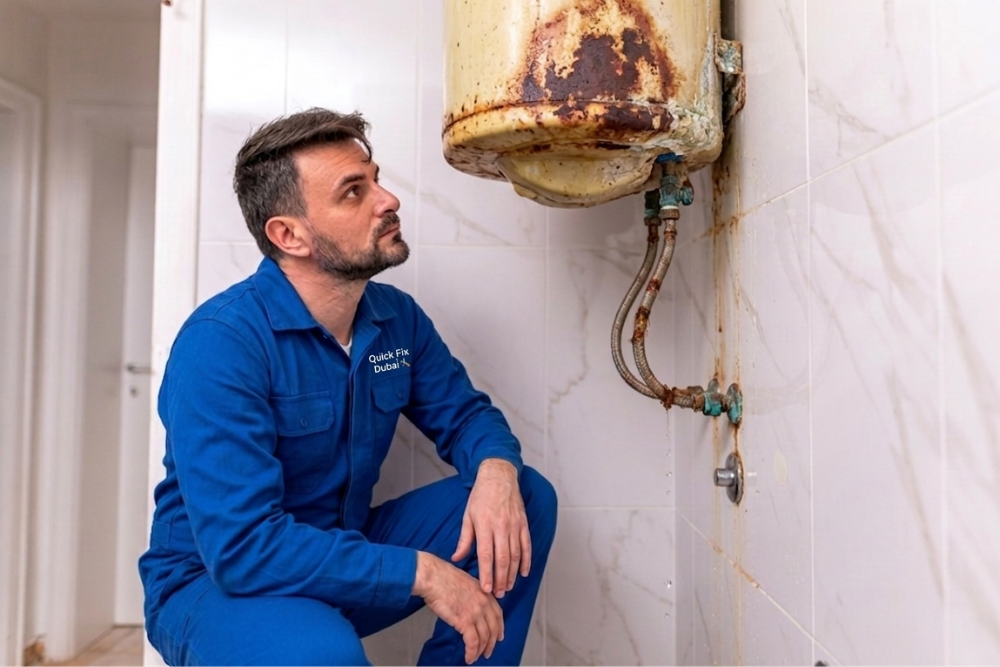
Brown, reddish, or generally discolored hot water, with the cold water running clear, points toward internal corrosion, either the tank lining itself or a depleted anode rod that's no longer protecting it. This is worth taking seriously rather than waiting to see if it clears, since a depleted anode rod means the tank's own metal has started sacrificing itself instead, which is the beginning of the corrosion process that eventually causes a tank to fail outright. Checking and replacing the anode rod on a two-year cycle, shorter than the interval typically quoted for softer water conditions, is the main preventive step against this in Dubai specifically.
Water Leaking From the Unit
Unlike the symptoms above, visible water at the base of the unit or dripping from a fitting is worth acting on immediately rather than troubleshooting further yourself. Shut off the water supply to the unit and, for an electric heater, switch off the breaker before anything else. A leak from a fitting or connection is often a straightforward repair. A leak from the tank body itself, rather than a connection, usually means the tank has corroded through and is nearing the end of its service life, at which point replacement, not repair, is the realistic conversation.
When to Stop Troubleshooting and Call Someone
- The breaker trips again immediately after being reset once
- There's any visible water leaking from the tank or its connections
- You've confirmed the symptom, no heat, lukewarm, fast runout, but the fix involves opening the unit itself
- A rotten egg smell persists after running the cold tap confirms it's specific to the hot water
- The unit is more than eight years old and showing more than one of these symptoms at once, worth a repair-vs-replace conversation rather than fixing each symptom individually as it appears
Most of these symptoms map to one of a small number of components, a thermostat, an element, the anode rod, or accumulated sediment, and confirming which one you're actually dealing with before calling anyone means the conversation starts with an informed description rather than just "it's not working."
Related Service
Water Heater Repair
Dealing with this issue right now? See real pricing and how we handle it.
View Water Heater Repair