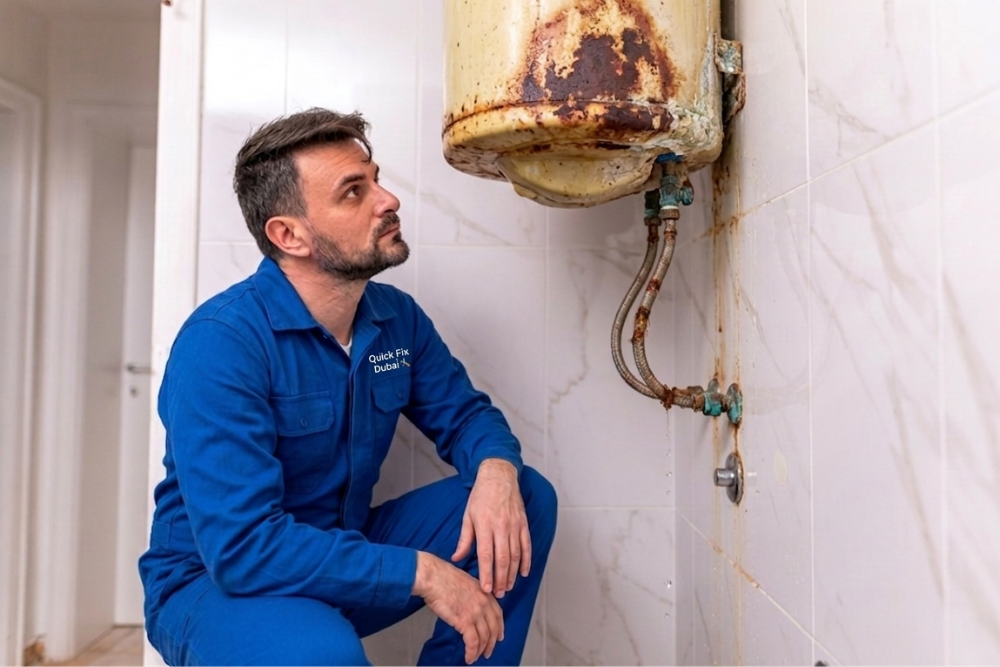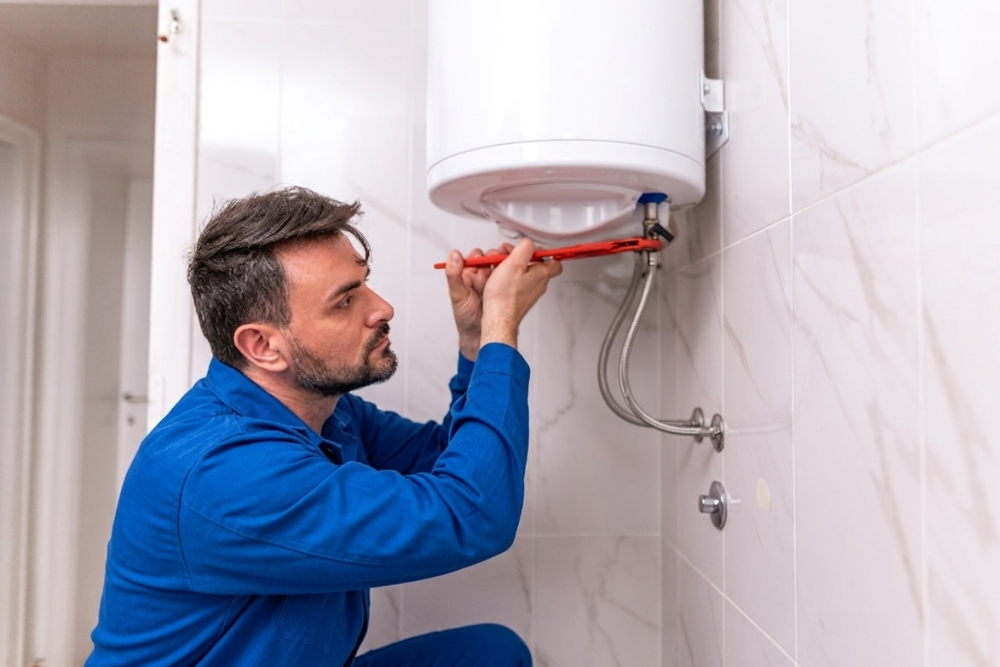
"How much will this cost" is usually the second question anyone asks after "why is there no hot water," and it's a genuinely hard one to answer accurately without seeing the actual unit, since a water heater fault could be a AED 100 part or a full replacement depending on what's actually failed. This guide covers real component-level pricing, a few checks worth doing yourself before you message us anyone, and the honest math on when repair stops making sense compared to replacement.
Check These Two Things Before Assuming It's Broken
Two quick questions rule out the most common false alarms, and they cost nothing to check.
First: is it every fixture in the property, or just one. If a single shower or tap has no hot water while everything else is fine, the water heater itself almost certainly isn't the problem, the fault is local to that fixture, most often a mixing valve or an isolated connection issue. That's a genuinely different, usually cheaper repair than anything involving the heater itself.
Second, if the whole property lost hot water suddenly: has there been unusually heavy use recently, several showers back to back, a bath, a washing machine cycle. A tank needs real recovery time after being drawn down heavily, generally somewhere between thirty minutes and an hour and a half depending on tank size, before it's back up to full temperature. What looks like a failure is sometimes just a tank that hasn't caught up yet.
!The breaker reset rule
If an electric water heater has no power, check the breaker. If it's tripped, reset it once and give the tank time to reheat. But if it trips again immediately, stop, don't keep resetting it. A breaker that trips repeatedly usually means the tank's internal high-limit safety switch is doing exactly what it's designed to do, cutting power because something, usually a failed thermostat or a shorting element, is causing dangerous overheating. Repeatedly resetting past that point is a genuine safety risk, not persistence paying off.
Component-Level Repair Costs
Most water heater faults come down to one of a handful of components, and the cost genuinely does depend on which one it is. These are realistic Dubai ranges, including labour, for a standard residential visit.
| Repair | Typical Cost (AED) |
|---|---|
| Diagnostic visit | 150 - 250 |
| Thermostat replacement | 150 - 300 |
| Heating element replacement | 150 - 350 |
| Anode rod replacement | 150 - 300 |
| Pressure relief valve replacement | 100 - 250 |
| Tank flush (sediment removal) | 150 - 300 |
| Minor leak repair (fitting or connection) | 200 - 400 |
A genuinely useful thing to understand before any of these numbers make sense: the part itself is rarely the majority of the bill. A thermostat or anode rod is a relatively inexpensive component on its own. What the price above actually covers is the diagnostic time to confirm which component has actually failed, since several different faults produce similar symptoms, the labour to access and replace it safely, particularly for anode rods and heating elements that involve working inside a pressurised tank, and the callout itself. A quote that seems unusually low for one of these repairs is worth a second look at what's actually included.
Tankless Units Cost More to Diagnose and Repair
Less common than tank systems in Dubai residential properties but present in some newer builds and commercial settings, tankless units have a genuinely different fault profile and typically cost more per repair than the equivalent tank-system component swap. There's no anode rod or thermostat in the same sense; instead, the parts that fail are a flow sensor that detects when water is running and triggers heating, an igniter or heating element depending on whether it's gas or electric, and the heat exchanger itself, the compact unit that does the actual heating as water passes through.
The heat exchanger is the component most affected by Dubai's hard water specifically. It has far less surface area than a tank's heating element, so the same mineral scale that gradually reduces a tank system's efficiency can cause a tankless unit to underperform or fault out considerably sooner without regular descaling, a maintenance step tank systems don't need in the same way. Diagnostic visits for tankless units tend to sit toward the higher end of the range above, and component costs for flow sensors and heat exchangers typically run higher than a tank system's thermostat or element, given the more compact, specialised design.
What Drives a Specific Job to the Higher End of Its Range
- Tank access: a unit tucked into a tight cupboard or mounted high on a wall takes longer to work on than one with clear access
- Age and general condition: an older unit with visible corrosion or scale buildup elsewhere often needs more than the single component that triggered the call
- Multiple faults found during diagnosis: a thermostat and an element failing around the same time isn't unusual on an ageing unit, and doing both in one visit costs more than either alone but less than two separate callouts
- Tankless and gas units: these involve different components entirely and typically cost more to diagnose and repair than a standard electric storage tank, covered in more detail below
Access is worth elaborating on since it's the factor most property owners underestimate. A water heater installed with clear space around it and an accessible panel takes a technician a predictable amount of time to diagnose and repair. The same job on a unit built into a tight service cupboard, behind stored items, or mounted somewhere requiring a ladder and awkward positioning genuinely takes longer, and that time is reflected honestly in the labour portion of the quote rather than being an arbitrary markup.
Full Replacement Cost by Tank Size
When repair isn't the right call, either because the tank itself has failed or because the honest math below points toward replacement, cost scales with tank size and property type.
| Tank Size | Typical Property | Cost (AED) |
|---|---|---|
| 30L | Small apartment, single bathroom | 750 - 950 |
| 80L | Standard 2-bedroom apartment | 1,000 - 1,250 |
| 100L | Larger apartment, small villa | 1,200 - 1,600 |
| 150-200L | Villa, multiple bathrooms | 1,900 - 2,500 |
The Honest Repair-vs-Replace Math
This is where a lot of quotes get more complicated than they need to be, and where an honest answer genuinely depends on the specific unit rather than a blanket rule. A AED 250 thermostat swap on a four-year-old water heater is a straightforward repair call, there's no real argument for replacing a unit that young over a single cheap component. A AED 900 repair on a nine-year-old unit that's already had one prior fault is a genuinely harder decision, and the honest answer sometimes points toward replacement even though the repair itself is entirely possible.
The rough guide worth applying: if the unit is under five years old, repair almost always makes sense regardless of which component has failed. Between five and eight years, it depends on the specific repair cost relative to a new unit, and whether this is the first fault or a recurring pattern. Past eight to ten years, particularly with any sign of tank corrosion or a second fault within a short period, replacement is usually the more sensible spend, since a repair on a unit that age is often just delaying a bigger expense rather than avoiding it.
!A quote that only offers replacement deserves a second opinion
If a technician recommends full replacement without clearly explaining what specifically failed and why repair isn't a reasonable option, that's worth a second opinion, particularly on a unit under five years old. Replacement is sometimes genuinely the right call, but it should come with a specific reason tied to your actual unit's condition, not a default recommendation.
Questions Worth Asking Before Agreeing to Any Quote
- What specifically has failed, and how was that confirmed rather than assumed
- Does the quoted price include the diagnostic visit, or is that billed separately on top
- Is the part being used a genuine or compatible match for the unit's brand, particularly relevant for anode rods and elements where an incorrect size can cause problems later
- If repair is being recommended over replacement, or vice versa, what's the specific reasoning for this unit at its current age and condition
- Is there a written quote confirmed before work begins, rather than a verbal estimate that could change once the job is underway
Why Dubai Water Heaters Need This Kind of Repair More Often
Two Dubai-specific factors show up repeatedly in why these components fail in the first place, and they're worth understanding since they affect how often you should expect to see this cost again. Hard water accelerates scale buildup inside the tank and around the heating element specifically, both reducing efficiency and shortening the working life of the element itself. The anode rod, whose entire job is to corrode instead of the tank, gets consumed faster in mineral-heavy water than the general manufacturer guidance assumes, which is why checking it every couple of years, rather than the longer interval sometimes quoted for milder water conditions, is the more realistic schedule here.
Preventing the Next Repair Call
- An annual tank flush removes sediment before it hardens into scale that insulates the element and makes it work harder than it should
- Checking the anode rod every two years rather than waiting for the longer interval quoted for softer water conditions elsewhere
- Setting the thermostat in the 55 to 60°C range, higher accelerates mineral buildup, lower risks bacterial growth, this range is a genuine balance for Dubai conditions specifically
- Testing the pressure relief valve periodically, lifting the test lever briefly to confirm it releases and reseats properly, a stuck valve is a safety issue as much as a maintenance one
Most water heater callouts land somewhere in the AED 150 to 400 range for a single confirmed component, and the two checks at the start of this guide, whole-house versus single fixture, and giving a heavily used tank time to recover, rule out a meaningful share of calls before they need to become a callout at all.
Related Service
Water Heater Repair
Dealing with this issue right now? See real pricing and how we handle it.
View Water Heater Repair